

Ultrasound or thermal imaging for electrical equipment: which to choose
A thermal camera sees heat, which appears late, once enough current flows. Ultrasound hears corona, tracking and arcing at any stage of discharge. That is why SDT recommends using both methods.
Thermal imaging and ultrasound find different electrical faults, so they are used together. According to SDT, an electrical fault usually only starts to generate heat at an advanced stage, once enough current flows along the discharge path, and only then does a thermal camera see it. Acoustic energy is produced at any stage of discharge, so ultrasound hears corona, tracking and arcing before heating begins.
What a thermal camera sees
Thermography shows surface temperature. It finds faults that already generate heat. SDT puts the limitation this way: heat does not accumulate until the situation has progressed to the point where enough current flows along the discharge path. SDT's conclusion: relying on infrared alone may result in a missed diagnosis.
What ultrasound hears
An electrical discharge emits ultrasound. According to SDT, a partial discharge produces a localised, directional acoustic signal in the 20–50 kHz range. SDT distinguishes three types of discharge:
| Discharge type | SDT definition | Typical location |
|---|---|---|
| Corona | A breakdown of insulation in the air around high-voltage conductors | High-voltage conductors, busbars |
| Tracking | The creation of a conductive path along the surface of the insulator | Insulators, bushings; dirt, dust and moisture make it easier |
| Arcing | A continuous and intense discharge | Often loose or damaged contacts |
Ultrasound is directional, so the source can be located quickly and from a safe distance. For switchgear, SDT notes another property: with an electrical defect, the inside of the panel is flooded with ultrasound, and ultrasound, being small in wavelength, passes through the tiniest air paths. How to tell corona from tracking and arcing by the recording is covered in Corona discharge at a substation: how to find it with ultrasound.
Equipment covered in this article
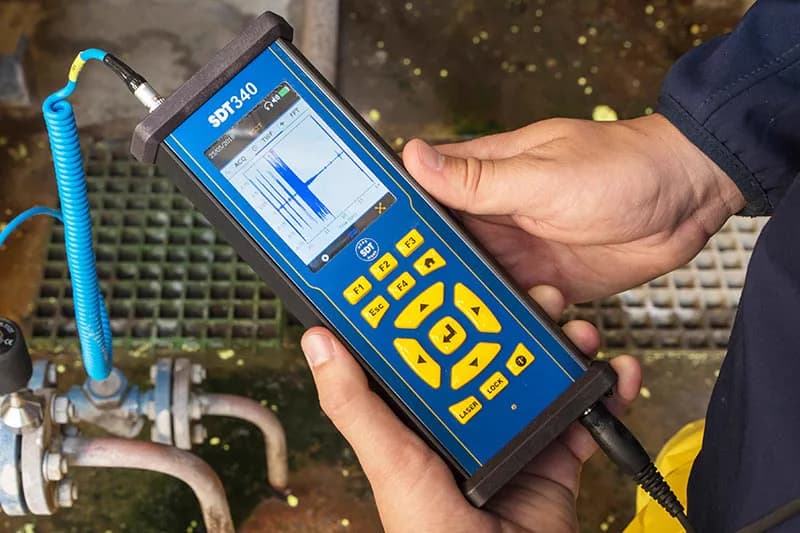
SDT340 - Advanced Ultrasound Detector
The most advanced ultrasound detector for collecting, analysing and trending data
Comparing the methods
| Question | Thermal camera | Ultrasound |
|---|---|---|
| Physical principle | Infrared radiation from a heated surface | Acoustic signal of the discharge, 20–50 kHz per SDT |
| When it sees the fault | Once the fault heats up: enough current flows along the discharge path | At any stage of discharge |
| What it finds | Heat | Corona, tracking, arcing |
| How findings are confirmed | With an ultrasound recording: is there a discharge | With a thermal camera: is there heat |
Why the methods are combined: an SDT case
SDT describes a survey at a Gerdau Ameristeel plant. On 161/13.8 kV transformers, thermal images of phases A, B and C showed no noticeable hot spots. The ultrasound recording, however, gave clear evidence of early tracking on the B and C phase bushings. Events repeating at line frequency in the spectrum indicated nuisance corona as well, and noise between the peaks pointed to tracking.
The repair was simple: connections on all three phases were cleaned and re-tightened, after which the time signal improved significantly. Surveys are now done more often, and ultrasound monitoring of the transformers continues. SDT concludes that the ultrasound and infrared pairing suits detecting partial discharge on insulators, in MCC panels and on high-voltage lines.
This is one case described by a maker of ultrasonic instruments. The main lesson is that no heat on a thermogram does not mean no discharge.
How to set up an inspection route
- Include both methods in the route: thermal imaging for heat, ultrasound for discharges.
- With ultrasound, check panels at gaps, grilles and door seams, plus transformer bushings, insulators and busbars.
- When a discharge is found, record the signal to identify the discharge type and to compare on later rounds.
- Check the discharge with a thermal camera: is there heating yet?
- Watch for dirt and moisture: according to SDT, they make tracking easier.
- After repair, repeat the measurement and compare with the original recording.
More on partial discharge in Partial discharge in electrical equipment: ultrasonic detection.
Which instrument to choose
KEG TRK does not supply thermal cameras; the ultrasound part of the route is covered by SDT instruments.
- Rounds of panels, transformers and insulators with signal recording and analysis: SDT340.
- Surveying outdoor switchyards, busbars and high points with an image of the sound source: the SonaVu acoustic camera.
KEG TRK supplies SDT ultrasonic instruments and SonaVu acoustic cameras in Kazakhstan. Price on request.
Sources
- SDT Ultrasound Solutions. The Dynamic Duo: Ultrasound Inspection and Infrared Imaging, 2022.
- SDT Ultrasound Solutions. Using Ultrasound for Electric Power Reliability, 2022.
- SDT Ultrasound Solutions. The SDT340: Ultrasound for Electrical Integrity, 2025.
Frequently asked questions
Equipment in this article
KEG TRK quotes prices and delivery times to Kazakhstan on request. We will prepare a commercial offer for your application.
SDT340 - Advanced Ultrasound Detector
The most advanced ultrasound detector for collecting, analysing and trending data

SDT SonaVu - Acoustic Camera for Equipment Diagnostics
SonaVu acoustic camera with 112 sensors and a built-in 5-inch touchscreen for visualising air leaks, electrical discharges and mechanical defects from up to 50 metres…
Read also
10/10/2026
Corona Discharge at a Substation: How to Find It with Ultrasound
Corona barely heats equipment, so a thermal camera misses it. An ultrasound detector hears corona from a distance, and a spectrum with peaks every 50 Hz tells it apart from tracking and arcing.
7/17/2026
SonaVu+ and NFPA 70B: making electrical faults visible
Arcing, tracking and corona generate ultrasound that people cannot hear. How the SonaVu+ acoustic camera helps meet NFPA 70B requirements and prevent failures in substations and switchgear.
6/30/2026
18-month reliability roadmap: SDT + Artesis
Month-by-month plan from asset register and leaks to IoT — SDT ultrasound and Artesis ESA only.