
Corona Discharge at a Substation: How to Find It with Ultrasound
Corona barely heats equipment, so a thermal camera misses it. An ultrasound detector hears corona from a distance, and a spectrum with peaks every 50 Hz tells it apart from tracking and arcing.
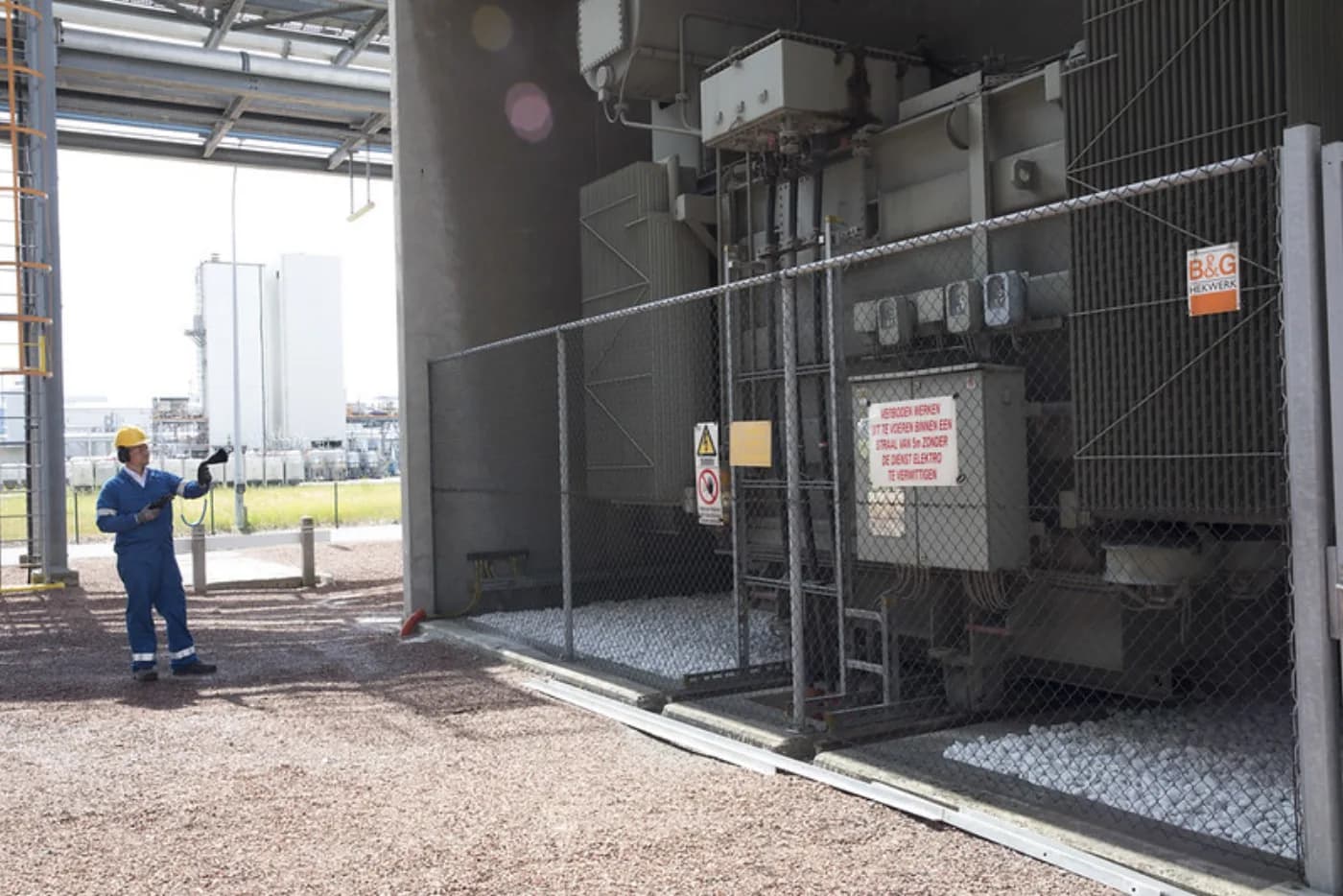
Corona discharge at a substation is found with an ultrasound detector or an acoustic camera: corona emits ultrasound long before any heating appears that a thermal camera could see. The inspector walks the equipment with a directional sensor, finds the typical buzzing by ear, records the signal and uses a spectrum with peaks every 50 Hz to tell corona apart from tracking and arcing.
This article is the practical follow-up to the overview "Partial discharge in switchgear and substations": that article explains what corona, tracking and partial discharge are, and this one shows how to find corona on an inspection round.
Corona, tracking and arcing: what is the difference
Definitions from SDT Ultrasound Solutions:
| Phenomenon | What happens |
|---|---|
| Corona | Breakdown of insulation in the air around high-voltage conductors, progressively degrading surfaces |
| Tracking | A conductive path forming along the surface of an insulator; essentially arcing in its early phase |
| Arcing | A continuous, intense discharge, often at loose or damaged contacts |
All three seek a path to earth. Dirt, dust and moisture help the discharge establish that path along the insulation surface.
Why corona is found with ultrasound, not a thermal camera
- Electrical faults usually generate heat only at an advanced stage, while acoustic energy is produced at any stage of discharge.
- Partial discharge pulses are very short, from nanoseconds to microseconds. In air they produce ultrasound in the 20–50 kHz range, according to SDT with peaks around 40 kHz.
- Ultrasound is directional: the source is located quickly and from a safe distance, including in a noisy plant.
- Ultrasound passes through the tiniest air paths, so a discharge inside a closed switchgear panel can be heard at the vents.
In a case described by SDT, thermal images of 161/13.8 kV transformers showed no hot spots on any phase, while the ultrasound recording gave clear evidence of early tracking. Ultrasound does not replace the thermal camera; it complements it.
Equipment covered in this article
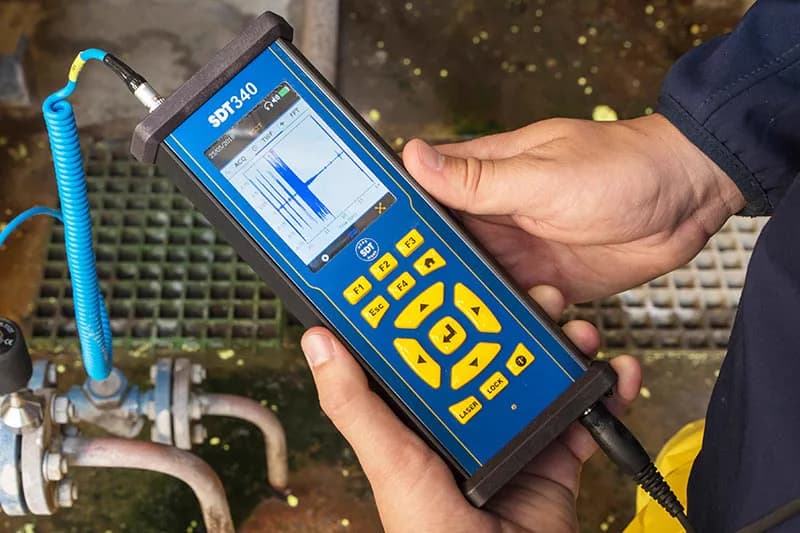
SDT340 - Advanced Ultrasound Detector
The most advanced ultrasound detector for collecting, analysing and trending data
How to find corona discharge: step by step
- Plan the route. SDT singles out the places that need attention: cable joints and termination points, bus sections, insulators, surge arresters in switchgear. On transformers and closed panels, scan the vents and openings.
- Keep your distance. The inspection is non-contact and the equipment stays energised. Do not break the required clearances to live parts or your work permit rules.
- Scan with a directional sensor. In the outdoor switchyard use a parabolic sensor (PARADISH2 for the SDT270); at switchgear panels use a flexible airborne sensor (FLEX ID2), which is easy to run along gaps and vents.
- Listen. Healthy electrical equipment is quiet. Corona and tracking sound like buzzing and crackling in the headphones. Turn the sensor and follow the signal maximum to locate the source.
- Measure and record. Note the ultrasound level and save a sound recording. The SDT340 records 600 s at a 32 kHz sampling rate or 150 s at 128 kHz.
- Analyse the spectrum. In UAS3 software or on the SDT340 screen, look at the time waveform and the spectrum (FFT). Signs:
- regular peaks spaced 50 Hz apart (the mains frequency in Kazakhstan) — corona;
- a high noise level between those peaks — tracking;
- buzzing that builds up to a flashover, then quiet, then a new cycle — developing tracking.
- Trend it. Repeat the measurement at the same point with the same sensor on every round and compare amplitudes. This shows whether the defect is growing and which of several defects to fix first.
Visualising with an acoustic camera
Searching a large switchyard or panel board with a detector takes time. An acoustic camera shows the ultrasound source as a coloured spot directly on the video image:
| Instrument | Sensors | Frequency range | Distance |
|---|---|---|---|
| SDT SonaVu | 112 MEMS microphones | 1–47.5 kHz | 0.3–50 m |
| Crysound CRY2623 | 128 MEMS sensors | ultrasound up to 100 kHz | up to 120 m |
The CRY2623 also builds PRPD maps (phase-resolved partial discharge), which help classify the discharge type. Use the camera for a fast search and the detector for recording, spectrum analysis and trending.
What to do after finding corona
- Do not postpone. According to SDT, the higher the voltage, the more destructive partial discharge becomes. Ozone and nitrogen oxides formed by discharges become corrosive with water vapour and harm insulation.
- Clean the insulation. Dirt, dust and moisture make tracking easier, so cleaning extends equipment life. In the SDT case of corona on a high-voltage transformer, the recommendation was a thorough cleaning of the transformer.
- Check the gas in SF6 equipment. If a discharge is heard at an SF6 circuit breaker or GIS, test the gas for decomposition products: SF6 breaks down under partial discharge, see "SF6 decomposition products: SO2, HF and what to do about them".
- Measure again after repair. A quiet signal at the same point confirms that the cause has been removed.
Which instrument to choose
For route-based inspections with recording, spectrum and trending, use the SDT340 ultrasound detector: 20–50 kHz ultrasound channel, focUS mode with sampling up to 256 kHz, analysis in UAS3. For a fast search for the source in switchyards and on large panel boards, use the SDT SonaVu acoustic camera. The SDT Level 1 course teaches how to distinguish arcing, tracking and corona by sound and how to work safely in high-voltage areas.
KEG TRK supplies SDT ultrasound detectors and acoustic cameras in Kazakhstan. Price on request.
Sources
- SDT Ultrasound Solutions. The SDT340: Ultrasound for Electrical Integrity, 2025: https://sdtultrasound.com/2025/11/27/the-sdt340-ultrasound-for-electrical-integrity-maximum-safety-and-zero-unplanned-downtime/
- SDT Ultrasound Solutions. Using Ultrasound for Electric Power Reliability, 2022: https://sdtultrasound.com/2022/07/14/using-ultrasound-for-electric-power-reliability/
- SDT Ultrasound Solutions. Ultrasound Prevents Transformer Outages, 2022: https://sdtultrasound.com/2022/06/23/ultrasound-prevents-transformer-outages/
- SDT Ultrasound Solutions. The Dynamic Duo: Ultrasound Inspection and Infrared Imaging, 2022: https://sdtultrasound.com/2022/06/30/the-dynamic-duo-ultrasound-inspection-and-infrared-imaging/
- SDT Ultrasound Solutions. Case Study: Electrical Inspection on High-Voltage Transformer Leads to Corona Discovery, 2024: https://sdtultrasound.com/2024/07/04/case-study-electrical-inspection-on-high-voltage-transformer-leads-to-corona-discovery/
- SDT Ultrasound Solutions. Electrical safety through proactivity with the CRYSOUND Acoustic Imager, 2024: https://sdtultrasound.com/2024/02/29/electrical-safety-through-proactivity-with-the-crysound-acoustic-imager/
- SDT Ultrasound Solutions. Airborne and Structure Borne Ultrasound Inspector, Level 1 (course outline): https://ftp.sdt.be/pub/misc-documents/Training/Level%201%20Overview.pdf
Frequently asked questions
Equipment in this article
KEG TRK quotes prices and delivery times to Kazakhstan on request. We will prepare a commercial offer for your application.
SDT340 - Advanced Ultrasound Detector
The most advanced ultrasound detector for collecting, analysing and trending data
SDT SonaVu - Acoustic Camera for Equipment Diagnostics
SonaVu acoustic camera with 112 sensors and a built-in 5-inch touchscreen for visualising air leaks, electrical discharges and mechanical defects from up to 50 metres…
Read also
10/13/2026
Ultrasound or thermal imaging for electrical equipment: which to choose
A thermal camera sees heat, which appears late, once enough current flows. Ultrasound hears corona, tracking and arcing at any stage of discharge. That is why SDT recommends using both methods.
6/11/2026
Partial Discharge in Switchgear and Substations: Hearing a Breakdown Before It Happens
Corona, tracking and partial discharge silently destroy switchgear, transformer and cable-joint insulation for months before a flashover. How ultrasound and UV inspection catch insulation defects from a safe distance.
10/13/2026
How to find a gas leak at an industrial site: methods and instruments
Pressurised gas leaks are located with ultrasound, VOCs measured with a PID, SF₆ found with an SF₆ detector, helium and hydrogen with a thermal conductivity detector, concentration with an analyser.