
SF6 Decomposition Products: SO2, HF and What to Do About Them
Discharges and arcs break SF6 down into SO2, HF, SOF2, S2F10 and metal fluoride dust. Why they are dangerous, which exposure limits apply and how to measure them with an analyser.
SF6 decomposition products form when electrical discharges occur in an SF6 compartment: partial (corona) discharges, sparking, switching arcs and failure arcs. The main hazardous gases among them are SO2, HF, SOF2 and S2F10, and metal fluoride dust settles on surfaces. Measure them with an SF6 analyser before opening the equipment, and handle them with protective equipment.
Where decomposition products come from
SF6 is inert during normal operation. According to EPA (citing CIGRE), SF6 decomposes under four types of electrical discharge:
- Partial corona discharges — at insulation defects.
- Spark discharges — at insulation defects or during switching.
- Switching arcs — in load break switches and power circuit breakers.
- Failure arcs — on insulation breakdown or interruption failure.
Each discharge type produces its own mixture of by-products at different concentrations. That is why gas composition helps you understand what is happening inside the equipment. How to find partial discharges from the outside is described in the article "Partial discharge in switchgear and substations".
Which by-products form
EPA quotes an experiment with repeated sparking under conditions similar to GIS (Dervos and Vassiliou, 2000):
| Formula | Name | Experimental concentration, % by volume |
|---|---|---|
| HF | hydrogen fluoride | 1.0 |
| SOF2 (SF4) | thionyl fluoride (sulphur tetrafluoride) | 0.5 |
| SOF4 | sulphur tetrafluoride oxide | 0.085 |
| SiF4 | silicon tetrafluoride | 0.085 |
| S2F10 | disulphur decafluoride | 0.025 |
| SO2F2 | sulphuryl fluoride | 0.006 |
| SO2 | sulphur dioxide | 0.002 |
These are laboratory results. In real equipment the composition and concentrations depend on the equipment and the discharge type. SF4 is readily hydrolysed to SOF2, which is why they are listed together.
Besides these gases, arcing produces H2S, other sulphur and fluorine compounds, metal fluorides (CuF2, AlF3) and tungsten compounds (WF6, WO3). Solid by-products settle in the compartment as powder.
Equipment covered in this article
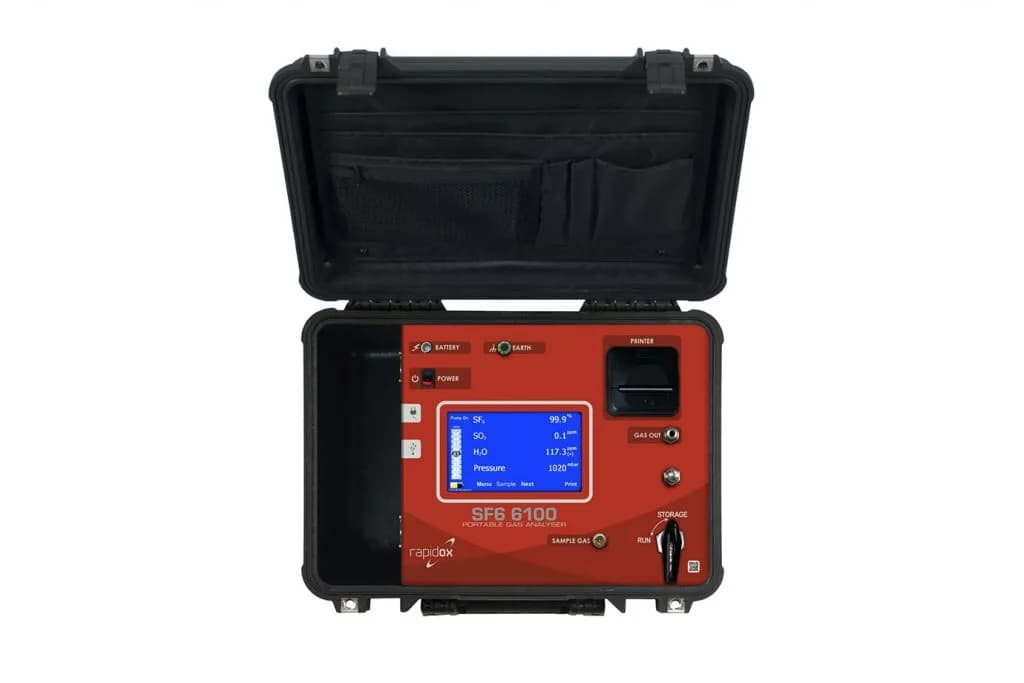
Rapidox SF6 6100 Portable — Portable SF6 Gas Analyser
Lightweight (8.5 kg) SF6 analyser for medium and high voltage GIS and breakers: purity, moisture and decomposition products, up to 8 gases at once.
Why SO2, HF and other by-products are dangerous
- Gaseous SF4, SiF4, SO2F2, SO2 and HF are extremely irritating to the eyes, nose and throat. Because they are corrosive, they can cause pulmonary oedema, skin and eye burns and bronchitis.
- Cambridge Sensotec warns in its analyser manual that HF and SO2 are toxic and can be fatal if inhaled, cause severe skin burns, and HF causes severe eye damage.
- Aluminium and copper fluoride dust irritates skin, eyes and the respiratory tract.
- Research names S2F10 as the by-product of greatest concern because of its high toxicity.
EPA describes several cases of workers exposed to decomposition products while repairing SF6 equipment. In one of them an electrician lost consciousness while repairing a circuit breaker, and his lung capacity was reduced by 45 %.
Workplace exposure limits
The EPA document (2002) summarises US occupational exposure limits (OSHA, NIOSH, ACGIH). Values in ppm by volume in air:
| Substance | Time-weighted average (PEL-TWA, OSHA) | Short-term or ceiling limit | IDLH (NIOSH) |
|---|---|---|---|
| S2F10 | 0.025 | 0.01 (ceiling, OSHA, NIOSH, ACGIH) | 1 |
| SF4 | — | 0.1 (ceiling) | — |
| SO2 | 2 | 5 (STEL) | 100 |
| HF | 3 | 6 (STEL) | 30 |
| SO2F2 | 5 | 10 (STEL) | 200 |
| SF6 (for comparison) | 1000 | — | — |
These are US limits as of 2002, shown for the order of magnitude. At sites in Kazakhstan, apply the current national hygiene standards.
How to measure decomposition products
The Rapidox SF6 6100 analyser measures decomposition products with electrochemical sensors at the same time as SF6 purity and moisture:
| Gas | Range | Accuracy |
|---|---|---|
| SO2 | 0–100 or 0–500 ppm | ±2 % FS |
| HF | 0–10 or 0–30 ppm | ±2 % FS |
| H2S | 0–100 ppm | ±2 % FS |
| CO | 0–1000 ppm | ±2 % FS |
Procedure:
- Connect the analyser to the compartment with a self-sealing coupling. Gas flows under compartment pressure, up to 10 bar at the inlet.
- If the analyser is built without an SF6 sensor, select the correct background gas in the settings (SF6 or N2/air). According to the Cambridge Sensotec manual, the wrong background gas gives an error of about 50 % on SO2, H2S and CO: the high density of SF6 strongly affects electrochemical sensor response. With an SF6 sensor fitted, the analyser applies the density correction itself.
- Run an IEC or CIGRE test: the analyser shows PASS or FAIL for each gas.
- Collect the used sample in a gas recovery bag or return it to the compartment with the Rapidox SF6 6100 Pump Back.
- Compare the result with previous tests of the same compartment. A simultaneous rise in SO2, HF and moisture points to discharges inside the equipment. How to measure moisture correctly is described in the article "SF6 moisture limits".
If you have a 3-gas Rapidox 6100 Pump Back without an HF channel, an HF sensor can be added as an upgrade by Cambridge Sensotec or a certified partner.
Limits for the gas
Numerical limits for decomposition products in re-used gas are set by IEC 60480:2019; take them from the current text of the standard and from the equipment manufacturer's instructions. For reference: CIGRE guide 117 (1997) gave a tolerable level of 100 ppmv and an impurity limit for re-use of 50 ppmv for gaseous decomposition products (SF4, WF6, SOF4, SOF2, SO2, HF, SO2F2). In the field they were detectable from 10 ppmv using SO2 and SOF2 as indicator gases.
What to do when decomposition products are found
- Do not rely on smell. Some by-products, such as SF4, smell of rotten eggs, but the most toxic, S2F10, is generally odourless in pure form.
- Wear protection. Many SF6 handling procedures require protective clothing and an approved respirator when decomposition products are suspected, for example after a breaker has been exposed to a prolonged arc.
- Recover the gas with the right equipment. According to CIGRE guide 117, gaseous decomposition products are removed by absorbents in gas handling equipment, and solid particles by dust filters with a 1 micrometre pore size.
- Clean the compartment by procedure. Solid by-products (CuF2, WO3, AlF3 and others) are toxic; when opening the equipment, follow the manufacturer's cleaning procedure.
- Find the cause. Decomposition products are a consequence of a discharge. Check contacts, insulation and switching history, and look for discharges on energised equipment from the outside with ultrasound.
The full procedure for checking gas at a substation is in the article "How to check SF6 gas quality".
Which analyser to choose
To check the gas before opening a compartment and after high-current switching, use the Rapidox SF6 6100 Portable with SO2 and HF sensors. If you test often and cannot lose gas, choose the Rapidox SF6 6100 Pump Back: it returns the sample to the compartment and measures the same decomposition products.
KEG TRK supplies Cambridge Sensotec SF6 analysers in Kazakhstan. Price on request.
Sources
- U.S. EPA. Byproducts of Sulfur Hexafluoride (SF6) Use in the Electric Power Industry, 2002: https://www.epa.gov/system/files/documents/2022-05/sf6_byproducts.pdf
- Bolin P. SF6 Recycling Guide: Reuse of SF6 Gas in Electrical Power Equipment and Final Disposal (CIGRE Report 117, 1997). EPA conference presentation, 2000: https://19january2021snapshot.epa.gov/sites/static/files/2016-02/documents/conf00_bolin.pdf
- IEC 60480:2019. Specifications for the re-use of sulphur hexafluoride (SF6) and its mixtures in electrical equipment. IEC webstore: https://webstore.iec.ch/en/publication/61024
- Cambridge Sensotec. Rapidox SF6 6100 Portable instruction manual D61-070-5: https://www.cambridge-sensotec.co.uk/wp-content/uploads/2023/04/D61-070-5-Rapidox-SF6-6100-Portable-Analyser.pdf
- Cambridge Sensotec. Measuring SF6, H2O, SO2 and HF in gas-insulated switchgear: https://sf6.co.uk/importance-of-measuring-sf6-h2o-so2-and-hf/
Frequently asked questions
Equipment in this article
KEG TRK quotes prices and delivery times to Kazakhstan on request. We will prepare a commercial offer for your application.
Rapidox SF6 6100 Portable — Portable SF6 Gas Analyser
Lightweight (8.5 kg) SF6 analyser for medium and high voltage GIS and breakers: purity, moisture and decomposition products, up to 8 gases at once.
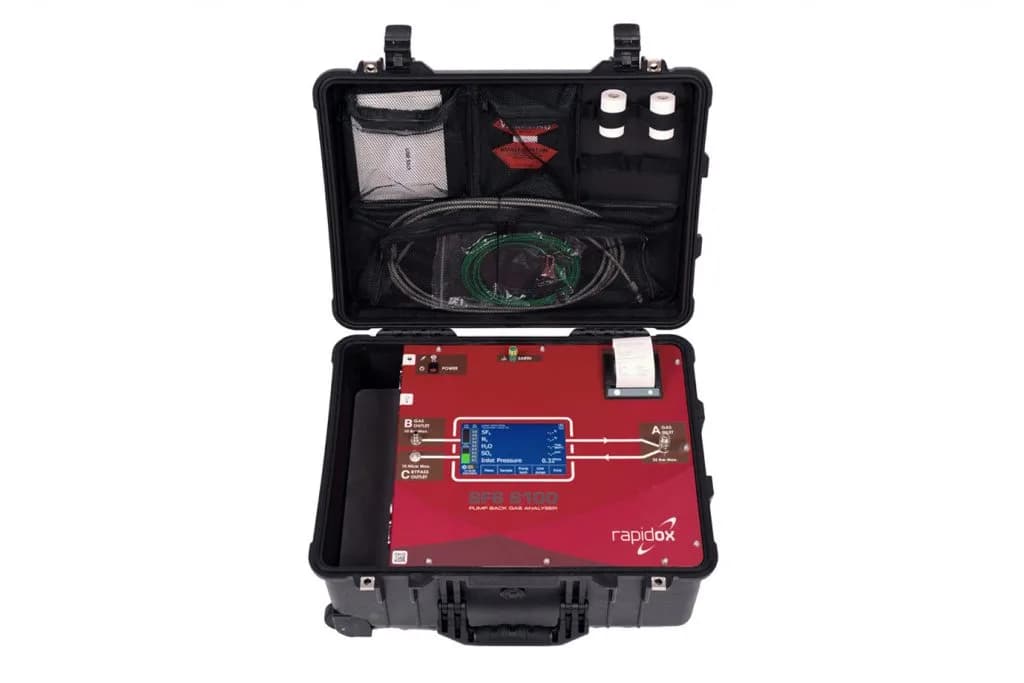
Rapidox SF6 6100 MK2 Pump Back — SF6 Analyser with Gas Return
Fully automatic zero-emissions SF6 analyser: purity, moisture and decomposition products in 2–8 minutes, then a compressor returns the gas to the equipment at up to 10…
Read also
10/13/2026
How to Test SF6 Gas Quality at a Substation: Step-by-Step Guide
SF6 gas quality is tested with an analyser connected directly to the compartment: SF6 purity, moisture and decomposition products. What to measure, how to connect, what to compare the result with and when to test the gas.
10/10/2026
SF6 Moisture Limits: Dew Point, ppmv and How to Measure Water in SF6
SF6 moisture is stated in ppmv or as a dew point. The acceptable water content depends on the gas pressure in the equipment. How to convert the units and measure moisture with a Rapidox SF6 6100.
6/26/2026
Transformer DGA at CHP: What to Add Beyond Oil Chromatography
Dissolved gas analysis (DGA) is the gold standard for transformer diagnosis but not the only tool. Companion methods at CHP plants: cooling vibration, PD ultrasound, SF₆ and O₂ on adjacent switchgear.