
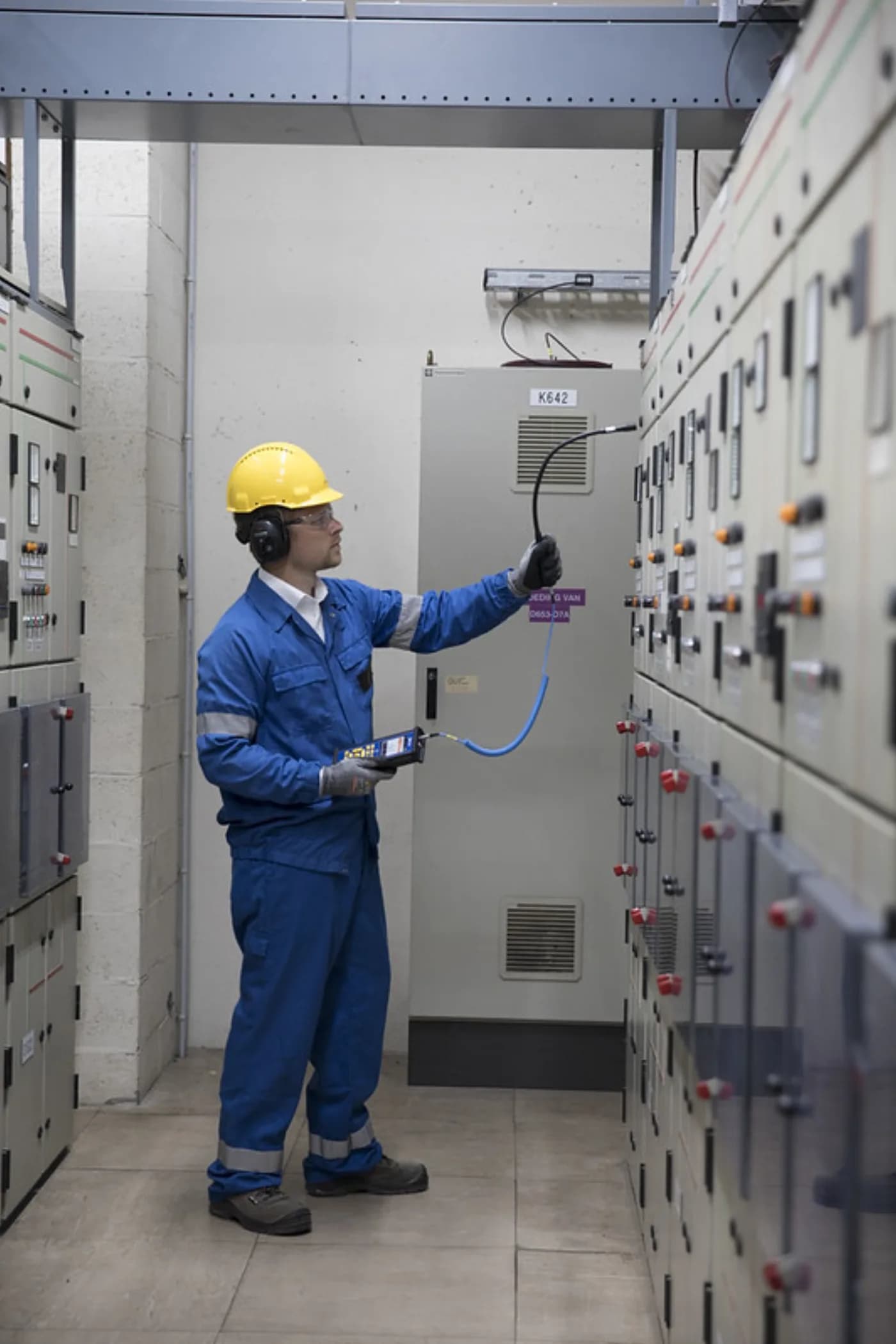
How to Test SF6 Gas Quality at a Substation: Step-by-Step Guide
SF6 gas quality is tested with an analyser connected directly to the compartment: SF6 purity, moisture and decomposition products. What to measure, how to connect, what to compare the result with and when to test the gas.
SF6 gas quality at a substation is tested with a portable SF6 analyser connected to the sampling port of the compartment. One connection covers three groups of parameters: SF6 purity (air and CF4 impurity), moisture and decomposition products (SO2, HF). The result is compared with the limits in IEC 60480 and the equipment manufacturer's instructions, and with earlier readings from the same compartment.
What "SF6 gas quality" means
Contaminants enter SF6 from several sources. CIGRE guide 117, "SF6 Recycling Guide" (1997), lists gas handling, leakage, desorption from surfaces and polymers, decomposition by electrical discharges and mechanical generation of dust. This gives the three parameters that are checked in the field.
SF6 purity: air and CF4
Air enters the gas during filling and maintenance; CF4 forms in switching arcs. Both impurities reduce switching capability and the insulation of the gas gap. CIGRE 117 gives a tolerable level of 3 % by volume for air and CF4 and an impurity limit for re-use of 2 %. These impurities cannot be filtered out; they are reduced only by dilution with new gas.
Moisture
Water desorbs from surfaces and polymer parts of the equipment. If the gas cools below its dew point, water condenses on insulators and degrades surface insulation. The acceptable moisture level depends on gas pressure: the higher the pressure, the less water in ppmv is allowed. How to convert between dew point and ppmv, and why a dew point without a pressure means nothing, is covered in SF6 moisture limits.
Decomposition products
Partial discharges, sparking and arcs break SF6 down. The products include SOF2, SO2, HF, S2F10, H2S and metal fluorides. They are toxic and degrade surface insulation. In the field they were traditionally detected using SO2 and SOF2 as indicator gases; modern analysers measure SO2 and HF with electrochemical sensors. Composition, hazards and exposure limits are covered in SF6 decomposition products: SO2, HF and how to handle them.
Which standards apply
| Document | What it covers |
|---|---|
| IEC 60376:2018 | Quality of technical grade SF6 and complementary gases (N2, CF4) before filling into equipment |
| IEC 60480:2019 | Criteria for re-use of SF6 and its mixtures after recovery from equipment |
| CIGRE 117 (1997) | Purity limits for re-use of gas; the revision of IEC 480 was to follow them |
| Equipment manufacturer's instructions | Limits for a specific breaker or GIS, which may be stricter than the standard |
The numerical limits of IEC 60376 and IEC 60480 are given in tables in the full text of the standards. We do not paraphrase them: take the values from the current edition and from the manufacturer's instructions.
For orientation, the limits from CIGRE guide 117 (1997):
| Impurity | Tolerable level | Impurity limit for re-use |
|---|---|---|
| Air and CF4 | 3 % vol. | 2 % vol. |
| Moisture at 100 kPa | 4000 ppmv | 1600 ppmv |
| Moisture at 500 kPa | 800 ppmv | 320 ppmv |
| Moisture at 2 MPa | 200 ppmv | 120 ppmv |
| Gaseous decomposition products (SF4, WF6, SOF4, SOF2, SO2, HF, SO2F2) | 100 ppmv | 50 ppmv |
These are 1997 values. For gas acceptance, use the current edition of IEC 60480.
Equipment covered in this article
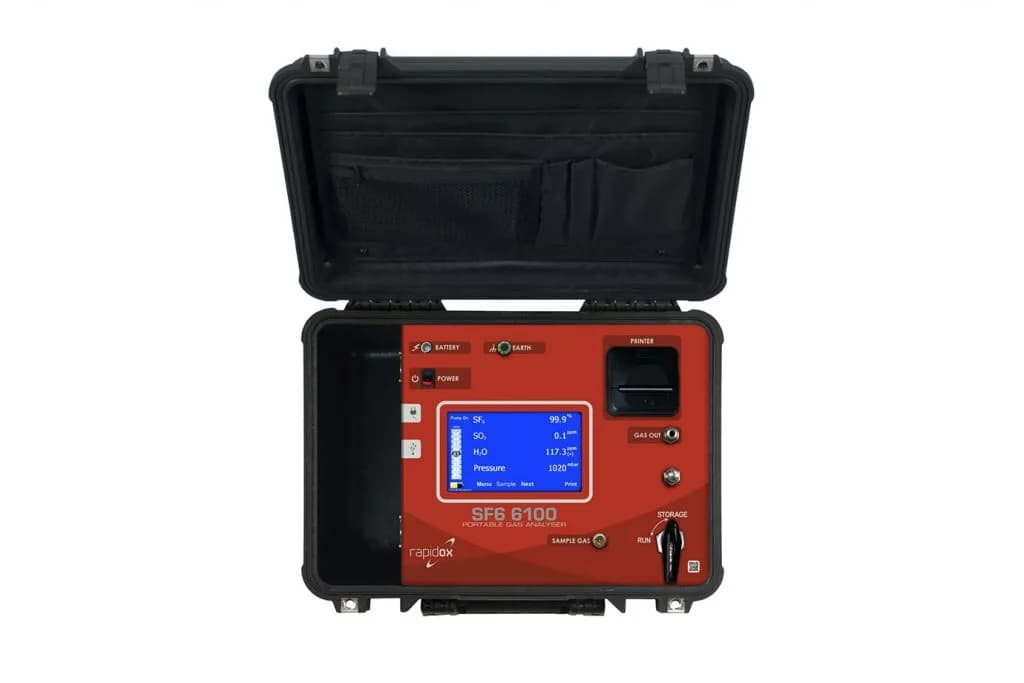
Rapidox SF6 6100 Portable — Portable SF6 Gas Analyser
Lightweight (8.5 kg) SF6 analyser for medium and high voltage GIS and breakers: purity, moisture and decomposition products, up to 8 gases at once.
Step 1. Preparation
What you need:
- an SF6 analyser, for example the Rapidox SF6 6100 Portable with the required sensors;
- adapters for the ports on your equipment from the SF6 hose connection kit;
- a gas recovery bag if the analyser does not return the sample;
- protective equipment: gloves and goggles, and, if decomposition products are suspected, protective clothing and a certified respirator.
Find out in advance which sampling port each piece of equipment has. The Cambridge Sensotec kit includes adapters from RECTUS 21 to ¼″, 3/8″ and ½″ JIC, 1/4″ NPT and European DN6, DN7, DN8, DN12 and DN20, plus a regulator for sampling from a cylinder. The kit is configured for the customer's equipment fleet.
Before connecting, check the gas pressure in the compartment on the gauge or density monitor and write it down: you will need it to compare moisture with the limit.
Step 2. Connection
- Make sure the sampling port valve is closed.
- Fit the matching adapter from the kit to the port.
- Connect the analyser hose to the adapter through the RECTUS 21 coupling. It is a closed coupling, so almost no gas escapes when connecting and disconnecting.
- Switch the analyser on. The Rapidox SF6 6100 Portable warms up in 3–4 minutes at 20 °C.
- If the analyser was stored with the Rapidri lever in the STORAGE position, move it to RUN.
- Open the port valve slowly.
Gas flows through the analyser under compartment pressure; the Rapidox SF6 6100 Portable accepts up to 10 bar at the inlet. For low-pressure sources (below 0.5 bar according to the Cambridge Sensotec manual) the optional pump is needed.
Step 3. Measurement
- In the menu, choose Timed mode and the test that matches the equipment, for example "IEC 60480 > 200kPa". IEC and CIGRE tests are preset in the Rapidox SF6 6100.
- Set the sample time. For moisture in timed mode, the Cambridge Sensotec manual requires at least six minutes.
- If the instrument has no SF6 sensor, select the correct background gas (SF6 or N2/air). Otherwise the SO2, H2S and CO readings will be off by about 50 %.
- Wait for the test to finish. The instrument shows PASS or FAIL for each parameter and records the gas pressure.
- The sample goes into the gas recovery bag. The Rapidox SF6 6100 Pump Back returns it to the compartment with a compressor.
What the Rapidox SF6 6100 Portable measures (from the product page):
| Parameter | Range | Accuracy |
|---|---|---|
| SF6 purity | 0–100 % | ±0.5 % |
| Moisture | −60 to +20 °C dew point (10–24,000 ppmV) | ±2 °C dew point |
| SO2 | 0–100 or 0–500 ppm | ±2 % FS |
| HF | 0–10 or 0–30 ppm | ±2 % FS |
| H2S | 0–100 ppm | ±2 % FS |
| CO | 0–1000 ppm | ±2 % FS |
| CF4 (calculated) | 0–80 % | ±1 % of reading |
CF4 is calculated by the instrument and requires the air sensor. One instrument holds up to eight sensors; the combination is agreed with the manufacturer.
Step 4. How to read the result
Compare each parameter with the limit from the manufacturer's instructions and IEC 60480, then with earlier readings from the same compartment:
- Air content is rising. Errors during filling or maintenance are likely. Air and CF4 cannot be filtered out; they are reduced by dilution with new gas.
- Moisture is rising. Check which pressure the value refers to and convert it to the pressure at which the limit is stated. According to CIGRE 117, water comes from surfaces and polymers, from gas handling and through leaks.
- SO2 and HF have appeared. There have been discharges or an arc inside the equipment. Before opening the compartment, the gas is removed with handling equipment fitted with adsorbents, and staff wear protection. The cause is investigated separately: contact wear, partial discharges, high-current switching.
- SO2, HF and moisture rise together. This indicates discharges inside the equipment; check this compartment first.
If a parameter is out of limits, the gas is treated with a reclaiming unit or replaced following the manufacturer's procedure.
Step 5. Test record
The Rapidox SF6 6100 prints the result on its built-in printer and exports Excel-compatible files to a USB stick. Record:
- date and time of the test;
- equipment and compartment number;
- gas pressure and temperature;
- values of all parameters and the test result (PASS or FAIL);
- comparison with the previous reading;
- conclusion and signature of the responsible person.
When to test SF6
There is no single interval for all equipment: the routine interval is set by the manufacturer's instructions and the operator's procedures. Outside the schedule, the gas is tested:
- at commissioning, as the baseline for all later readings;
- after filling, topping up and repair;
- after interrupting a short-circuit current or a series of heavy switching operations;
- when a pressure or density alarm trips;
- before opening a compartment, to assess the decomposition product hazard;
- at incoming inspection of cylinders with new or reclaimed gas.
Common mistakes
- No baseline reading. Without a value at commissioning, there is no trend.
- Dew point without pressure. Values at operating pressure and at atmospheric pressure are different numbers for the same gas.
- Measurement too short. The moisture sensor needs time; for timed mode Cambridge Sensotec specifies at least six minutes.
- Checking only pressure and moisture. SO2 and HF reveal discharges inside the equipment; without them a fault can be missed.
- Venting the sample. SF6 is a greenhouse gas; collect the sample in a bag or return it to the compartment.
- Looking for leaks with an analyser. The analyser shows gas quality; leaks are located with a leak detector, see SF6 leak detector or gas analyser.
Which instrument to choose
For field crews and occasional tests, the Rapidox SF6 6100 Portable fits: 8.5 kg with case, up to eight gases, sample collected in a bag. If you test often and cannot lose gas, choose the Rapidox SF6 6100 Pump Back: it returns the sample to the compartment and works with 0.3–35 bar at the inlet. Adapters for your equipment are assembled into the SF6 hose connection kit.
KEG TRK supplies Cambridge Sensotec SF6 analysers in Kazakhstan. Price on request: info@keg-trk.kz.
Sources
- IEC 60376:2018. Specification of technical grade sulphur hexafluoride (SF6) and complementary gases to be used in its mixtures for use in electrical equipment. IEC webstore: https://webstore.iec.ch/en/publication/33028
- IEC 60480:2019. Specifications for the re-use of sulphur hexafluoride (SF6) and its mixtures in electrical equipment. IEC webstore: https://webstore.iec.ch/en/publication/61024
- Bolin P. SF6 Recycling Guide: Reuse of SF6 Gas in Electrical Power Equipment and Final Disposal (CIGRE Report 117, 1997). EPA conference paper, 2000: https://19january2021snapshot.epa.gov/sites/static/files/2016-02/documents/conf00_bolin.pdf
- U.S. EPA. Byproducts of Sulfur Hexafluoride (SF6) Use in the Electric Power Industry, 2002: https://www.epa.gov/system/files/documents/2022-05/sf6_byproducts.pdf
- Cambridge Sensotec. Rapidox SF6 6100 Portable, operating manual D61-070-5: https://www.cambridge-sensotec.co.uk/wp-content/uploads/2023/04/D61-070-5-Rapidox-SF6-6100-Portable-Analyser.pdf
- Cambridge Sensotec. Rapidox SF6 6100 Portable, technical specification: https://www.cambridge-sensotec.co.uk/wp-content/uploads/2023/04/Rapidox-SF6-6100-Portable-Technical-Specification.pdf
Frequently asked questions
Equipment in this article
KEG TRK quotes prices and delivery times to Kazakhstan on request. We will prepare a commercial offer for your application.
Rapidox SF6 6100 Portable — Portable SF6 Gas Analyser
Lightweight (8.5 kg) SF6 analyser for medium and high voltage GIS and breakers: purity, moisture and decomposition products, up to 8 gases at once.
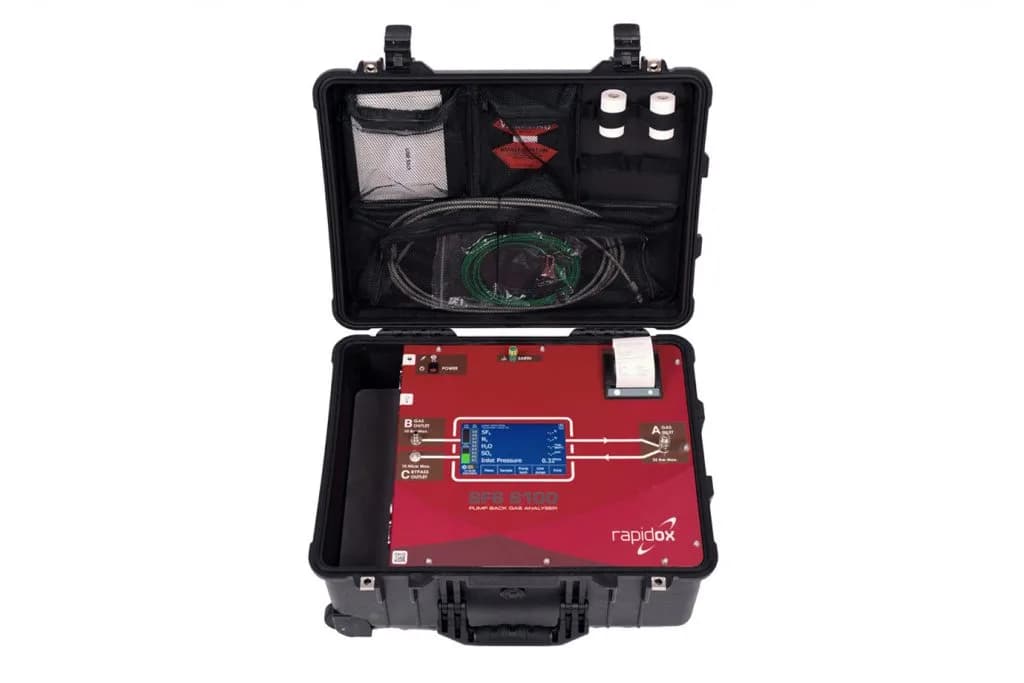
Rapidox SF6 6100 MK2 Pump Back — SF6 Analyser with Gas Return
Fully automatic zero-emissions SF6 analyser: purity, moisture and decomposition products in 2–8 minutes, then a compressor returns the gas to the equipment at up to 10…
Also in this article: SF6 Hose Connection Kit - Insulating Gas Hose Connection Set
Read also
6/26/2026
Clean Air and Oxygen in SF₆-Free Switchgear: Monitoring at CHP During the SF₆ Transition
New dry-air (Clean Air) switchgear at CHP plants needs O₂, humidity and purity control. Rapidox 6100 Clean Air Pumpback for mixed SF₆ and SF₆-free fleets.
6/26/2026
Transformer DGA at CHP: What to Add Beyond Oil Chromatography
Dissolved gas analysis (DGA) is the gold standard for transformer diagnosis but not the only tool. Companion methods at CHP plants: cooling vibration, PD ultrasound, SF₆ and O₂ on adjacent switchgear.
10/10/2026
SF6 Moisture Limits: Dew Point, ppmv and How to Measure Water in SF6
SF6 moisture is stated in ppmv or as a dew point. The acceptable water content depends on the gas pressure in the equipment. How to convert the units and measure moisture with a Rapidox SF6 6100.