
SF6 Moisture Limits: Dew Point, ppmv and How to Measure Water in SF6
SF6 moisture is stated in ppmv or as a dew point. The acceptable water content depends on the gas pressure in the equipment. How to convert the units and measure moisture with a Rapidox SF6 6100.
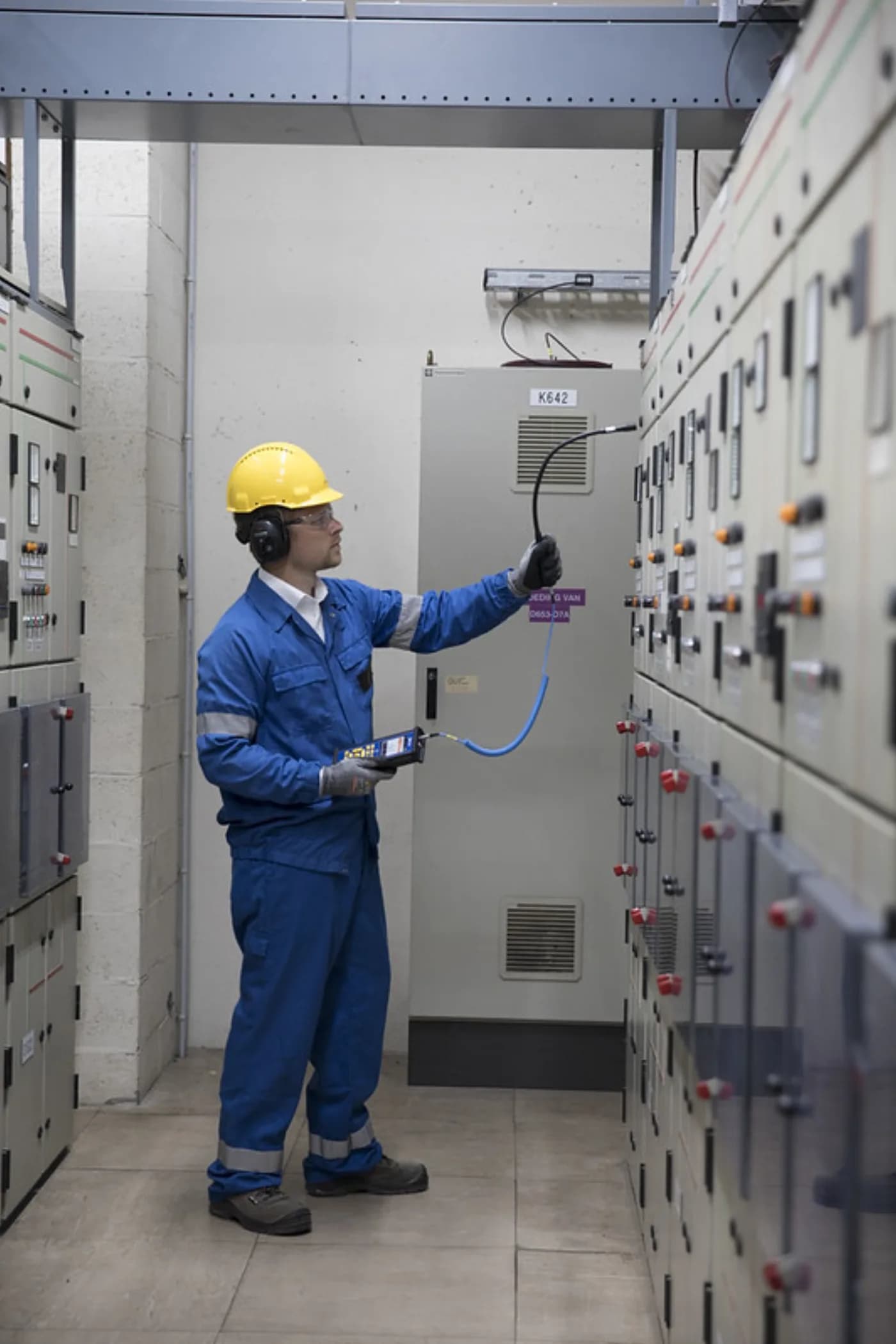
Moisture in sulphur hexafluoride (SF6) is expressed in two ways: as the volume fraction of water vapour in ppmv or as a dew point in °C. The acceptable water content depends on the gas pressure in the equipment: the higher the pressure, the less moisture in ppmv is allowed, because under pressure the vapour condenses sooner. Take the exact limit from the equipment manufacturer's instructions and IEC 60480, and measure moisture with an SF6 analyser directly at the compartment.
Why moisture in SF6 is a problem
Water enters the gas from surfaces and from polymer parts inside the equipment. If the gas cools below its dew point, water condenses on the insulators and degrades surface insulation. This is how the CIGRE SF6 recycling guide (brochure 117) describes the mechanism.
Moisture also takes part in forming decomposition products. Electrical discharges break SF6 down; the sulphur tetrafluoride SF4 that forms is readily hydrolysed to thionyl fluoride SOF2, and hydrogen fluoride HF is among the by-products. More in the article "SF6 decomposition products: SO2, HF and what to do about them".
ppmv and dew point: what is the difference
| Quantity | What it shows | Depends on gas pressure |
|---|---|---|
| ppmv (µl/l) | Volume fraction of water vapour: parts per million of the gas volume | No |
| ppmw | Mass fraction of water in the gas | No |
| Dew point (°C dp) | Temperature at which the vapour in the gas starts to condense | Yes |
Below 0 °C the vapour deposits as frost, so strictly this region is the frost point. Analysers usually still show it as dew point in °C dp.
Equipment covered in this article
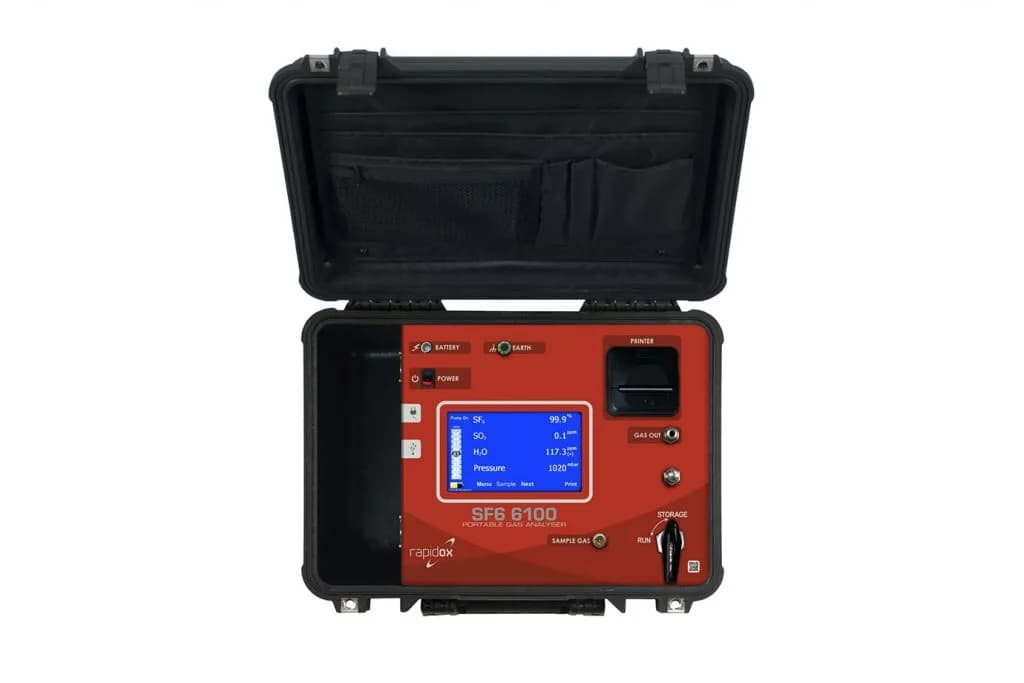
Rapidox SF6 6100 Portable — Portable SF6 Gas Analyser
Lightweight (8.5 kg) SF6 analyser for medium and high voltage GIS and breakers: purity, moisture and decomposition products, up to 8 gases at once.
Why the conversion depends on pressure
The partial pressure of water vapour equals its volume fraction multiplied by the total gas pressure. Vapour condenses when its partial pressure reaches the saturation vapour pressure at the given temperature.
The practical consequence:
- Take the same gas sample with the same ppmv.
- Inside a pressurised compartment the partial pressure of the vapour is several times higher than in the same sample at atmospheric pressure.
- So inside the compartment the vapour condenses at a higher temperature: the dew point at operating pressure is higher than at atmospheric pressure.
A dew point without a stated pressure tells you nothing. Record the pressure the value refers to, and when comparing with a limit, bring the result to the same pressure at which the limit is stated.
Which moisture limits apply
Two IEC standards set SF6 quality requirements:
- IEC 60376:2018 — quality of technical grade SF6 and complementary gases (N2, CF4) for electrical equipment, i.e. gas before it is filled into the equipment;
- IEC 60480:2019 — criteria for re-use of SF6 and its mixtures after recovery and reclaiming from equipment (third edition, replacing the 2004 edition).
The numerical moisture limits in these standards are in tables available only in the full text. We do not quote them from second-hand summaries: take the values from the current edition of the standard and from your equipment manufacturer's instructions. A manufacturer may set a stricter limit than the standard.
The principle is clearly visible in CIGRE guide 117 "SF6 Recycling Guide" (1997): the revision of IEC 480 was expected to follow its purity limits. The guide gives the tolerable moisture level as a function of the pressure at which the gas is stored and used:
| Gas pressure | Tolerable moisture level, ppmv | Impurity limit for re-use, ppmv |
|---|---|---|
| 100 kPa | 4000 | 1600 |
| 500 kPa | 800 | 320 |
| 2 MPa | 200 | 120 |
These are 1997 values, shown to illustrate the pressure dependence. For gas acceptance, use the current edition of IEC 60480.
The Rapidox SF6 6100 analyser has pre-loaded IEC and CIGRE tests. The test for high-pressure equipment is called "IEC 60480 > 200kPa". The name alone shows that the criterion depends on the equipment pressure.
How to measure SF6 moisture: step by step
Using the portable Rapidox SF6 6100 analyser (Cambridge Sensotec) as an example:
- Prepare the analyser. Between tests the Rapidri lever is in the STORAGE position: a molecular sieve draws moisture out of the dew point sensor. Before measuring, turn the lever to RUN.
- Connect to the compartment. Use self-sealing couplings from the connection kit. Gas flows through the analyser under compartment pressure, up to 10 bar at the inlet. The pump is needed only when the gas pressure is below 0.5 bar.
- Select the test. In the Sampling menu choose Timed mode, set the sample time and the test, for example "IEC 60480 > 200kPa". For moisture in timed mode the manual requires at least six minutes.
- Measure. The analyser records moisture, SF6 purity and decomposition products (depending on the fitted sensors) at the same time, plus the compartment gas pressure. At the end the screen shows PASS or FAIL for each parameter.
- Collect the sample. The used gas goes into a recovery bag, not into the atmosphere. The Rapidox SF6 6100 Pump Back returns the gas to the compartment with a compressor.
- Document. The result is printed on the built-in printer and exported to a USB stick. Record gas pressure and temperature: without them the dew point cannot be compared with the previous test.
Rapidox SF6 6100 moisture sensor specifications
| Parameter | Value |
|---|---|
| Range | −60 to +20 °C dp (10–24,000 ppmV) |
| Accuracy | ±2 °C dp |
| Sensor type | polymer |
| Calibration | 12 months (sensor replacement) |
| Sensor life | 2–3 years |
| Response | down to −60 °C dp from wet in less than 10 minutes |
In continuous mode the dew point sensor runs a self-clean cycle every thirty minutes to keep readings accurate.
Common mistakes
- Comparing dew points without pressure. The value at operating pressure and at atmospheric pressure are different numbers for the same gas.
- Stopping the test too early. The moisture sensor needs time to stabilise; for timed mode Cambridge Sensotec specifies a minimum of six minutes.
- Storing the analyser with the sensor open. If the Rapidri lever is not set to STORAGE and the hose is not removed, the sensor picks up moisture from the air and the next test takes longer.
- Measuring moisture only. Rising moisture together with SO2 and HF points to discharges inside the equipment. The full gas check procedure is in the article "How to check SF6 gas quality at a substation".
Which analyser to choose
For field crews and occasional tests the Rapidox SF6 6100 Portable fits well: 8.5 kg with case, up to 8 gases, the sample is collected in a bag. If you test often and need to return the gas to the compartment, choose the Rapidox SF6 6100 Pump Back. SF6 leaks are found with a different instrument, see "SF6 leak detector or gas analyser".
KEG TRK supplies Cambridge Sensotec SF6 analysers in Kazakhstan. Price on request.
Sources
- IEC 60376:2018. Specification of technical grade sulphur hexafluoride (SF6) and complementary gases to be used in its mixtures for use in electrical equipment. IEC webstore: https://webstore.iec.ch/en/publication/33028
- IEC 60480:2019. Specifications for the re-use of sulphur hexafluoride (SF6) and its mixtures in electrical equipment. IEC webstore: https://webstore.iec.ch/en/publication/61024
- U.S. EPA. Byproducts of Sulfur Hexafluoride (SF6) Use in the Electric Power Industry, 2002: https://www.epa.gov/system/files/documents/2022-05/sf6_byproducts.pdf
- Bolin P. SF6 Recycling Guide: Reuse of SF6 Gas in Electrical Power Equipment and Final Disposal (CIGRE Report 117, 1997). EPA conference presentation, 2000: https://19january2021snapshot.epa.gov/sites/static/files/2016-02/documents/conf00_bolin.pdf
- Cambridge Sensotec. Rapidox SF6 6100 Portable instruction manual D61-070-5: https://www.cambridge-sensotec.co.uk/wp-content/uploads/2023/04/D61-070-5-Rapidox-SF6-6100-Portable-Analyser.pdf
- Cambridge Sensotec. Rapidox SF6 6100 Portable technical specification: https://www.cambridge-sensotec.co.uk/wp-content/uploads/2023/04/Rapidox-SF6-6100-Portable-Technical-Specification.pdf
Frequently asked questions
Equipment in this article
KEG TRK quotes prices and delivery times to Kazakhstan on request. We will prepare a commercial offer for your application.
Rapidox SF6 6100 Portable — Portable SF6 Gas Analyser
Lightweight (8.5 kg) SF6 analyser for medium and high voltage GIS and breakers: purity, moisture and decomposition products, up to 8 gases at once.
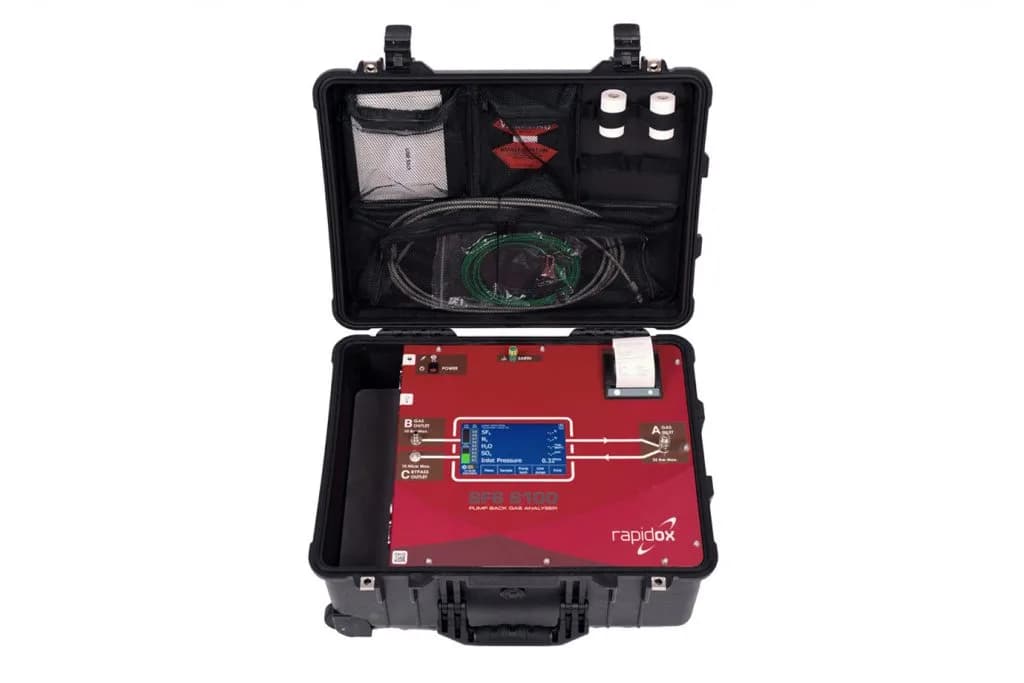
Rapidox SF6 6100 MK2 Pump Back — SF6 Analyser with Gas Return
Fully automatic zero-emissions SF6 analyser: purity, moisture and decomposition products in 2–8 minutes, then a compressor returns the gas to the equipment at up to 10…
Read also
10/13/2026
How to Test SF6 Gas Quality at a Substation: Step-by-Step Guide
SF6 gas quality is tested with an analyser connected directly to the compartment: SF6 purity, moisture and decomposition products. What to measure, how to connect, what to compare the result with and when to test the gas.
10/10/2026
SF6 Decomposition Products: SO2, HF and What to Do About Them
Discharges and arcs break SF6 down into SO2, HF, SOF2, S2F10 and metal fluoride dust. Why they are dangerous, which exposure limits apply and how to measure them with an analyser.
6/26/2026
Transformer DGA at CHP: What to Add Beyond Oil Chromatography
Dissolved gas analysis (DGA) is the gold standard for transformer diagnosis but not the only tool. Companion methods at CHP plants: cooling vibration, PD ultrasound, SF₆ and O₂ on adjacent switchgear.