
Accepting a motor after repair: electrics with Artesis AMT Pro, bearings with SDT340
How to check a motor after rewinding or a bearing change before it returns to service: compare before-and-after tests on Artesis AMT Pro and check the bearings with SDT340 ultrasound.
In this article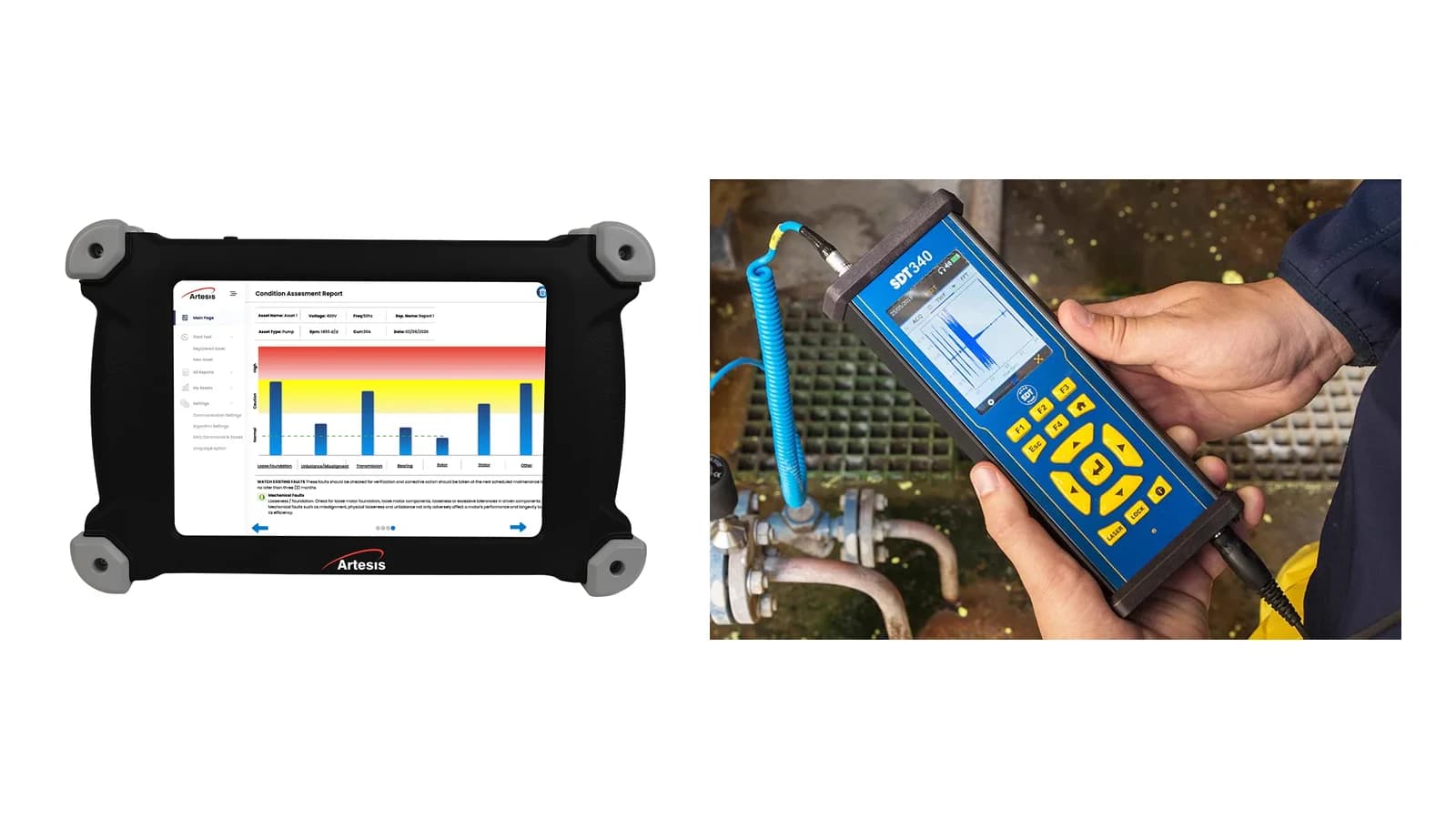
Prepared by the KEG TRK team · How we prepare our content
A motor returning from repair is accepted on two measurements. The electrical side is compared with Artesis AMT Pro tests before and after the repair at the same load. Bearings and lubrication are checked with SDT340 ultrasound. Both tests take under an hour, need no sensors on the machine and give a baseline for the future.
Why repairs should be accepted by measurement
Usually a motor is accepted on the fact of starting: it turns, does not overheat, does not make noise. Some defects are not visible that way. A rewind can leave turn-to-turn problems, rotor bar cracks show up only under load, and a misalignment error or over-greasing shortens bearing life within the first months. Post-repair inspection is cheap compared with a second shutdown.
Different methods see different causes:
| What we check | With | Why this tool |
|---|---|---|
| Stator windings, rotor, supply, load | Artesis AMT Pro | current and voltage analysis, no sensors on the machine |
| Bearings, lubrication, friction | SDT340 | ultrasound catches defects and lack or excess of lubricant early |
| Misalignment, unbalance | vibration, laser alignment | AMT Pro assesses mechanical faults, but alignment is checked on site |
Acceptance sequence
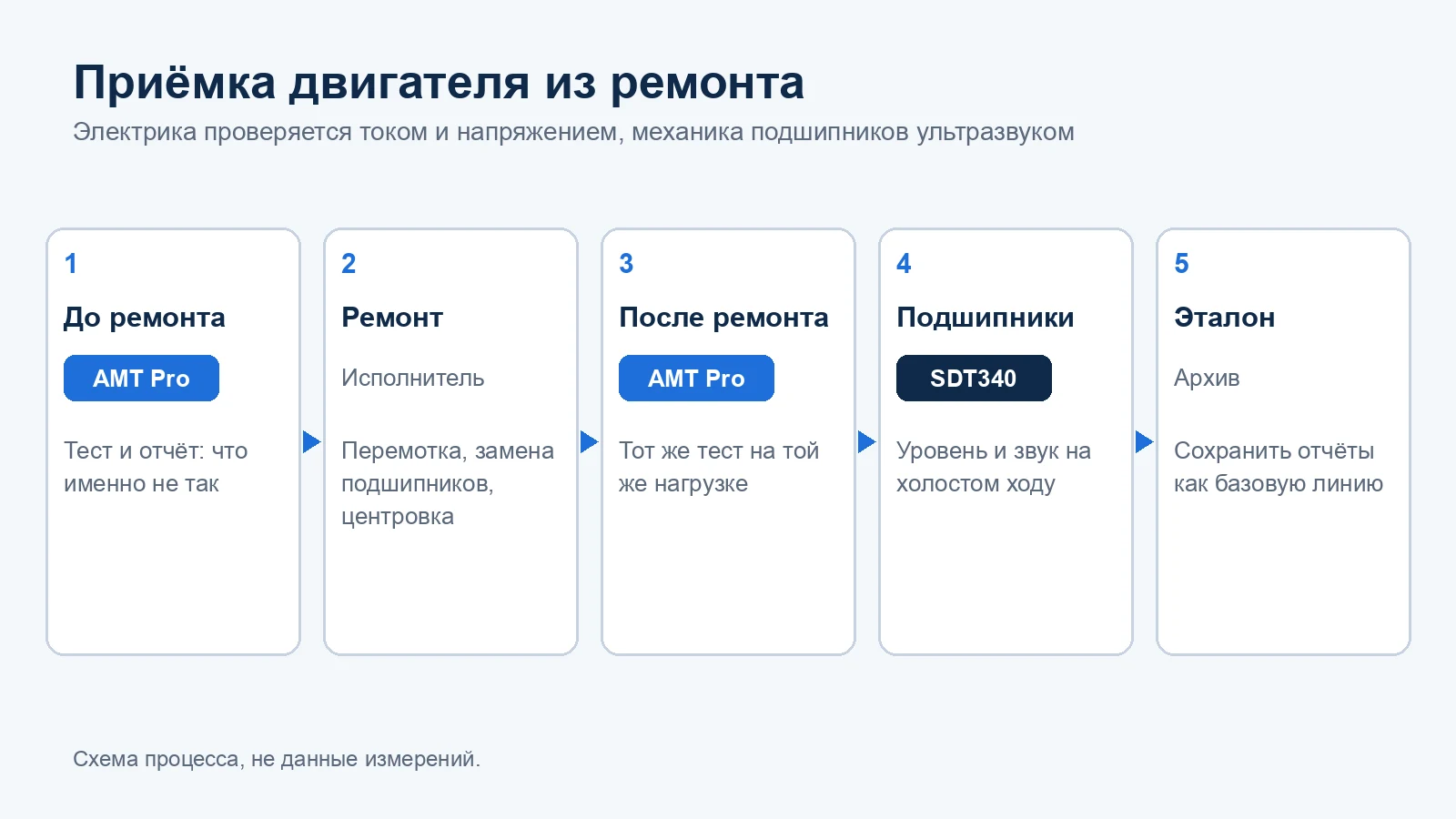
Process diagram, not measurement data.
1. Test before repair
While the motor is still in place and running, run an AMT Pro test: connect three current clamps and the voltage leads, enter nameplate data (power, speed, start type), run the motor at no load and at working load. Keep the report with the condition rating and defect list together with the repair order. It tells the contractor what to fix and tells you what to compare with.
The instrument is intended for pre-repair diagnostics, as its listed applications state.
2. Repair
Rewinding, bearing and coupling replacement. It helps to include a requirement in the order: return with the contractor's test report and without altering the seats.
3. Test after repair at the same load
Once the motor is installed and connected, repeat the test with the same settings and, where possible, in the same mode. Compare the reports, not just the rating. The point is that closed defects are gone and no new ones appeared. If the load differs, record it: part of the difference will come from the mode, not the repair. Typical findings are covered in Route diagnostics of motors with Artesis AMT Pro and 5 typical electric motor defects.
4. Bearing check with the SDT340
Ultrasound hears what a current test will not show: friction in the bearing, lack or excess of lubricant, damage during installation. At no load take readings on both bearing housings and compare with a second motor of the same type or with the previous machine. If you use ultrasound-based lubrication, readings can be tied to the mode of LUBExpert on the SDT340. If a bearing runs hot, look for the cause in Why an electric motor bearing overheats.
5. Save the baseline
Post-repair reports become the motor's baseline. Later periodic tests are compared with it, not with an abstract norm. The first 2–3 rounds after repair serve exactly to build such a baseline.
Equipment covered in this article
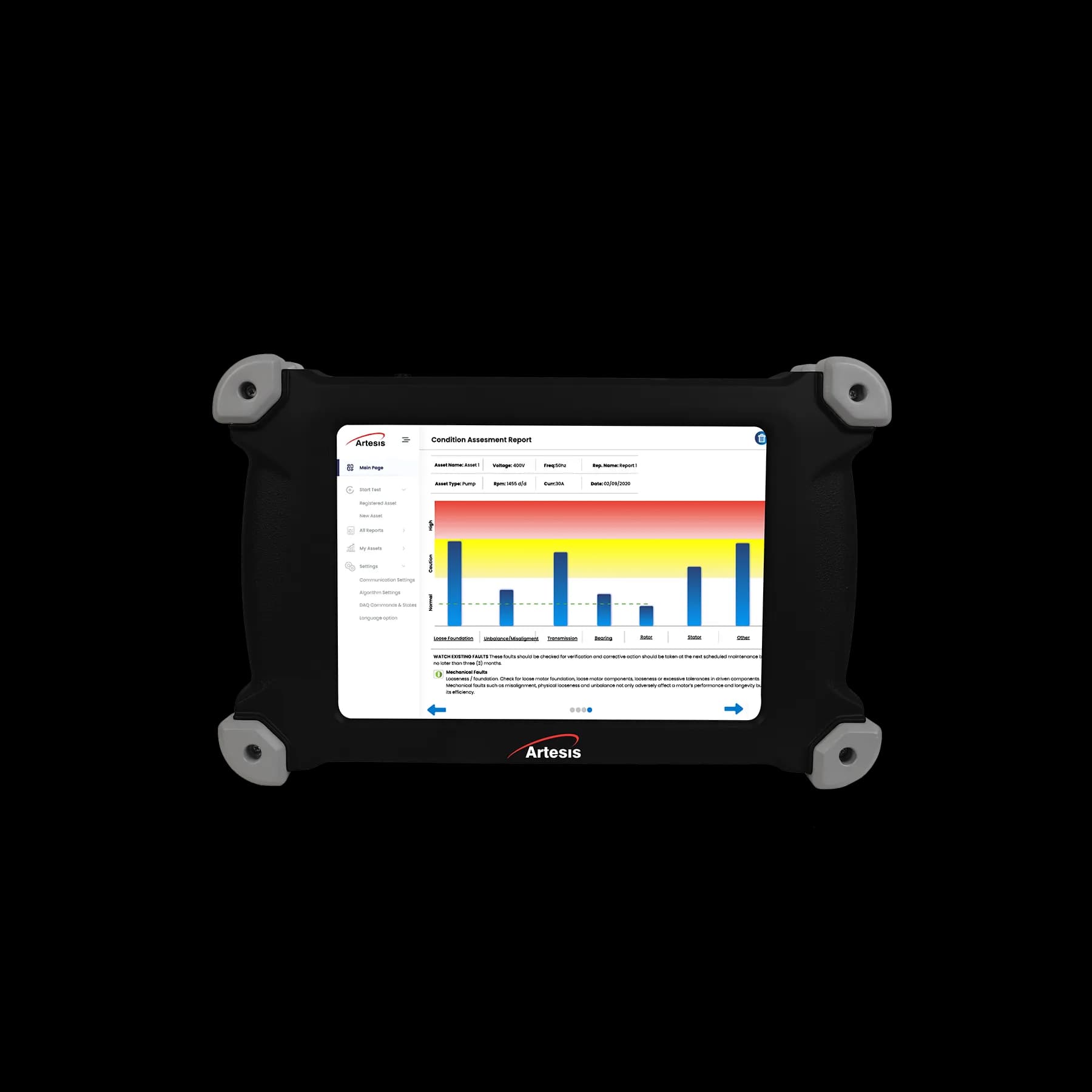
Artesis AMTPro portable motor tester
Assess motors and driven equipment from cabinet current and voltage. Review test conditions, report categories and AMTPro configuration for a site survey.
What justifies rejecting the motor
AMT Pro produces a rating and a defect list. Agree the acceptance criteria in advance and write them into the order:
- the electrics must show no defects that did not exist before the repair;
- the defects the repair was for must disappear;
- for bearings, ultrasound readings must be no worse than the reference for this type and mode.
Specific thresholds depend on the machine. We do not give universal numbers: the instrument supplier and your reliability engineer should set them from the first measurements.
Common mistakes
- No test before repair. Nothing to compare, and the dispute with the contractor goes by impressions.
- Different modes before and after. The difference is explained by load rather than a defect.
- Checking with current only. A bearing installation error will not show in an electrical test.
- Baseline not saved. Half a year later you start from scratch.
What you need
- Artesis AMT Pro: 7 minutes per test, portable, suited to acceptance and baseline measurements.
- SDT340: ultrasonic instrument for bearings, lubrication and leaks.
KEG TRK supplies both instruments in Kazakhstan and runs on-site demonstrations. Price on request. If you repair many motors, start with one shop: three or four machines a month will give baselines and show where the repair shop errs most often.
See also: Artesis three-level PdM strategy, How to check a motor bearing without disassembly.
Frequently asked questions
Equipment in this article
KEG TRK quotes prices and delivery times to Kazakhstan on request. We will prepare a commercial offer for your application.
Artesis AMTPro portable motor tester
Assess motors and driven equipment from cabinet current and voltage. Review test conditions, report categories and AMTPro configuration for a site survey.
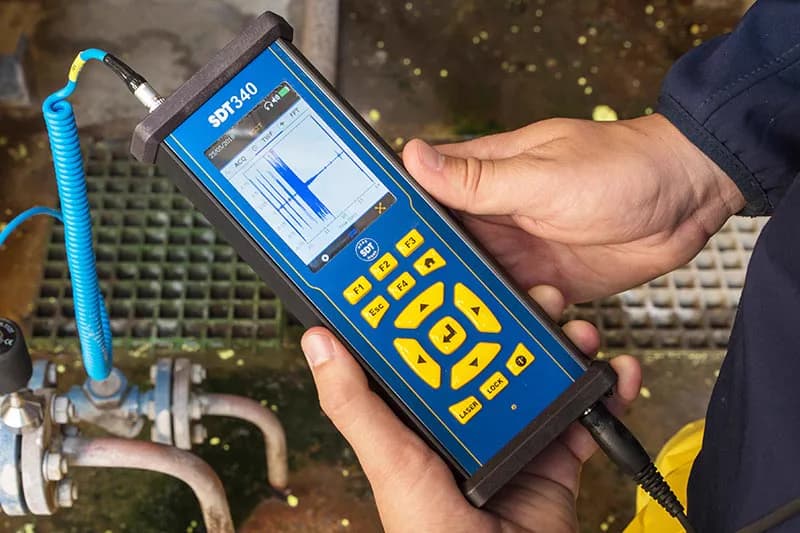
SDT340 - Advanced Ultrasound Detector
The most advanced ultrasound detector for collecting, analysing and trending data
Read also
8/24/2026
Artesis OmniSight: investigating an electrical signature alarm
Compare a motor spectrum with operating load, test a fault hypothesis and decide when portable AMTPro measurements or continuous monitoring are appropriate.
6/30/2026
Multi-site monitoring with Artesis OmniSight: a pilot plan
Scope a two-site OmniSight pilot: map monitored assets, assign responsibility for alarms and verify a maintenance outcome before extending coverage.
6/30/2026
Three-Tier Artesis PdM: AMT Pro → e-MCM/e-PCM → IoT
Build predictive maintenance without a big-bang project: AMT Pro route on the full fleet, online on critical assets, IoT for multi-site corporate reporting.