
Lubrication savings in money: a cement plant calculation before and after SDT
A model cement plant with 600 grease points: what it looked like on schedule-based greasing, what changes after moving to condition-based lubrication with SDT ultrasound, and what that is worth in dollars in three scenarios. Inputs come from real SDT case studies.
In this article
LUBExpert with a grease gun: the sensor transmits the asset signal so its response to added grease can be assessed.
SDT Ultrasound SolutionsPrepared by the KEG TRK team · How we prepare our content
In How much money does precise lubrication save we covered what open sources show. Here we take the next step: a model enterprise, and a calculation in money of what changes before and after moving to condition-based lubrication with SDT ultrasound. The calculation is a model, but its benchmarks come from real SDT case studies.
Setup: the plant and assumptions
The plant is a model cement plant: crushers, mills, fans, conveyors, gearboxes. Cement was chosen because it has a lot of rotating equipment, dust and expensive stoppages.
| Parameter | Value |
|---|---|
| Grease points (bearings) | 600 |
| Bearing failures in rotating equipment per year | 24 |
| Share of failures linked to lubrication | about 40%, so about 10 failures (sources give 36-80%; SKF's 36% refers to premature failures) |
| Greasing before | 40 g per point, 13 times a year (every 4 weeks) |
| Grease price | 10 dollars per kg |
These inputs are invented for the calculation. Replace them with your own.
What real SDT case studies show
Benchmarks for the model come from SDT Ultrasound Solutions case studies:
- Paper mill. A dryer roll received 40 g every 4 weeks. After moving to ultrasound-guided lubrication the first shot was 20 g (50% less), the next 25 g. A bearing that had failed before the program cost 16,000 Canadian dollars (about 10,865 euros), plus 8 hours of labor and lost production during replacement. Full breakdown: paper mill case study with LUBEChecker.
- Cement plant, cooling fan. The schedule was 50 g every two weeks per bearing. After moving to condition-based lubrication the latest shots were 16 g and 14.4 g, 68-71% less. Two bearings with developing defects were replaced at a planned stop, avoiding an unplanned outage.
- Fans, norm-based greasing. The calculated amount was 13 g per bearing every 4,000 hours; measurement showed 5.2-6.5 g was needed, 50-60% less.
- Water treatment plant. One lubrication technician served about 700 bearings, 35-40 bearings per shift. In Q4 2020 against Q4 2019 bearing failures dropped noticeably and there were no lubrication-related failures. The case gives no money estimate.
What can be concluded: grease use falls 50-70%, and one serious failure costs on the order of 11,000 euros or more. Money itself is almost absent from the cases: a cost appears in only one.
Equipment covered in this article
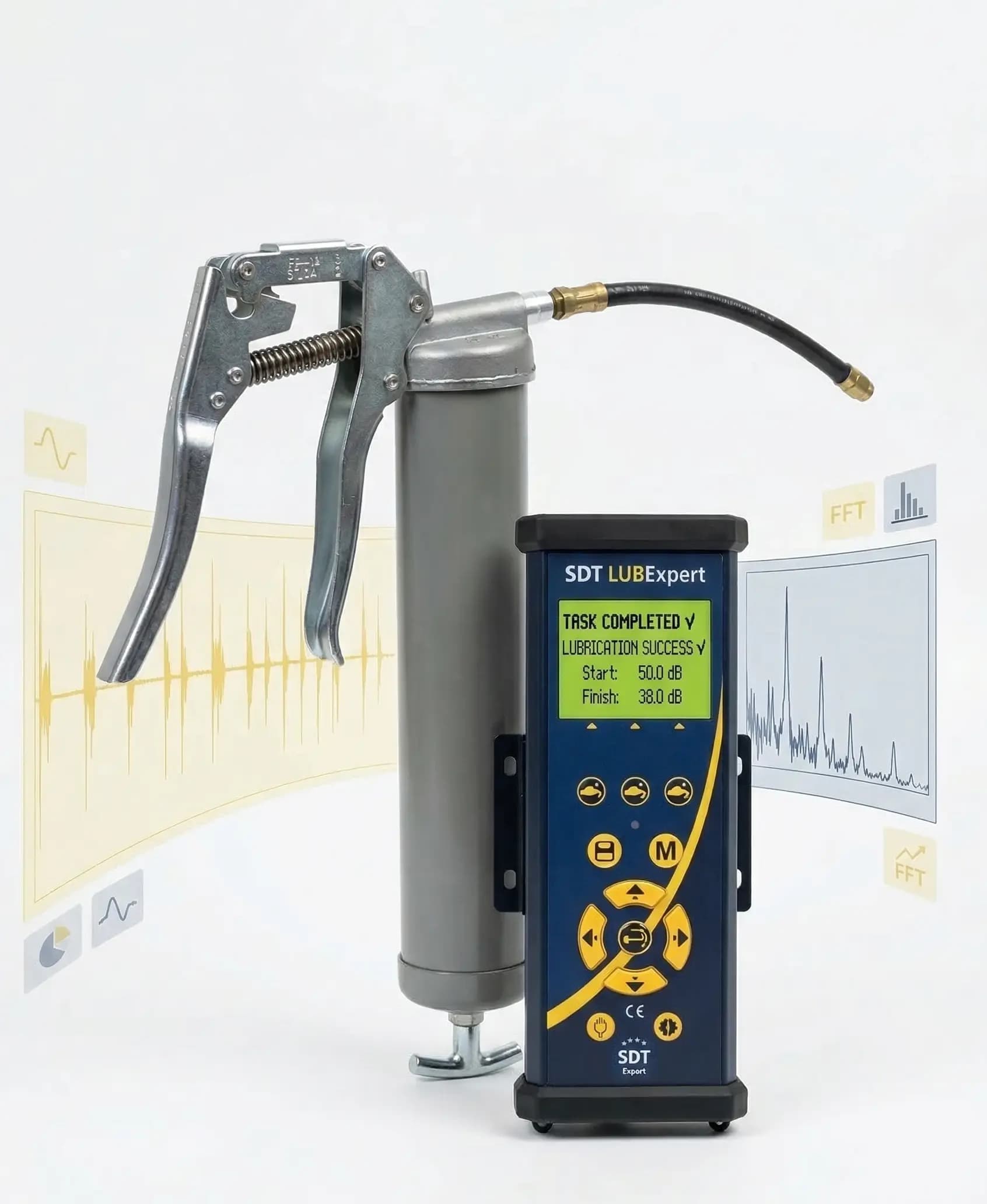
LUBExpert — SDT Ultrasound Bearing Lubrication Assistant
SDT instrument for precision ultrasound-guided greasing of rolling element bearings: tells you when to add grease and when to stop, follows routes from UAS3 and closes…
The plant before
- Calendar greasing: 40 g per point every 4 weeks, 600 points, 13 visits a year.
- Annual use: 600 x 13 x 40 g = 312 kg, about 3,120 dollars.
- Some bearings get too much grease, some too little. In a study cited by SDT, about 70% of bearings were over-greased, 15% under-greased and only 15% greased correctly.
- Failures: about 10 of 24 are lubrication-related. They become known when the machine has already stopped.
The plant after
- Greasing by measurement: before and after each shot the operator sees the ultrasound level and decides whether grease is needed. The principle is in How often to grease bearings.
- Bulk points are covered by operators with LUBEChecker, critical assets by a specialist with the SDT340 in LUBExpert mode, hard-to-reach points by LUBExpert ON-GUARD.
- Bearings with a defect that grease does not cure show up in the data and are replaced at a planned stop.
The calculation in money: three scenarios
We run three cases to show the spread. The conservative scenario is deliberately milder than the real case studies.
| Line | Conservative | Base | Optimistic |
|---|---|---|---|
| Grease use reduction | 30% | 50% | 70% |
| Grease saving per year | 936 dollars | 1,560 dollars | 2,184 dollars |
| Failures prevented per year | 3 | 5 | 7 |
| Cost of one failure | 5,000 dollars | 15,000 dollars | 25,000 dollars |
| Failure saving per year | 15,000 dollars | 75,000 dollars | 175,000 dollars |
| Total per year | 15,936 dollars | 76,560 dollars | 177,184 dollars |
The cost of a failure is the bearing and labor, downtime hours and collateral damage. In the paper mill case one such failure cost about 11,000 euros before counting lost production, so the base value of 15,000 dollars for a cement plant is not inflated.
Almost all the saving comes from failures: in the base scenario grease is 2% of the total. This is not a flaw of the method but a pattern: grease is cheap, stoppages are expensive.
Payback
SDT kit prices depend on configuration and delivery terms, so below is an illustrative program budget (equipment, training, implementation). It is not a price list or an offer.
| Program budget | Conservative | Base | Optimistic |
|---|---|---|---|
| 30,000 dollars | 22.6 months | 4.7 months | 2.0 months |
| 60,000 dollars | 45.2 months | 9.4 months | 4.1 months |
In the conservative scenario with the larger budget the program pays back in 3-4 years, which is a weak argument. So where stoppages are cheap and failures rare, condition-based lubrication is mainly about order and safety, not fast payback.
What the calculation leaves out
- Labor. Measuring before and after each shot takes time, so labor is treated as neutral. A gain is possible if visits to healthy machines are dropped, but a pilot must confirm it.
- Energy. Bearings over-filled with grease run hot and draw more power. The effect is usually small and counted separately.
- Safety and environment. Failures at height, grease leaks, disposal.
- Bearing life and spares. Fewer failures also mean fewer spare parts.
- Indirect production losses. If a stop disrupts shipments, a failure costs more.
How to carry the calculation to your plant
- Take the bearing failure report for 2-3 years and mark which failures were lubrication-related.
- For each failure work out the cost: bearing, labor, downtime hours x cost per hour, damage.
- Measure annual grease use and number of visits.
- Run a pilot on 20-30 bearings of different types and compare grease use and signal trends over 3-6 months.
- Put the results into the table.
KEG TRK supplies SDT ultrasound equipment in Kazakhstan and can help calculate a pilot for your bearing fleet. Price on request.
Sources
- SDT Ultrasound Solutions. Success Stories: Precision Lubrication with LUBExpert (paper mill).
- SDT Ultrasound Solutions. Success Stories: Bearing Grease Management using Ultrasound.
- SDT Ultrasound Solutions. Success Stories: Time-Based greasing. Sure?
- SDT Ultrasound Solutions. Success Stories: Diagnosing Bearing Failure with LUBExpert Static and Vibration (cement plant).
- SDT Ultrasound Solutions. Success Stories: We succeeded, what is next? (water treatment plant).
- Reliability Solutions. The Real Cost of Poor Bearing Lubrication: https://reliabilitysolutions.net/articles/poor-bearing-lubrication-costs-downtime-energy-replacement/
- Calculation model: the authors' assumptions, not data from a specific plant.
Frequently asked questions
Equipment in this article
KEG TRK quotes prices and delivery times to Kazakhstan on request. We will prepare a commercial offer for your application.
LUBExpert — SDT Ultrasound Bearing Lubrication Assistant
SDT instrument for precision ultrasound-guided greasing of rolling element bearings: tells you when to add grease and when to stop, follows routes from UAS3 and closes…
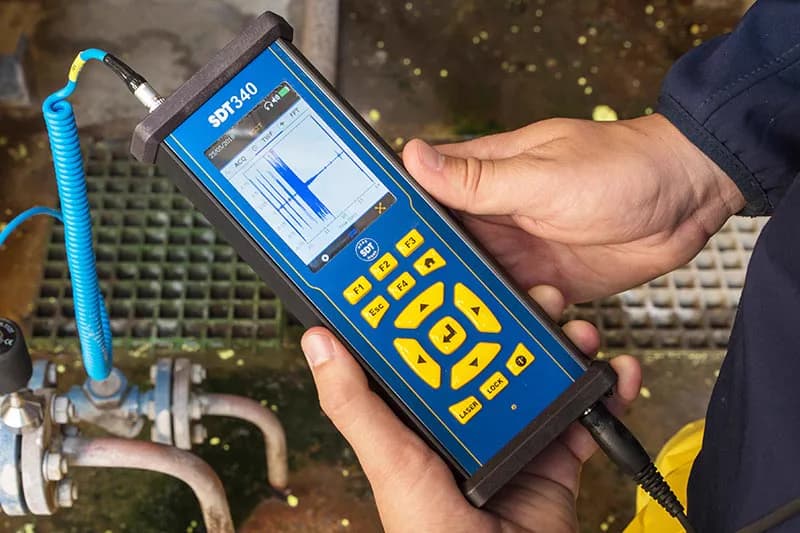
SDT340 - Advanced Ultrasound Detector
The most advanced ultrasound detector for collecting, analysing and trending data
Also in this article: LUBEChecker - Bearing Lubrication Control, LUBExpert ON-GUARD - Automatic Bearing Lubrication System
Read also
10/14/2026
What lubrication programs delivered at real plants: public case studies with numbers
Woodgrain, Owens Corning, a grain mill and others: what the plants themselves report in money after moving to managed lubrication, what can be checked, and which figures are better not to repeat.
10/12/2026
Downtime, efficiency and people: what ultrasound-guided precision lubrication delivers
Energy savings are not the only argument for condition-based lubrication. How LUBEChecker, the SDT340 in LUBExpert mode and LUBExpert ON-GUARD cut downtime, free up specialists and make greasing a task for the whole shift.
10/12/2026
How much money does precise lubrication save: what open sources show and how to calculate it for your plant
There is no single savings figure for condition-based lubrication. We separate the data in open sources that can be checked from the claims that cannot, show where money is really lost and how to calculate the effect for your own bearings.