
Downtime, efficiency and people: what ultrasound-guided precision lubrication delivers
Energy savings are not the only argument for condition-based lubrication. How LUBEChecker, the SDT340 in LUBExpert mode and LUBExpert ON-GUARD cut downtime, free up specialists and make greasing a task for the whole shift.
In this article
Prepared by the KEG TRK team · How we prepare our content
Precision lubrication is usually pitched on energy and grease consumption. For a plant, the more pressing questions are how many hours of downtime were avoided and what the people who used to walk a grease-gun route are doing instead. This article covers those two arguments, based on an October 2026 SDT Ultrasound Solutions piece, and separates hard numbers from estimates.
The cost of unplanned downtime
The Siemens study "The True Cost of Downtime 2024" (prepared with Senseye) puts the losses of the world's largest industrial companies like this:
| Metric | Value |
|---|---|
| Annual loss from unplanned stoppages (Fortune Global 500) | about 1.4 trillion dollars, roughly 11% of revenue |
| 2021 estimate | 864 billion dollars, a 62% increase |
| Average downtime at a large plant | about 360 hours a year |
| Companies with at least one unplanned stoppage in three years | 82% |
For the US the totals are smaller but the point is the same: about 50 billion dollars a year for industrial manufacturers, with the average plant losing 5-20% of annual productivity.
These are aggregate figures built with different methods, so they cannot be carried over to a specific workshop. They show the order of magnitude. For your own case you need your own data: the hourly cost of a line stoppage and the number of bearing-related stops per year.
Bearings and seals are among the largest sources of unplanned stops, alongside shaft imbalance and misalignment. SDT points out that a large part of bearing wear traces back to lubrication, with studies putting its share of failures between 36% and 80%. A range this wide honestly says there is no precise figure. The conclusion is the same either way: calendar greasing is a cheap lever on an expensive problem. Why the calendar fails is covered in How often to grease bearings.
Efficiency: fewer rounds, more analysis
SDT describes a slow-speed ball mill bearing: 1,600 mm outside diameter, 18.6 rpm. After moving to condition-based lubrication with LUBExpert, the plant tripled the interval between condition-monitoring data collection runs. Greasing moved to a 14-day cycle justified by measurements, and fault detectability did not drop. The freed specialist hours went to covering more assets and deeper analysis.
This is one plant's example, not a guaranteed result. The logic holds generally, though: when the greasing decision rests on a measurement rather than a schedule, pointless visits to healthy machines disappear.
There is also an organizational problem. Condition monitoring and lubrication are usually run by different people, on different schedules, in different records. The LUBExpert mode in the SDT340 combines them in one instrument and one database: every grease shot, grease type and friction reading is tied to the asset's condition history. More on the mode: SDT340 in LUBExpert mode.
Equipment covered in this article
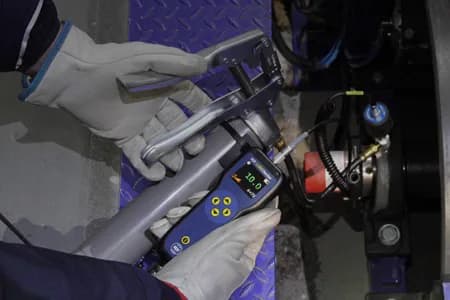
LUBEChecker - Bearing Lubrication Control
Portable detector that doses bearing grease by the real-time ultrasound friction signal
People: who does what
The shortage of skilled maintenance staff affects nearly every industry. SDT addresses it by splitting roles, not by replacing people with automation.
LUBEChecker for the operator. The instrument turns the expert skill of listening to a bearing into an objective decibel reading. A trained operator can grease by condition on a daily round. It is part of SDT's Operator-Driven Lubrication, within the wider Operator-Driven Safety and Reliability approach. A plant example: the paper mill case study.
SDT340 in LUBExpert mode for the technician. One instrument replaces several: high-resolution ultrasound, vibration and tachometer. Guided work orders reduce errors and missed steps. Time waveform recordings, condition indicators and trends remain available for deeper analysis.
LUBExpert ON-GUARD for hazardous points. The system is meant for bearings at height or in hard-to-reach and hazardous areas, where manual lubrication is riskiest and most often skipped. Technicians are freed from repetitive and unsafe routes to focus on diagnosis and root causes. Design and layouts: LUBExpert ON-GUARD.
The result: operators get a tool for routine greasing, specialists get diagnostic depth, and people leave the riskiest places. A human still makes the decisions.
Other arguments for precision lubrication
- Energy. Motor-driven systems are estimated to use 69-72% of industrial electricity, and friction accounts for about 20% of global energy use (Holmberg and Erdemir, 2017). Managing bearing friction is one efficiency lever.
- Motor reliability. Bearing problems cause 50-65% of motor failures.
- Regulation. EU Directive 2023/1791 on energy efficiency sets energy audit and energy management system obligations phased in through October 2026 and October 2027. Detailed, measurement-backed lubrication logs suit that reporting. For Kazakhstan this is a reference point: the directive does not apply directly, but exporters to the EU meet its requirements.
Where to start
- List your critical bearings and work out the cost of an hour of downtime for each machine.
- Check who is responsible for greasing and who for monitoring today, and how their records connect.
- Start with one area: operator rounds with LUBEChecker on bulk points, the SDT340 for specialists, ON-GUARD for unreachable points.
- After 2-3 months compare grease consumption, failure count and hours spent on rounds.
KEG TRK supplies SDT ultrasound equipment in Kazakhstan and helps select a kit for your machine park. Price on request.
Sources
- SDT Ultrasound Solutions. Downtime, Efficiency, and Workforce Empowerment: The Human Side of Precision Lubrication, 2026: https://sdtultrasound.com/2026/10/01/downtime-efficiency-and-workforce-empowerment-the-human-side-of-precision-lubrication/
- Siemens, Senseye. The True Cost of Downtime, 2024.
- Holmberg K., Erdemir A. Influence of tribology on global energy consumption, costs and emissions. Friction, 2017.
- IEA 4E. Studies on energy use of motor-driven systems, 2026.
Frequently asked questions
Equipment in this article
KEG TRK quotes prices and delivery times to Kazakhstan on request. We will prepare a commercial offer for your application.
LUBEChecker - Bearing Lubrication Control
Portable detector that doses bearing grease by the real-time ultrasound friction signal
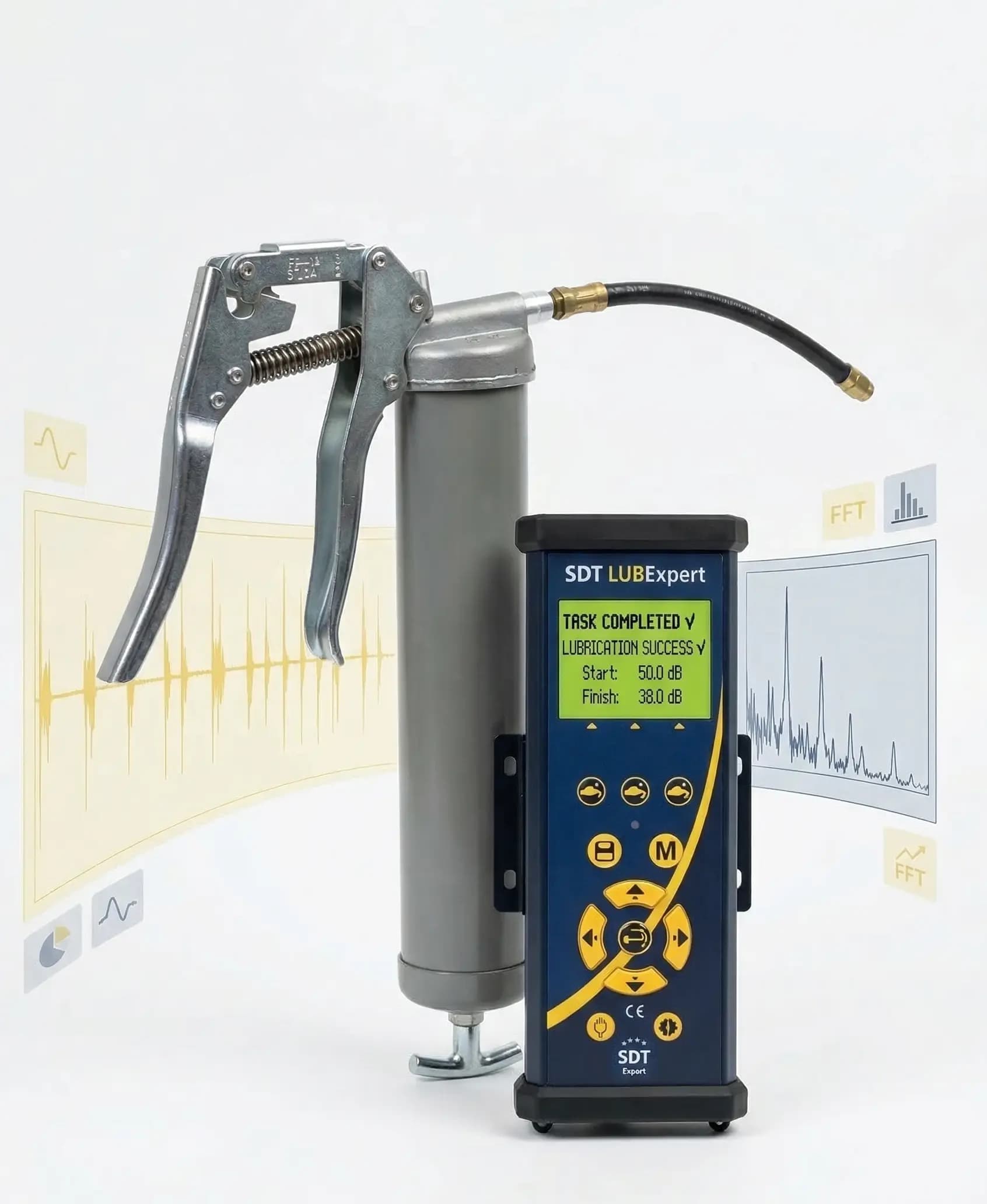
LUBExpert — SDT Ultrasound Bearing Lubrication Assistant
SDT instrument for precision ultrasound-guided greasing of rolling element bearings: tells you when to add grease and when to stop, follows routes from UAS3 and closes…
Also in this article: SDT340 - Advanced Ultrasound Detector, LUBExpert ON-GUARD - Automatic Bearing Lubrication System
Read also
10/14/2026
What lubrication programs delivered at real plants: public case studies with numbers
Woodgrain, Owens Corning, a grain mill and others: what the plants themselves report in money after moving to managed lubrication, what can be checked, and which figures are better not to repeat.
10/12/2026
How much money does precise lubrication save: what open sources show and how to calculate it for your plant
There is no single savings figure for condition-based lubrication. We separate the data in open sources that can be checked from the claims that cannot, show where money is really lost and how to calculate the effect for your own bearings.
7/25/2026
Automatic vs manual bearing lubrication: which to choose
A comparison of manual route lubrication, time-based lubricators and condition-based automatic lubrication. When a grease gun is enough and when you need ON-GUARD.