
How much money does precise lubrication save: what open sources show and how to calculate it for your plant
There is no single savings figure for condition-based lubrication. We separate the data in open sources that can be checked from the claims that cannot, show where money is really lost and how to calculate the effect for your own bearings.
In this article
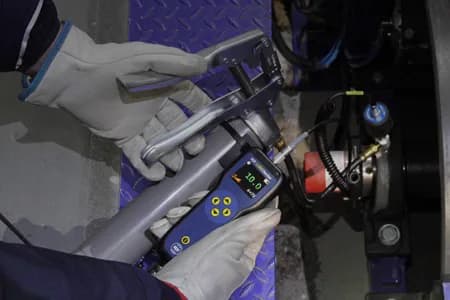
LUBExpert with a grease gun: the sensor transmits the asset signal so its response to added grease can be assessed.
SDT Ultrasound SolutionsPrepared by the KEG TRK team · How we prepare our content
"How much money does precise lubrication save?" is the most common question and the worst answered. Marketing materials quote "up to 50%" and "ROI of several times" without a method. We went through open sources and separated what can be checked from what cannot. The result: there is no universal figure, but there is a clear calculation model you can fill with your own data.
What is reliably known
Friction and wear are expensive at the scale of the economy. In a 2017 review (Friction journal), Holmberg and Erdemir estimated that about 23% of global energy use is tied to friction and wear: roughly 20% to overcome friction and 3% to remanufacture worn parts. They calculated that applying modern tribology could cut these losses by about 18% in 8 years and 40% in 15 years, which in the long run equals about 1.4% of global GDP a year. An important caveat: this covers all of tribology (materials, coatings, design, lubricants), not only bearing lubrication in a plant.
The idea is not new. The 1966 Jost Report in the UK estimated potential annual savings from better friction and wear management at 515 million pounds, about 1.3% of the country's GDP. The figure is known from secondary retellings; check the original before citing.
Condition-based maintenance is cheaper than a schedule. The US Department of Energy O&M Best Practices Guide gives a benchmark: predictive maintenance cuts costs by 8-12% compared with a preventive program, and can exceed 30-40% savings compared with run-to-failure. We saw these figures in secondary coverage of the guide, not in the document itself, so check the wording before quoting.
What is known about lubrication specifically
- Lubricants are cheap. According to suppliers and consultants, lubrication is only 1-3% of the maintenance budget, while lubrication-related failure losses at weak performers reach about 18% of the budget. The sources are commercial, but the order of magnitude agrees: the money is in failures, not in grease.
- Over-greasing is widespread. In a trial on bearings greased at fixed rates, SDT reports that about 70% received more grease than needed, 15% less, and only 15% were at the correct rate. The trial operator and bearing count are not named, so this is an illustration, not statistics.
- A consumption example. On a paper mill dryer roll, a bearing was greased 40 g every 4 weeks by schedule. Under ultrasound guidance the first shot was 20 g, and the signal fell from 14.1 to 12.2 dBuV. It is one bearing, but it shows the mechanism of the saving. A similar plant breakdown: paper mill case study with LUBEChecker.
- Effect on failures. A mineral processing plant, as reported by a grease supplier, cut roller bearing failures from 114 to 24 in a year. At 1,450 dollars per replacement including labor, that is about 196,000 dollars. This is a supplier report on a change of grease brand, not an independent study.
What we could not find in the open: independent studies measuring dollar savings specifically from ultrasound-guided lubrication. The honest conclusion: the mechanism is confirmed, and the scale at your plant has to be measured.
Equipment covered in this article
LUBEChecker - Bearing Lubrication Control
Portable detector that doses bearing grease by the real-time ultrasound friction signal
What the saving is made of
| Line | How to calculate |
|---|---|
| Grease | annual grease use x price x share reduced |
| Labor | points x visits per year x time per visit x rate x share reduced |
| Avoided failures | lubrication-related failures per year x share avoided x cost of one failure |
| Energy | over-greased bearings run hot and draw more power; the effect is usually small and counted separately |
Cost of one failure = bearing and labor + cost of downtime hours + damage to shaft, housing and seals. Take the hourly downtime cost from finance: it moves the result more than anything else. Why over-greasing also destroys bearings is covered in Over-greasing bearings: hidden consequences.
Worked example (assumptions are illustrative)
All inputs below are invented for illustration. Substitute your own.
- 300 grease points, 12 bearing failures a year, about 40% of them lubrication-related, so 5 failures
- cost of one failure: bearing and labor 1,450 dollars plus 8 hours of downtime at 5,000 dollars, 41,450 dollars in total
- annual grease use 1,000 kg at 15 dollars per kg, so 15,000 dollars
- rounds: 300 points x 12 times x 10 minutes = 600 hours a year at 15 dollars
Assume condition-based lubrication cuts grease use by 30%, rounds by half, and lubrication-related failures by 2 a year:
| Line | Annual saving |
|---|---|
| Grease (30% of 15,000) | 4,500 dollars |
| Labor (300 hours x 15) | 4,500 dollars |
| Two avoided failures (2 x 41,450) | 82,900 dollars |
| Total | about 91,900 dollars |
Nearly 90% of the effect comes from avoided failures, not from saved grease. If downtime on your line is cheap, the total will look very different. That is why the same system pays back in months in continuous production and more slowly where a stop costs little.
How to get your own number
- Pick a pilot group of 20-30 bearings of different types.
- Record before the change: grease use over 6-12 months, number of visits, lubrication-related failures.
- Introduce condition-based lubrication: measurement before and after each shot, for example with the SDT340 in LUBExpert mode or LUBEChecker for operator rounds. The principle is described in How often to grease bearings.
- After 3-6 months compare grease use and labor. Failures on a small sample show the effect slowly, so use signal trends and records of defects found instead.
- Scale the table above to the whole machine park.
KEG TRK supplies SDT ultrasound equipment in Kazakhstan and can help assess a pilot. Price on request.
Sources
- Holmberg K., Erdemir A. Influence of tribology on global energy consumption, costs and emissions. Friction, 2017, vol. 5, pp. 263-284: https://link.springer.com/article/10.1007/s40544-017-0183-5
- Jost H.P. Lubrication (Tribology): A report on the present position and industry's needs. HMSO, London, 1966 (figures from secondary retellings).
- U.S. Department of Energy. Operations and Maintenance Best Practices Guide, Release 3.0 (figures from secondary retellings).
- SDT Ultrasound Solutions. Bearing Grease Management using Ultrasound (also published by Ludeca and Maintworld): https://ludeca.com/blog/lubrication/10732/bearing-grease-management-using-ultrasound/
- SDT Ultrasound Solutions. Materials on lubrication with LUBEChecker and LUBExpert at a paper mill.
- Reliability Solutions. The Real Cost of Poor Bearing Lubrication: https://reliabilitysolutions.net/articles/poor-bearing-lubrication-costs-downtime-energy-replacement/
Frequently asked questions
Equipment in this article
KEG TRK quotes prices and delivery times to Kazakhstan on request. We will prepare a commercial offer for your application.
LUBEChecker - Bearing Lubrication Control
Portable detector that doses bearing grease by the real-time ultrasound friction signal
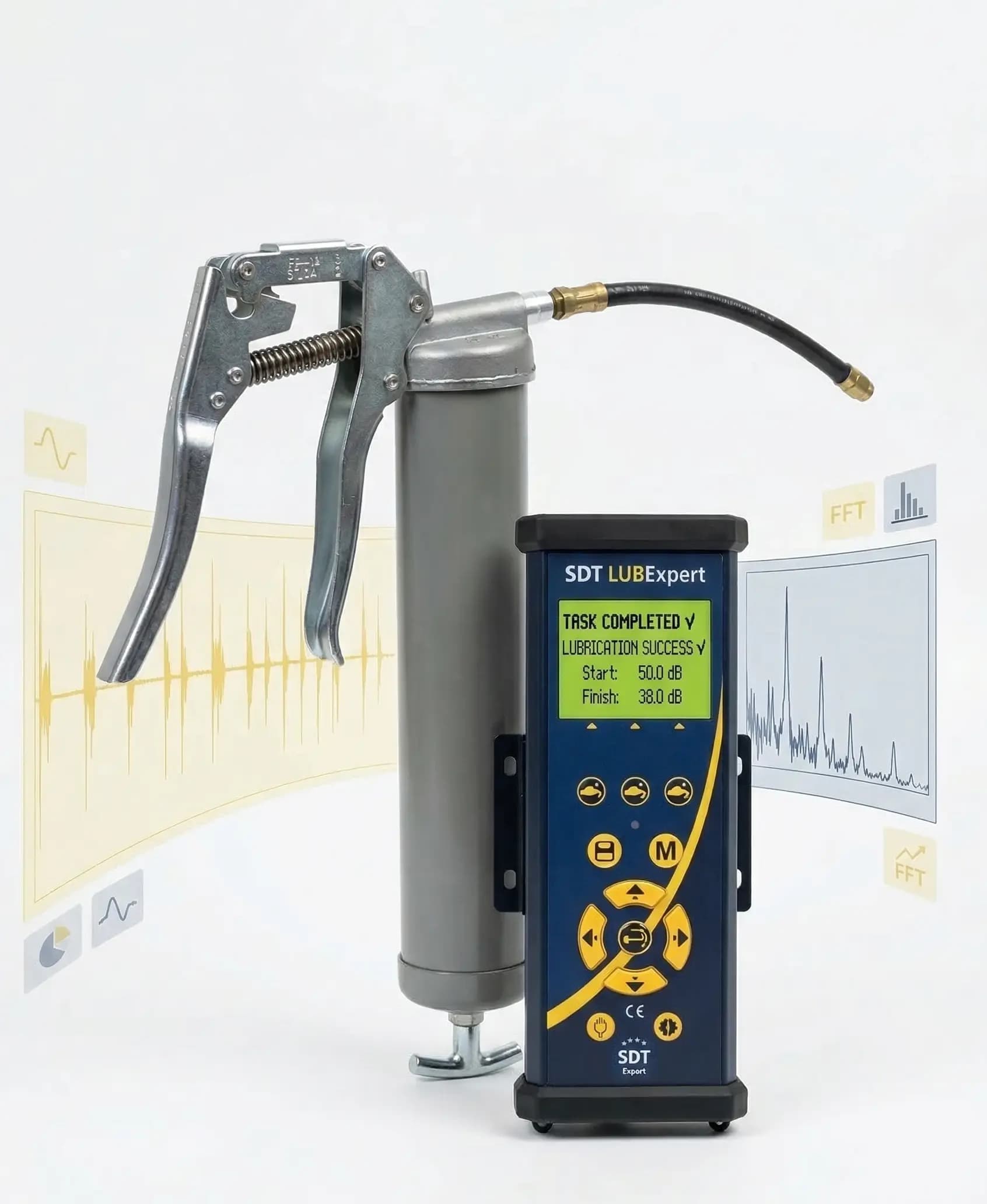
LUBExpert — SDT Ultrasound Bearing Lubrication Assistant
SDT instrument for precision ultrasound-guided greasing of rolling element bearings: tells you when to add grease and when to stop, follows routes from UAS3 and closes…
Also in this article: SDT340 - Advanced Ultrasound Detector
Read also
10/12/2026
Downtime, efficiency and people: what ultrasound-guided precision lubrication delivers
Energy savings are not the only argument for condition-based lubrication. How LUBEChecker, the SDT340 in LUBExpert mode and LUBExpert ON-GUARD cut downtime, free up specialists and make greasing a task for the whole shift.
7/25/2026
What Is Acoustic Bearing Lubrication — and Why It Beats the Calendar
In plain language: acoustic (ultrasonic) lubrication means adding grease based on friction level, not only the date in the PM schedule. How it works and who it is for.
10/14/2026
What lubrication programs delivered at real plants: public case studies with numbers
Woodgrain, Owens Corning, a grain mill and others: what the plants themselves report in money after moving to managed lubrication, what can be checked, and which figures are better not to repeat.