
Photoionization detector (PID): how it works and what it measures
A PID exposes the sample to UV light and measures the ion current. It sees compounds with ionization energy below the lamp energy (10.0-11.7 eV): aromatics, solvents, fuels. Not methane.
In this article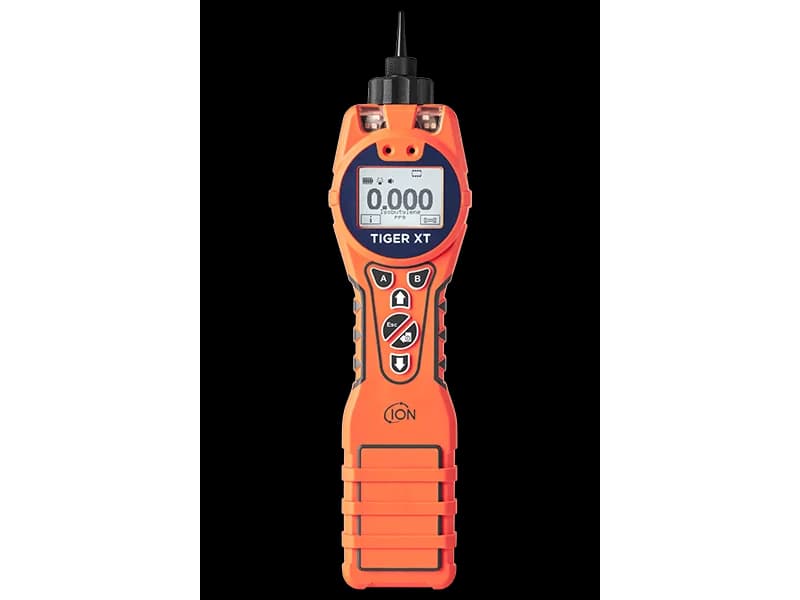
Prepared by the KEG TRK team · How we prepare our content
A photoionization detector (PID) passes an air sample past an ultraviolet lamp. The photons knock electrons out of molecules whose ionization energy is below the lamp energy (10.0, 10.6 or 11.7 eV), and the instrument measures the resulting current. A PID sees aromatics, solvents, fuels, hydrogen sulfide and ammonia, but not methane. Readings are given relative to isobutylene.
Below, in order: how the sensor is built, which compounds it sees, how to convert a reading to a specific gas, and what distorts the result. Choosing instruments for leak detection and LDAR programmes is covered in the article "Gas and VOC leak detection: Ion Science PID detectors"; this one is about the method itself.
How a PID sensor works
- Sampling. A pump or diffusion brings air to the sensor. According to Ion Science, about 1% of the sample passes through a membrane filter into the ionization chamber.
- Ionization. A UV lamp illuminates the chamber. If the photon energy exceeds the ionization energy of a molecule, the molecule loses an electron and becomes a positive ion.
- Ion collection. A voltage is applied between electrodes; ions and electrons move towards them and a current flows.
- Conversion. The current is proportional to the concentration of ionizable compounds. The instrument is calibrated with a known concentration of isobutylene and displays the result in ppm or ppb.
Nitrogen, oxygen and carbon dioxide give no response, so a PID works directly in air. The sensor consumes no chemical reagents, but the lamp window gets contaminated over time and needs cleaning (more on this below).
Lamp energy and the ionization energy rule
The core rule of the method: a PID sees a compound only if the lamp's photon energy is higher than the ionization energy (IE) of that compound.
| Lamp | Who makes it | What it means in practice |
|---|---|---|
| 9.8 eV | RAE Systems (separate column in the TN-106 table) | Only compounds with IE below 9.8 eV |
| 10.0 eV | Ion Science (MiniPID 2 10.0 eV) | Largely screens out aliphatic hydrocarbons, leaving total aromatics (TAC mode) |
| 10.6 eV | Ion Science, RAE | Standard lamp: most volatile organic compounds, plus hydrogen sulfide and ammonia |
| 11.7 eV | Ion Science, RAE | Adds high-IE compounds: methanol, formaldehyde, chloroform, ethane, propane |
An example from Ion Science's TA-02 table: a 10.6 eV lamp measures hydrogen sulfide (IE 10.46 eV) and everything with a lower IE, but cannot see methanol (IE 10.85 eV). Methanol needs an 11.7 eV lamp.
The rule has caveats. RAE Systems notes in TN-106 that high-boiling ("heavy") compounds may give little response because they do not vaporize enough, even though their IE is below the lamp energy. Some inorganic compounds, such as nitrogen dioxide and hydrogen peroxide, give a weak response even with a low IE.
Equipment covered in this article
Ion Science Tiger XT — handheld PID detector for volatile organic compounds
Intrinsically safe Ion Science photoionisation detector for over 750 volatile organic compounds: 1 ppb to 20,000 ppm, T90 under 2 s, Fence Electrode technology against…
Which compounds a PID sees and which it does not
The table gives ionization energy and response factor (RF) from Ion Science's TA-02 table (13 March 2026 edition). "None" means zero response.
| Compound | IE, eV | RF, 10.0 eV | RF, 10.6 eV | RF, 11.7 eV |
|---|---|---|---|---|
| Isobutylene (calibration gas) | 9.24 | 1 | 1 | 1 |
| Benzene | 9.24 | 0.54 | 0.5 | 0.53 |
| Toluene | 8.82 | 0.6 | 0.56 | 0.55 |
| m-Xylene | 8.56 | 0.53 | 0.47 | 0.46 |
| Styrene | 8.40 | 0.52 | 0.45 | 0.5 |
| Gasoline | ~9.9 | 1 | 0.9 | n/a |
| Diesel fuel | ~8.0 | n/a | 0.8 | 0.4 |
| Acetone | 9.69 | 1.2 | 1.17 | 1.7 |
| Hexane | 10.13 | 13 | 4 | 0.6 |
| Ethanol | 10.47 | none | 11 | 3 |
| Hydrogen sulfide | 10.46 | none | 4 | 1.5 |
| Ammonia | 10.18 | n/a | 8.5 | 5.7 |
| n-Butane | 10.63 | none | 40 | 1.5 |
| Methanol | 10.85 | none | none | 2.9 |
| Propane | 11.07 | none | none | 3 |
| Ethane | 11.56 | none | none | 3 |
| Methane | 12.51 | none | none | none |
| Carbon monoxide | 14.01 | none | none | none |
| Water | 12.61 | none | none | none |
Three things follow from the table:
- Aromatics are what a PID sees best. Benzene, toluene and xylenes have an RF of about 0.5 on every lamp, so the sensitivity to them is roughly twice that to isobutylene.
- Light alkanes are almost invisible with a 10.6 eV lamp. n-Butane has an RF of 40; propane and ethane give no response. Only the 11.7 eV lamp sees them.
- No lamp sees methane. Its ionization energy of 12.51 eV is above 11.7 eV, so a PID is not suitable for natural gas or biogas. How to find a methane leak is covered in "Methane leak: what to use to find it".
Response factor and isobutylene calibration
Calibrating for every compound is rarely practical, so a PID is calibrated with isobutylene and the reading is converted with a response factor (RAE documents call it a correction factor, CF):
Compound concentration = isobutylene reading x RF
The Ion Science TA-02 example: anisole with a 10.6 eV lamp has RF 0.59. An isobutylene-calibrated instrument reads 10 ppm, so anisole is 10 x 0.59 = 5.9 ppm. Most instruments let you pick the RF from a built-in library and then display the target compound directly.
If the air contains a mixture
A PID sums the response of all ionizable compounds, so it cannot isolate a single component. If the mixture composition is known, the overall RF is calculated from the mole fractions X and the component factors:
RF of mixture = 1 / (X1/RF1 + X2/RF2 + X3/RF3 + ...)
The Ion Science example: a mixture of 20% anisole (RF 0.59), 30% acetone (RF 1.17) and 50% ethanol (RF 11) gives RF = 1.56. A reading of 100 ppm then means 20 ppm anisole, 30 ppm acetone and 50 ppm ethanol.
Converting ppm to mg/m³
Ion Science gives the formula for 25 °C and 1012 mbar:
mg/m³ = ppm x molecular weight (g/mol) / 24.5
For benzene (78 g/mol), 1 ppm corresponds to about 3.19 mg/m³, the same value as in the NIOSH guide.
Limits of response factors
- Table RFs are guideline values. They depend on electrode design, lamp intensity and conditions. For best accuracy Ion Science recommends calibrating with the target gas in the working concentration range.
- According to RAE Systems, the factors were measured at 50-100 ppm and apply up to about 1000 ppm. Ion Science warns that above a few thousand ppm the non-linearity of the response differs between compounds.
- After exposure to concentrations hundreds of times higher than the measured level, the sensor needs time to clear down, otherwise low readings will be too high.
What distorts readings: humidity, methane, contamination
Humidity and background gases. RAE Systems TN-106 gives data for the MiniRAE: water vapour, methane and methanol reduce the response by about 20% at 15,000 ppm and by about 40% at 30,000 ppm. Ion Science describes the same effect as suppression of the ionizing light by water vapour, methane and CO2.
Current leakage along contaminated walls. Lamp by-products settle on the chamber walls over time. They absorb moisture, a parasitic current appears between the electrodes and the reading drifts. Ion Science estimates the error of conventional PIDs at 90% relative humidity and above at around 60%. Ion Science sensors place an additional Fence Electrode between the main electrodes to block this leakage path.
Lamp window fouling. In the TA-02 table some compounds are flagged as fouling the lamp window or temporarily suppressing sensitivity (for at least 30 minutes after a 100 ppm-min exposure). For such compounds Ion Science advises more frequent bump tests and window cleaning.
Temperature and pressure. RAE recommends calibrating at the same temperature and pressure as the measurements and keeping the instrument no colder than the sample, so that moisture does not condense inside.
ppb or ppm: what sensitivity you need
1 ppm = 1000 ppb. The lower a compound's occupational exposure limit, the more ppb resolution matters: for benzene, for example, the OSHA action level is 0.5 ppm, so you have to measure tenths and hundredths of a ppm. Benzene limits and instruments are covered in "Benzene monitoring at an industrial site".
The difference is clear across Ion Science MiniPID 2 sensors:
| Sensor variant | Lamp | Lower limit | Range |
|---|---|---|---|
| MiniPID 2 PPM | 10.6 eV | 100 ppb | 0-4000 ppm |
| MiniPID 2 PPB | 10.6 eV | 1 ppb | 0 to over 40 ppm |
| MiniPID 2 HS | 10.6 eV | 0.5 ppb | 0 to over 3 ppm |
| MiniPID 2 10.0 eV | 10.0 eV | 5 ppb | 0 to over 100 ppm |
| MiniPID 2 11.7 eV | 11.7 eV | 100 ppb | 0 to over 100 ppm |
The more sensitive the sensor, the lower its upper limit. The portable Tiger XT covers both ranges in one instrument: 1 ppb to 20,000 ppm with a 10.6 eV lamp. With an 11.7 eV lamp its range is up to 9000 ppm, resolution 0.6 ppm, response T90 under 6 s (versus under 2 s with the 10.6 eV lamp).
Getting a correct reading: step by step
- Identify the target compound and look up its ionization energy. If the IE is above 11.7 eV (methane, CO, hydrogen), a PID will not work.
- Choose the lamp: 10.6 eV for most tasks, 10.0 eV for aromatics, 11.7 eV for methanol, formaldehyde, chlorinated solvents and light alkanes.
- Calibrate with isobutylene or the target gas at the same temperature and pressure as on site. Fit every filter you will use during measurements for the calibration too.
- Set the RF of the target compound from the instrument library or convert the reading by hand.
- Allow for background: high humidity or methane lowers readings.
- Bump test before each shift, especially after work with compounds that foul the lamp window.
Which instrument to choose
- Portable surveys, leak detection, confined space entry: Ion Science Tiger XT. 10.0, 10.6 and 11.7 eV lamps, a library of more than 750 compounds, ATEX/IECEx.
- Personal monitor in the breathing zone: Ion Science Cub, 111 g, 10.6 eV and 10.0 eV TAC versions.
- Benzene separately from other hydrocarbons: Ion Science Tiger XT Select with a pre-filter tube.
The first-generation Tiger is no longer presented on the Ion Science website (its address now leads to the Tiger XT), so we do not offer it for new purchases. The GasCheck leak detector works on thermal conductivity, not photoionization, and is not relevant to the tasks in this article. KEG TRK supplies Ion Science instruments in Kazakhstan. Price on request.
Sources
- Ion Science (ION Sense). Technical/Application Article 02: PID Gas Sensor Response Factors, 13 March 2026.
- Ion Science. Cross-sensitivity of photoionization detectors.
- Ion Science. The need for fast VOC detection in safety-critical petrochemical environments.
- Ion Science. Tiger XT Handheld VOC Detector.
- Ion Science. Cub TAC Personal Total Aromatic Compound Gas Monitor.
- RAE Systems. Technical Note TN-106: Correction Factors, Ionization Energies, and Calibration Characteristics, 2010.
- OSHA. 29 CFR 1910.1028 Benzene.
- NIOSH. Pocket Guide to Chemical Hazards: Benzene.
Frequently asked questions
Equipment in this article
KEG TRK quotes prices and delivery times to Kazakhstan on request. We will prepare a commercial offer for your application.
Ion Science Tiger XT — handheld PID detector for volatile organic compounds
Intrinsically safe Ion Science photoionisation detector for over 750 volatile organic compounds: 1 ppb to 20,000 ppm, T90 under 2 s, Fence Electrode technology against…

Ion Science Cub — personal VOC monitor
111 g personal PID monitor from Ion Science: volatile organic compounds up to 5000 ppm with resolution down to 0.001 ppm, a TAC version for benzene, STEL and TWA alarms…
Also in this article: Ion Science Tiger XT Select — handheld benzene detector
Read also
10/23/2026
Benzene monitoring at an industrial site: what to measure with and which limits apply
A standard PID shows total VOCs, not benzene. Benzene is measured selectively: a portable PID with a pre-filter tube or a fixed monitor. Limits: OSHA 1 ppm over 8 h, ACGIH 0.02 ppm, EU 0.2 ppm.
8/24/2026
Gas and VOC Leak Detection on Industrial Sites: Ion Science PID Detectors
How to choose a PID detector for gas and volatile organic compound leaks: Ion Science personal, portable and fixed instruments, LDAR programmes and the pairing with ultrasound.
10/23/2026
Eddy current testing: how it works and where it is used
An AC coil induces eddy currents in metal; a flaw changes them and the coil impedance. The method finds surface cracks, inspects tubes, measures conductivity and coatings. Conductive materials only.