
Benzene monitoring at an industrial site: what to measure with and which limits apply
A standard PID shows total VOCs, not benzene. Benzene is measured selectively: a portable PID with a pre-filter tube or a fixed monitor. Limits: OSHA 1 ppm over 8 h, ACGIH 0.02 ppm, EU 0.2 ppm.
In this article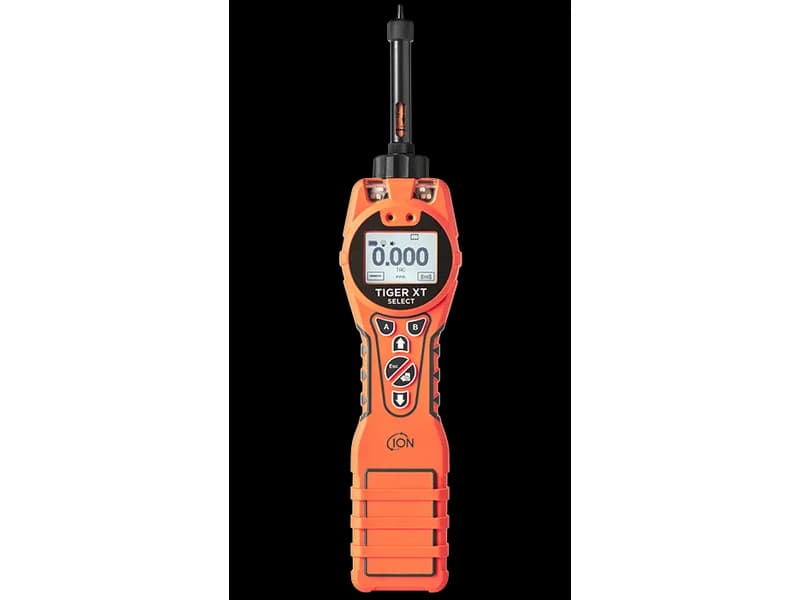
Prepared by the KEG TRK team · How we prepare our content
Benzene cannot be judged from an ordinary PID reading: such an instrument sums all volatile organic compounds. Benzene is measured selectively, with a portable PID and pre-filter tube (Ion Science Tiger XT Select, 0.01-200 ppm) or a fixed monitor (Titan 2, 0.02-20 ppm). Limits: OSHA 1 ppm over 8 hours and 5 ppm over 15 minutes, ACGIH 0.02 ppm, and in the EU 0.2 ppm from April 2026.
Below: why a total-VOC PID does not work, which limits apply, which instruments give benzene specifically, and how to set up monitoring. How the photoionization detector itself works is covered in "Photoionization detector (PID): how it works".
Why a total-VOC PID does not show benzene
A PID is not selective. Ion Science states plainly that a photoionization detector cannot measure individual components of a mixture. It shows one number that adds up the response of benzene, toluene, xylenes, alkanes and other ionizable compounds.
An example from RAE Systems technical note TN-106: vapour of 5% benzene and 95% n-hexane. The overall response factor of the mixture is 3.2. A reading of 100 means 320 ppm of mixture, of which 16 ppm is benzene and 304 ppm hexane. Without knowing the composition you cannot get the benzene share from one number, and on a process unit the vapour composition changes from point to point.
A 10.0 eV lamp helps only partly. According to Ion Science's TA-02 table, with this lamp n-butane gives no response and hexane has a factor of 13 (sensitivity 13 times lower than to isobutylene). But toluene (RF 0.6) and xylenes (RF about 0.55) are seen almost as well as benzene (RF 0.54). So a 10.0 eV lamp gives total aromatics (TAC), not benzene.
Which limits apply
| Document | Shift average (TWA) | Short-term limit | Other |
|---|---|---|---|
| OSHA 29 CFR 1910.1028 (USA) | 1 ppm over 8 h | 5 ppm over 15 min (STEL) | Action level 0.5 ppm over 8 h |
| NIOSH REL (recommendation, USA) | 0.1 ppm | 1 ppm (ST) | IDLH 500 ppm |
| ACGIH TLV (since December 2023) | 0.02 ppm over 8 h | n/a | Previous value 0.5 ppm (1997) |
| EU Directive 2022/431 | 1 ppm until 5 April 2024, then 0.5 ppm, 0.2 ppm from April 2026 | n/a | As reported by Ion Science citing the directive |
Conversion to mg/m³: according to the NIOSH guide, 1 ppm of benzene = 3.19 mg/m³. So 1 ppm is about 3.2 mg/m³, 0.5 ppm about 1.6 mg/m³ and 0.2 ppm about 0.64 mg/m³.
Kazakhstan. Sites in Kazakhstan follow national hygiene standards for workplace air. We did not verify the official text of the current edition for this article, so we do not quote its values. Check the limits against the current standard and your site's occupational safety requirements, and use the foreign limits as a guide when choosing instrument sensitivity.
What OSHA requires from monitoring
The OSHA 1910.1028 standard gives a clear scheme that works well as a model:
- Accuracy. Monitoring must be accurate to within ±25% at a 95% confidence level.
- Frequency. If an employee's exposure is at or above the action level (0.5 ppm) but at or below 1 ppm, monitoring is repeated at least every year. If it is above 1 ppm, at least every 6 months.
- Termination. If two consecutive measurements at least 7 days apart are below the action level, monitoring for that employee may be discontinued.
- Additional monitoring. After changes in production, process, equipment, personnel or work practices, and after spills, leaks and ruptures, monitoring is done once the problem has been dealt with.
Equipment covered in this article
Ion Science Tiger XT Select — handheld benzene detector
Intrinsically safe Ion Science PID detector for selective benzene measurement from 0.01 ppm with pre-filter tubes, total aromatic compounds (TAC) with STEL and TWA, and…
Which instruments measure benzene specifically
| Instrument | Type | How it isolates benzene | Benzene range |
|---|---|---|---|
| Tiger XT Select | Portable PID, 10.0 eV lamp | Tube mode: a pre-filter tube lets benzene through to the sensor | 0.01 to 200 ppm (639 mg/m³), resolution 0.001 ppm, accuracy ±10% of reading |
| Cub TAC | Personal PID, 10.0 eV lamp | Does not isolate it: shows total aromatics (TAC) | TAC resolution 0.01 ppm, range 0-5000 ppm |
| Titan 2 | Fixed monitor, MiniPID T2 10.0 eV sensor | Sample separation method that removes toluene, xylene and methane | 0.02 to 20 ppm |
Points worth knowing in advance:
- Tiger XT Select has three modes. Standard mode shows total VOCs from 1 ppb benzene equivalent, TAC mode gives total aromatics with 15-minute STEL and 8-hour TWA values, and tube mode shows benzene. The Ion Science specification gives a response time of 130 seconds at 20 °C (variable), and the instrument displays benzene breakthrough through the tube in real time.
- Cub TAC weighs 111 g and is worn in the breathing zone, with a T90 response under 13 seconds. It is an alarm: it warns that aromatics are high but does not give the benzene concentration.
- Titan 2 takes a sample every 60 seconds and conditions it for up to 60 seconds before measuring. It has two configurable alarm levels, twin relay outputs to connect to the site alarm system, and 4-20 mA and RS485 Modbus outputs.
Compare instrument lower limits with the thresholds. The new ACGIH TLV of 0.02 ppm coincides with the bottom of the Titan 2 range, while the EU limit of 0.2 ppm is ten times higher. To assess exposure at 0.02 ppm, check with the manufacturer what accuracy the instrument gives at the very bottom of its range.
How to set up monitoring: three steps
In its refinery application note, Ion Science describes this sequence:
- TAC screening. A personal Cub TAC or a Tiger XT Select in TAC mode with a 10.0 eV lamp screens out aliphatics and shows total aromatics. If TAC is below the threshold, benzene is certainly below it.
- Tube mode. If TAC is above the threshold, the Tiger XT Select is switched to the pre-filter tube and benzene is measured.
- STEL. If benzene is above the threshold, short-term (15-minute) exposure is assessed.
The user sets the alarm levels. The Ion Science material uses 1 ppm as an example, but if you are working to 0.5 ppm or 0.2 ppm the set points need to be lower.
For areas where benzene may be present continuously, portable checks are complemented by a fixed monitor that sends its signal to the plant control system. The methods in "How to find a gas leak at an industrial site" help find the leak that is driving the concentration up.
Common mistakes
- Treating a total PID reading as benzene. Total VOCs overstate benzene in mixtures with toluene, xylenes and alkanes, and converting with benzene's response factor (0.5) gives a false picture.
- Using "default" set points. The 1 ppm example from instrument documentation does not match the EU limit of 0.2 ppm or the new ACGIH TLV.
- Measuring only after complaints. OSHA requires monitoring after process changes and after spills and leaks, not just on a schedule.
Which instrument to choose
- Walkdowns, workplace checks, STEL and TWA assessment: Ion Science Tiger XT Select.
- Continuous protection of a worker in the breathing zone: Ion Science Cub in the 10.0 eV TAC version, with alarms confirmed by a Tiger XT Select.
- Continuous area monitoring with output to the control system: Ion Science Titan 2.
A comparison of instruments for general VOC monitoring and LDAR programmes is in "Gas and VOC leak detection: Ion Science PID detectors". KEG TRK supplies Ion Science instruments in Kazakhstan. Price on request.
Sources
- OSHA. 29 CFR 1910.1028 Benzene.
- NIOSH. Pocket Guide to Chemical Hazards: Benzene.
- Gradient. ACGIH Reduces TLV for Benzene.
- Ion Science. ION Science unveils Titan 2: the next generation fixed benzene-specific monitor.
- Ion Science. Titan 2 Benzene Fixed Monitor.
- Ion Science. Tiger XT Select Benzene PID Gas Detector.
- Ion Science. Cub TAC Personal Total Aromatic Compound Gas Monitor.
- Ion Science. Detecting benzene in refinery applications (application note).
- Ion Science. Cross-sensitivity of photoionization detectors.
- Ion Science (ION Sense). Technical/Application Article 02: PID Gas Sensor Response Factors, 13 March 2026.
- RAE Systems. Technical Note TN-106: Correction Factors, Ionization Energies, and Calibration Characteristics, 2010.
Frequently asked questions
Equipment in this article
KEG TRK quotes prices and delivery times to Kazakhstan on request. We will prepare a commercial offer for your application.
Ion Science Tiger XT Select — handheld benzene detector
Intrinsically safe Ion Science PID detector for selective benzene measurement from 0.01 ppm with pre-filter tubes, total aromatic compounds (TAC) with STEL and TWA, and…
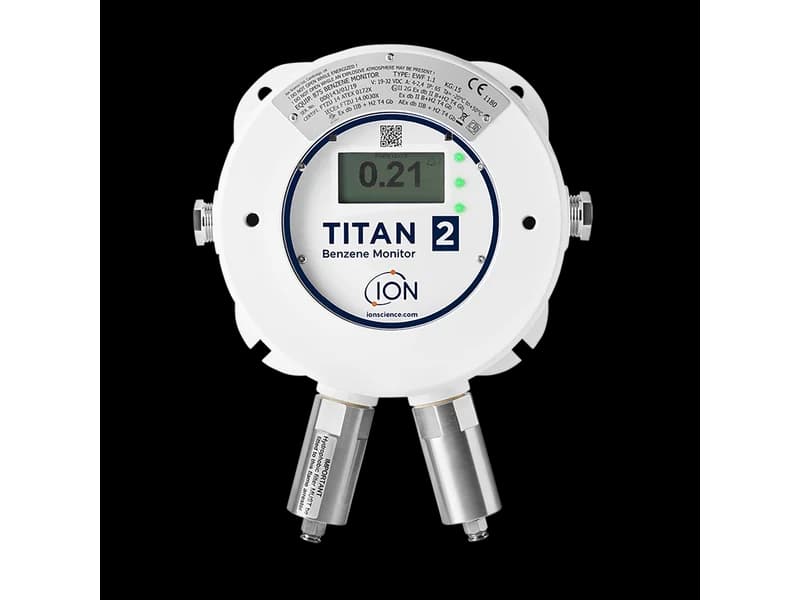
Ion Science Titan 2 — fixed benzene monitor
Flameproof fixed benzene monitor: MiniPID sensor with a proprietary separation method, 20 ppb – 20 ppm range, one reading per minute, 4–20 mA, RS485 Modbus and two…
Also in this article: Ion Science Cub — personal VOC monitor
Read also
10/23/2026
Photoionization detector (PID): how it works and what it measures
A PID exposes the sample to UV light and measures the ion current. It sees compounds with ionization energy below the lamp energy (10.0-11.7 eV): aromatics, solvents, fuels. Not methane.
8/24/2026
Gas and VOC Leak Detection on Industrial Sites: Ion Science PID Detectors
How to choose a PID detector for gas and volatile organic compound leaks: Ion Science personal, portable and fixed instruments, LDAR programmes and the pairing with ultrasound.
10/23/2026
Eddy current testing: how it works and where it is used
An AC coil induces eddy currents in metal; a flaw changes them and the coil impedance. The method finds surface cracks, inspects tubes, measures conductivity and coatings. Conductive materials only.