
Mercury vapor at industrial sites: how to detect it and what to measure with
Mercury is invisible and odorless, and its vapor builds up indoors. How to survey a site, find a spill and monitor workplace air with the portable Ion Science MVI indicator.
In this article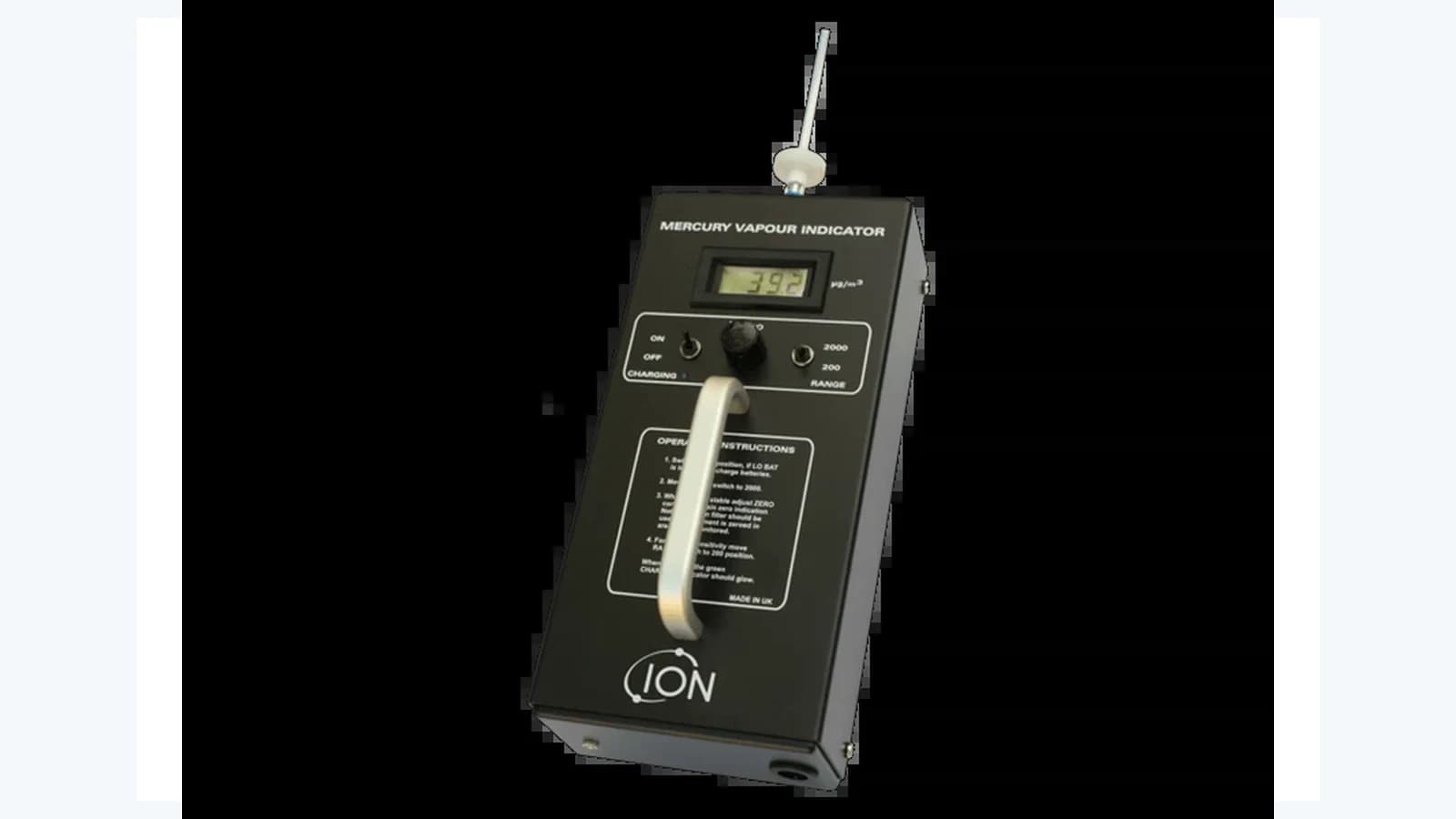
Prepared by the KEG TRK team · How we prepare our content
Mercury vapor is detected with a portable indicator based on 254 nm ultraviolet absorption. The Ion Science MVI shows concentration in µg/m³ in about 3 seconds, does not saturate at high readings and needs no regeneration between measurements. Below: where mercury appears at industrial sites, how the measurement works, which limits to use as a reference and how to survey after a spill.
Where mercury vapor appears
Metallic mercury evaporates at room temperature, so a spill or an open surface gradually fills the air. Ion Science lists these applications for the MVI:
- waste and fluorescent lamp recycling;
- mining;
- oil refining and the hydrocarbon industry;
- manufacturing where mercury is part of equipment or process;
- bioremediation of contaminated sites;
- spill detection and exposure-level monitoring at workplaces.
The danger is that mercury is invisible and odorless at hazardous concentrations. Only an instrument shows the problem.
How the MVI measures mercury vapor
A pump draws an air sample into a glass cell. Mercury atoms absorb 254 nm ultraviolet, and the more of them there are, the weaker the light that reaches the photodiode. The instrument converts the drop in intensity into concentration. The design is dual-beam, so high concentrations are measured without saturation.
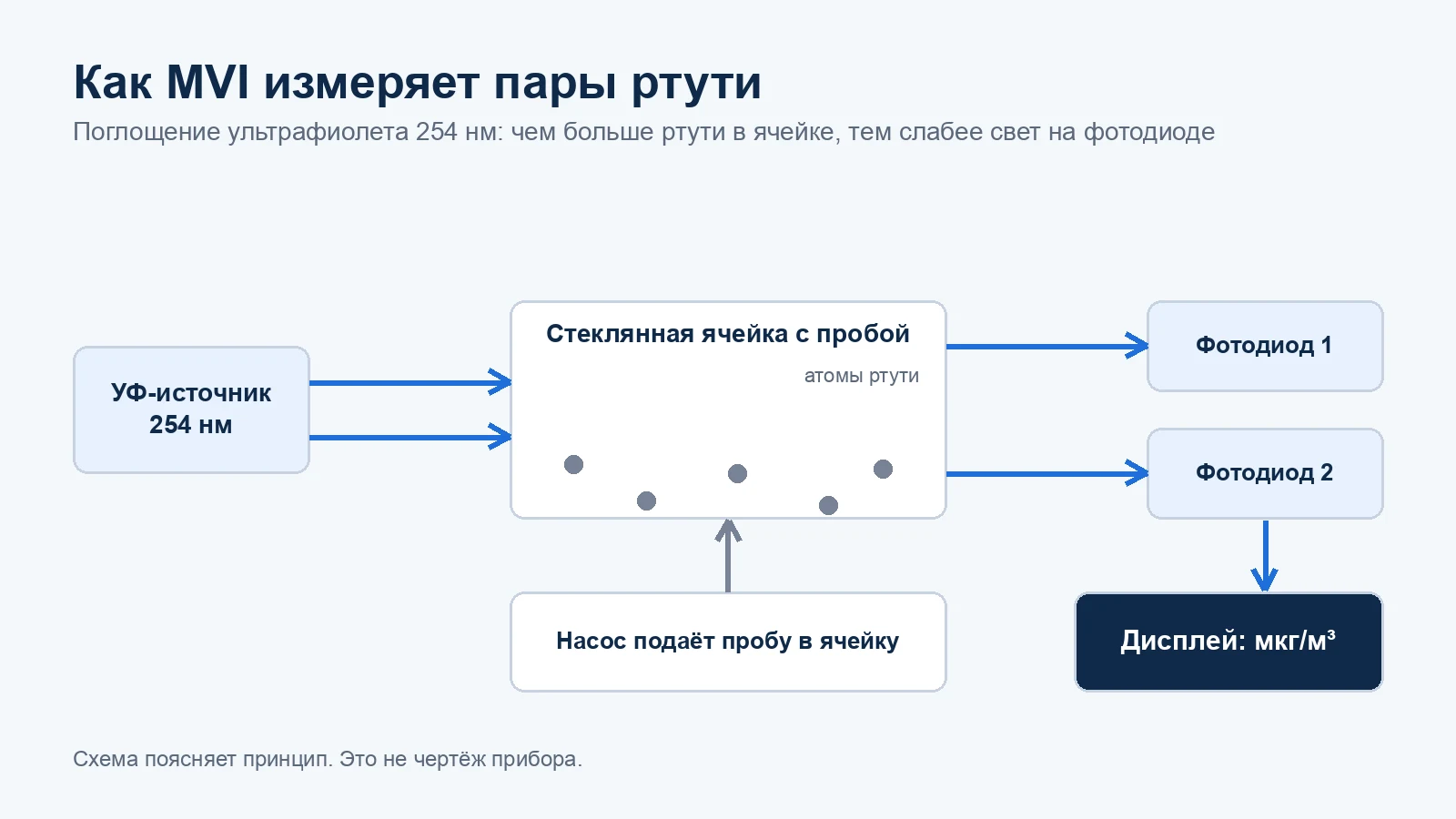
Illustration of the principle, not an instrument drawing.
Key MVI parameters from the manufacturer's documentation:
| Parameter | Value |
|---|---|
| Principle | dual-beam UV absorption, 254 nm |
| Ranges | 0.1–199.9 and 1–1999 µg/m³ |
| Response time | about 3 s |
| Accuracy | ±5 µg or ±10 % of reading |
| Zero drift | below 5 µg per hour |
| Alarm | audible, factory setpoint 20 µg/m³, not above 35 µg/m³ |
| Power | NiMH battery, over 4.5 h on a full charge |
| Conditions | +10…+50 °C, 0–100 % humidity non-condensing |
| Weight | 2.35 kg |
More on the instrument: Ion Science MVI.
Equipment covered in this article
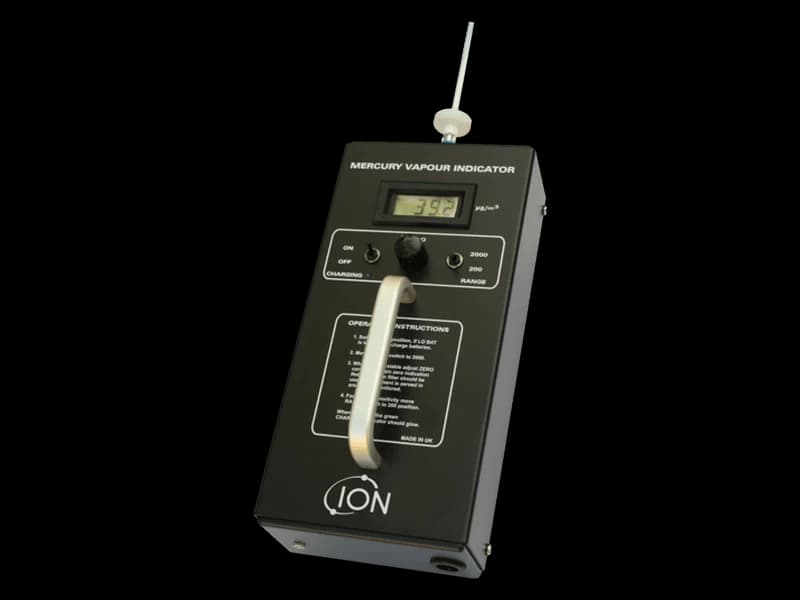
Ion Science MVI — portable mercury vapour detector
Portable mercury vapour indicator from Ion Science: dual beam UV absorption, about 3 second response, ranges 0.1–199.9 and 1–1999 µg/m3, no saturation or regeneration…
Limits to use as a reference
| Document | Value for mercury vapor |
|---|---|
| ACGIH TLV | 0.025 mg/m³ (25 µg/m³), shift average |
| NIOSH REL | 0.05 mg/m³ (50 µg/m³), 8-hour average |
| OSHA | 0.1 mg/m³ (100 µg/m³) |
Kazakhstan. National hygiene standards apply to workplace air. We did not check the current edition for this article, so we do not quote values. Ask your occupational safety service, and use the foreign limits as a reference when choosing the range and alarm setpoint.
The MVI range, with a lower bound of 0.1 µg/m³, covers these limits with a wide margin. The factory setpoint of 20 µg/m³ is below the ACGIH value, and it cannot be raised above 35 µg/m³.
What interferes
UV absorption is selective for mercury but not absolutely. Substances that absorb light at 254 nm interfere:
- hydrocarbons;
- water vapor;
- sulfur compounds;
- smoke.
Per the manufacturer, at 100 ppm of the interfering substance the reading rises by about:
| Substance | Apparent response, µg/m³ |
|---|---|
| Benzene | 20 |
| Ethanol | 6 |
| Toluene | 3.5 |
| Acetone | 3 |
| Ethyl acetate | 3 |
CO, CO2 and ammonia do not interfere. A sharp humidity change gives 5–10 µg/m³. At petrochemical sites, compare the reading with VOC control before drawing conclusions. Measuring the hydrocarbons themselves is covered in Benzene monitoring at an industrial site and Gas and VOC leak detection with Ion Science PID detectors.
Surveying after a spill
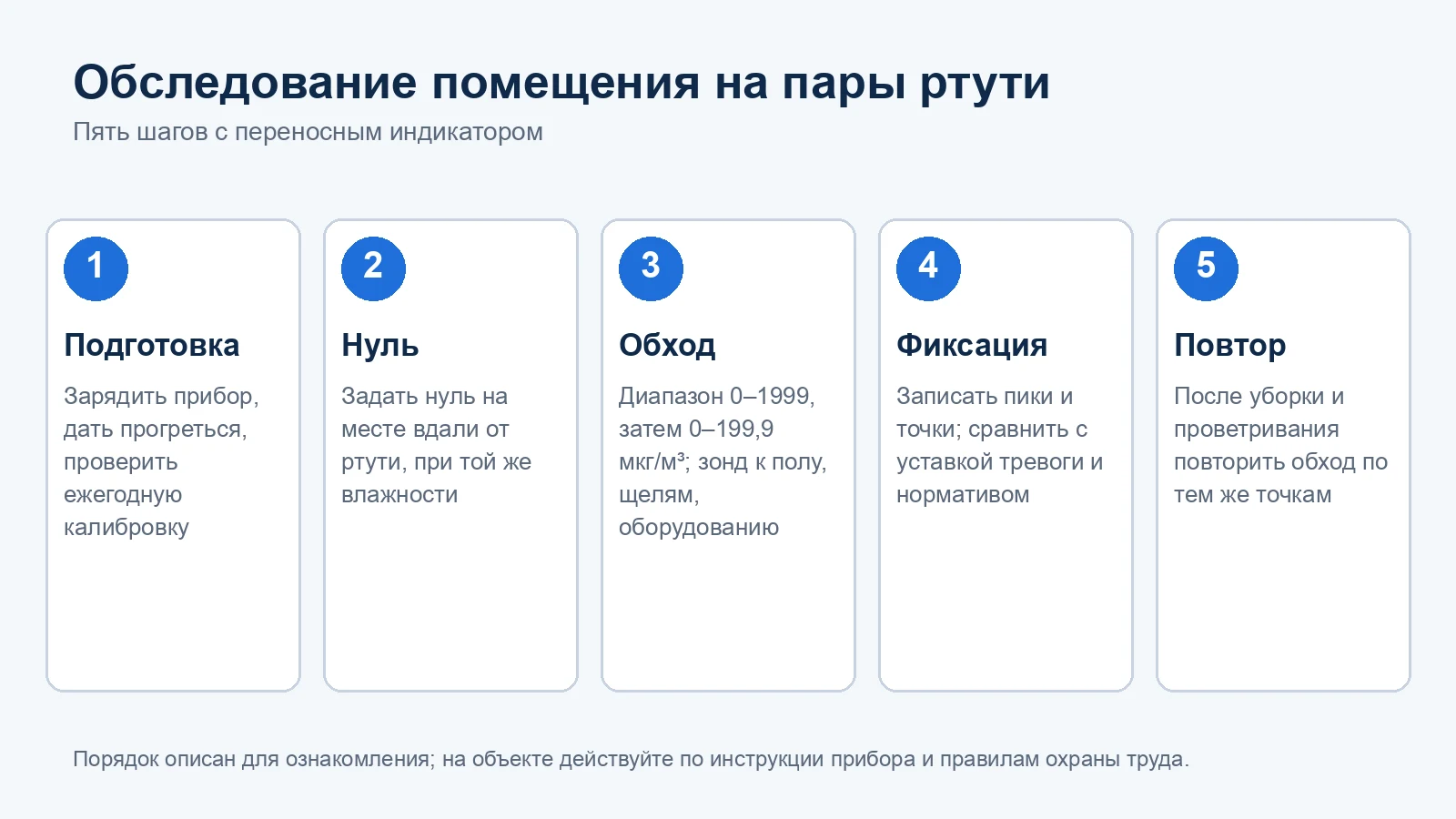
- Preparation. Charge the instrument, let it warm up, make sure the annual calibration is current.
- Zero. Set zero on site away from mercury and at the same humidity as the survey area. Otherwise a humidity swing gives a false 5–10 µg/m³.
- Walk-through. Start on the 0–1999 µg/m³ range so high values are not missed, then switch to 0–199.9 for accuracy. Hold the probe near the floor, cracks, joints, equipment and vents.
- Recording. Log peaks and locations. Mercury amalgamates with gold, silver, stainless steel, aluminum and copper alloys, so check those surfaces too.
- Repeat. After cleaning and ventilation, repeat the walk-through at the same points and compare.
The sequence is for information. On site follow the instrument manual, demercurization procedures and occupational safety rules. Only a specialist may open the MVI case: it contains an ultraviolet source.
Common mistakes
- Setting zero in a contaminated area. Zero must be set in clean air, otherwise all later readings are understated.
- Ignoring interferents. Near solvents and hydrocarbons overreading is possible, and comparing with VOC control is easier than revising a report later.
- Skipping calibration. The manufacturer requires it annually.
- Assuming the alarm threshold can be raised. The setpoint is limited to 35 µg/m³.
When continuous monitoring is needed
The MVI is a portable instrument for surveys, spill detection and exposure monitoring. For continuous recording it has a 0–2 V output for an external recorder, which is not included. If you need a round-the-clock scheme integrated into a safety system, ask our engineer about the solution.
KEG TRK supplies Ion Science instruments in Kazakhstan. Price on request. The Russian-language instrument brochure is available on the MVI page.
Sources
- Ion Science. MVI brochure, instrument documentation.
- CDC MMWR. Occupational Exposure to Mercury at an Electronics Waste and Lamp Recycling Facility, Ohio, 2023.
- NIOSH. Mercury vapor: Pocket Guide to Chemical Hazards.
- OSHA. Safety and Health Topics: Mercury.
Frequently asked questions
Equipment in this article
KEG TRK quotes prices and delivery times to Kazakhstan on request. We will prepare a commercial offer for your application.
Ion Science MVI — portable mercury vapour detector
Portable mercury vapour indicator from Ion Science: dual beam UV absorption, about 3 second response, ranges 0.1–199.9 and 1–1999 µg/m3, no saturation or regeneration…
Read also
11/3/2026
Which Ion Science instrument to choose: VOC, benzene, mercury, SF6, helium
Choosing an Ion Science gas instrument by task: PID detectors for VOC and benzene, mercury vapor indicator, SF6 leak detectors, helium and hydrogen detector. Tables of instruments, lamps and ranges.
10/14/2026
Ex Marking Explained: How to Decode ATEX, IECEx and TR CU 012
II 2G Ex ib IIC T4 Gb reads left to right: ATEX group and category, protection type, gas group, temperature class and protection level Gb, meaning zones 1 and 2. Tables and instrument examples.
10/14/2026
Non-Destructive Testing Methods: Types, What They Find, Where They Are Used
The main NDT methods: visual (videoscopes), ultrasonic thickness gauging, flaw detection and PAUT, eddy current, magnetic particle, penetrant, radiography and acoustic emission.