
Ex Marking Explained: How to Decode ATEX, IECEx and TR CU 012
II 2G Ex ib IIC T4 Gb reads left to right: ATEX group and category, protection type, gas group, temperature class and protection level Gb, meaning zones 1 and 2. Tables and instrument examples.
An Ex marking is read element by element. In II 2G Ex ib IIC T4 Gb: II is the equipment group (not mines), 2G is the ATEX category for gas, Ex ib is intrinsic safety at level b, IIC is the gas group, T4 means the surface stays at or below 135 °C, and Gb is the equipment protection level for zones 1 and 2. An instrument fits a zone only if all five elements match.
Element-by-element breakdown
Example: Ex II 2G Ex ib IIC T4 Gb
| Element | Meaning | Defined in |
|---|---|---|
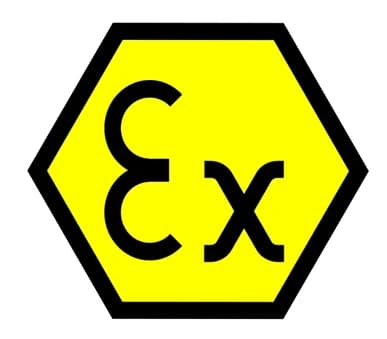
| Ex in a hexagon | Mark for equipment intended for explosive atmospheres | ATEX; the EAEU has its own Ex mark under TR CU 012/2011 |
| II | Equipment group: II — all places other than mines; I — underground mines | ATEX, TR CU 012/2011 |
| 2 | ATEX category: 1 — zone 0, 2 — zone 1, 3 — zone 2 | ATEX |
| G | Atmosphere: G — gases, vapours, mists; D — dust | ATEX |
| Ex ib | Type of protection (i — intrinsic safety) and level of protection (b) | IEC 60079 |
| IIC | Gas subgroup: IIA, IIB or IIC | IEC 60079-0, TR CU 012/2011 |
| T4 | Temperature class: maximum surface temperature 135 °C | IEC 60079-0, TR CU 012/2011 |
| Gb | Equipment protection level (EPL) | IEC 60079-0 |
The "II 2G" part appears only in ATEX marking. IECEx marking does not have it and starts with "Ex", for example "Ex db IIC T4 Gb".
Zones, ATEX categories and levels Ga, Gb, Gc
The zone is assigned by the operator through the site's hazardous area classification. Zone and category definitions follow the UK regulator HSE; the zones allowed for each EPL follow the WEG summary chart:
| Zone (gas) | When an explosive atmosphere is present | ATEX category | EPL | Where equipment with this EPL is allowed |
|---|---|---|---|---|
| 0 | Continuously, for long periods or frequently | 1G | Ga | Zones 0, 1 and 2 |
| 1 | Likely to occur occasionally in normal operation | 2G | Gb | Zones 1 and 2 |
| 2 | Not likely in normal operation and, if it occurs, only for a short period | 3G | Gc | Zone 2 only |
Dust follows the same scheme: zones 20, 21, 22 and levels Da, Db, Dc. Equipment with a higher protection level may be used in a lower-risk zone, never the other way round.
North America uses the class and division system: per the WEG chart, zones 0 and 1 correspond to Class I, Division 1, and zone 2 to Class I, Division 2. A Class/Division marking does not replace zone marking: in a zoned installation, look at the category and EPL.
Equipment covered in this article
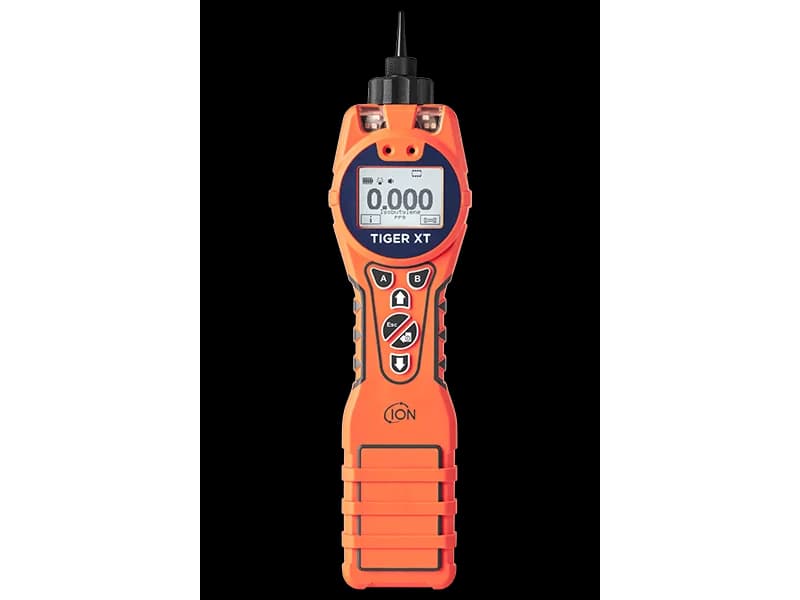
Ion Science Tiger XT — handheld PID detector for volatile organic compounds
Intrinsically safe Ion Science photoionisation detector for over 750 volatile organic compounds: 1 ppb to 20,000 ppm, T90 under 2 s, Fence Electrode technology against…
Types of protection and levels a, b, c
The letter after "Ex" is the type of protection; the second letter is the level: a — very high, b — high, c — normal.
| Code | Type of protection | IEC 60079 part | Principle |
|---|---|---|---|
| d | Flameproof enclosure | 1 | Enclosure withstands an internal explosion and does not let the flame out |
| p | Pressurization | 2 | Overpressure keeps the explosive atmosphere out |
| q | Powder (quartz) filling | 5 | Ignition source is buried in quartz |
| e | Increased safety | 7 | No sparking parts, increased creepage and clearance distances |
| i | Intrinsic safety | 11 | Circuit energy is limited so it cannot ignite the mixture |
| n | For zone 2 (non-sparking, etc.) | 15 | Simplified concepts for level Gc only |
| m | Encapsulation | 18 | Electrical circuit is moulded in compound |
| op | Optical radiation | 28 | Optical radiation is limited or protected |
| t | Protection by enclosure (dust) | 31 | Dust-tight IP5X or IP6X enclosure |
Which protection type and level match which EPL, per IEC 60079-14:
| EPL | d | e | i | m | p | n |
|---|---|---|---|---|---|---|
| Ga | da | — | ia | ma | — | — |
| Gb | db | eb | ib | mb | pxb, pyb | — |
| Gc | dc | ec | ic | mc | pzc | nA, nC, nR |
When several types of protection are used, they are written in sequence: "Ex db eb" means a flameproof enclosure with an increased-safety terminal box. Square brackets, for example "[ia Ga]", mean associated apparatus: a device that creates an intrinsically safe circuit at the stated level. The overall level of the product is still given by the EPL at the end of the marking.
The portable instruments in the examples below use intrinsic safety: Ex ia or Ex ic.
Gas groups IIA, IIB, IIC
| Subgroup | Typical gases | Comment |
|---|---|---|
| IIA | Propane, petrol, ethanol, acetone | Least stringent requirements |
| IIB | Ethylene, dimethyl ether | Intermediate |
| IIC | Hydrogen, acetylene, carbon disulphide | Most hazardous gases, most stringent requirements |
IIC equipment is also suitable for IIB and IIA. IIB equipment is suitable for IIB and IIA, but not for hydrogen. You may see "IIB+H2": subgroup IIB plus hydrogen.
For dust the subgroups are IIIA (combustible flyings), IIIB (non-conductive dust) and IIIC (conductive dust).
Temperature classes T1–T6
| Class | Maximum surface temperature |
|---|---|
| T1 | 450 °C |
| T2 | 300 °C |
| T3 | 200 °C |
| T4 | 135 °C |
| T5 | 100 °C |
| T6 | 85 °C |
The higher the number, the cooler the surface and the safer the equipment. An example from IECEx conference material: if an area is classified as zone 1, IIA, T4, surfaces become dangerous from 135 °C, so equipment is selected with class T4, T5 or T6.
Ambient temperature and the letter X
- Ta. If the marking does not state an ambient temperature range, the default is −20…+40 °C. An extended range is stated separately, for example "−20 °C ≤ Ta ≤ +50 °C".
- X. The letter X in a certificate number (for example, TI25ATEX 9895 X) means specific conditions of use. They are listed in the certificate and the manual and must be followed.
ATEX, IECEx and TR CU 012/2011: the differences
| System | Where it applies | Marking features |
|---|---|---|
| ATEX (Directive 2014/34/EU) | EU | Ex in a hexagon, group and category (II 2G), then the IEC 60079 code and EPL |
| IECEx | International certification scheme | IEC 60079 code without category: Ex ib IIC T4 Gb; the certificate can be checked in the online IECEx database |
| TR CU 012/2011 | EAEU, including Kazakhstan | Special Ex explosion-safety mark, certificate of conformity number in the marking, its own protection levels |
TR CU 012/2011 "On safety of equipment for work in explosive atmospheres" was adopted by Customs Union Commission Decision No. 825 of 18 October 2011 and entered into force on 15 February 2013. Under Article 4, the equipment must carry: the manufacturer's name or trademark, the type designation, the serial number, the certificate of conformity number and the explosion protection marking.
The regulation divides equipment into group I (mines), II (gas atmospheres) and III (dust atmospheres), subgroups IIA, IIB, IIC and three explosion protection levels:
| Level under TR CU 012/2011 | What it ensures | For which places |
|---|---|---|
| Especially explosion-safe (very high) | Protection maintained even with rare faults, including two independent ones | Where an explosive atmosphere is present constantly, for long periods or often |
| Explosion-safe (high) | Protection with one expected fault | Where an explosive atmosphere is likely to form |
| Increased reliability against explosion (enhanced) | Protection in normal operation only | Where an explosive atmosphere is unlikely or short-lived |
The temperature classes T1–T6 in the regulation are the same as in IEC 60079-0. The EAEU base standard for general requirements is GOST 31610.0-2019, which contains the requirements of IEC 60079-0:2017.
How to check whether an instrument may be used in a zone
- Get the area parameters from the hazardous area classification documents: zone number, gas subgroup (IIA, IIB, IIC) and required temperature class.
- Check the protection level. Zone 0 needs Ga (1G), zone 1 needs Ga or Gb (1G, 2G), zone 2 accepts Ga, Gb or Gc.
- Check the gas subgroup. The instrument's subgroup must be the same or more stringent: IIC covers everything; IIB is not suitable for hydrogen or acetylene.
- Check the temperature class. The instrument's class must be the same or have a higher number.
- Check ambient temperature against the Ta range in the marking, or the −20…+40 °C default.
- Read the X conditions in the certificate and manual: batteries, charging outside the zone, covers, accessories.
- Check the certificate for your country. In Kazakhstan and other EAEU countries, a TR CU 012/2011 certificate of conformity is required, and its number must be in the marking.
Examples: instruments from the KEG TRK catalog
Markings are checked against the manufacturers' certificates and product pages.
| Instrument | Marking | Ta | Allowed zones (gas) |
|---|---|---|---|
| Ion Science Tiger XT, portable PID gas detector | II 1G Ex ia IIC T4 Ga | −25…+45 °C with Li-ion battery, −25…+40 °C with alkaline battery pack | 0, 1, 2 |
| SDT SonaVu+ EX (SonaVu+ ATEX), acoustic camera | II 3G Ex ic IIC T5 Gc, certificate TI25ATEX 9895 X | −20…+50 °C | 2 only |
| Crysound CRY2624 ATEX, acoustic camera | II 3G Ex ic IIC T5 Gc | −20…+50 °C (operating environment) | 2 only |
| Ion Science Falco, fixed PID detector (pumped version) | II 2G db ib IIC T4 Gb | −20…+50 °C (operating range) | 1, 2 |
Worked example. Area: zone 1, subgroup IIB, required class T3.
- Tiger XT: Ga is suitable for zone 1, IIC covers IIB, T4 is cooler than T3. It may be used, subject to the specific conditions in the certificate.
- SonaVu+ EX and CRY2624 ATEX: level Gc, zone 2 only. They must not be used in zone 1, even though subgroup IIC and class T5 would fit.
If the same area is zone 2, all four instruments pass on level, subgroup and temperature class.
Which instrument to choose
- Leak and partial discharge detection with an acoustic camera in zone 2 — SonaVu+ ATEX or Crysound CRY2624 ATEX. Leak detection methods are compared in How to Find a Gas Leak at a Plant.
- Portable VOC monitoring in zones 0, 1 and 2 — Tiger XT.
- Continuous VOC monitoring in hazardous zone 1 — Falco.
Ask about the availability of a TR CU 012/2011 certificate for the specific model and configuration when you request a quote. Acoustic camera work in hazardous areas is covered in Safe Remote Inspection in Hazardous and Clean Areas. Price on request.
Sources
- IEC 60079-0:2017. Explosive atmospheres — Part 0: Equipment — General requirements. IEC webstore page: https://webstore.iec.ch/en/publication/32878
- Neleman K. (BARTEC). Overview of Explosion Protection Techniques. IECEx conference, 2018: https://www.iecex.com/assets/Uploads/D2S2-Ex-Protection-Techniques-BARTEC.pdf
- HSE. ATEX definitions (zones, equipment groups and categories): https://www.hse.gov.uk/electricity/atex/definitions.htm
- WEG. Guide to Explosive Atmospheres (ATEX, IECEx, NEC/CEC summary chart): https://static.weg.net/medias/downloadcenter/h83/h31/WEG-guide-to-explosive-atmospheres-50042119-brochure-english-web.pdf
- TR CU 012/2011 "On safety of equipment for work in explosive atmospheres", Customs Union Commission Decision No. 825 of 18.10.2011: https://zakon.uchet.kz/rus/docs/H11T0000825
- GOST 31610.0-2019, document record: https://www.normacs.info/ntds/11431
- Technická inšpekcia (NB 1354). EU-type examination certificate TI25ATEX 9895 X, SonaVu Plus EX; SDT North America, EU Declaration of Conformity. Documents on: https://sonavu.com/products/
- Crysound. CRY2624 128-Mic Industrial Acoustic Imaging Camera (ATEX): https://www.crysound.com/product/cry2624-128-mic-industrial-acoustic-imaging-camera-atex/
- Ion Science. Tiger XT: https://ionscience.com/en/products/tiger-handheld-voc-gas-detector/
- Ion Science. Falco, fixed VOC detector: https://ionscience.com/en/products/products-falco-fixed-voc-gas-detector-pumped-0-10ppm/
Frequently asked questions
Equipment in this article
KEG TRK quotes prices and delivery times to Kazakhstan on request. We will prepare a commercial offer for your application.
Ion Science Tiger XT — handheld PID detector for volatile organic compounds
Intrinsically safe Ion Science photoionisation detector for over 750 volatile organic compounds: 1 ppb to 20,000 ppm, T90 under 2 s, Fence Electrode technology against…

SDT SonaVu+ ATEX — Acoustic Camera for Explosive Atmospheres
SonaVu+ ATEX acoustic camera certified to ATEX II 3G Ex ic IIC T5 Gc (Zone 2) for use in explosive atmospheres.
Also in this article: Crysound CRY2624 ATEX — Acoustic Camera for Explosive Zones, Ion Science Falco 2 — fixed PID VOC detector
Read also
10/14/2026
Non-Destructive Testing Methods: Types, What They Find, Where They Are Used
The main NDT methods: visual (videoscopes), ultrasonic thickness gauging, flaw detection and PAUT, eddy current, magnetic particle, penetrant, radiography and acoustic emission.
10/13/2026
Acoustic Camera: What It Is and How It Works
How an acoustic camera with a MEMS microphone array shows an ultrasound source on video, what beamforming is, which tasks it handles and where the method has limits.
10/13/2026
Thickness Gauging Through Paint: Echo-to-Echo and THRU-COAT Modes
Why a standard gauge overstates painted steel thickness, how echo-to-echo and THRU-COAT remove the coating, which transducers they need, thickness ranges and temperature limits.