
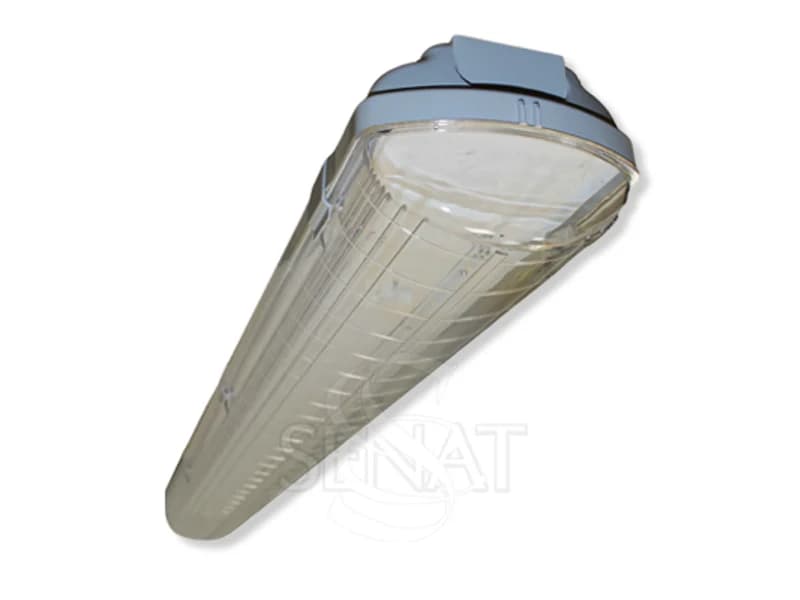
Industrial LED Lighting: How to Choose Fixtures for Workshops and Outdoor Sites
How to choose industrial LED fixtures for workshops, warehouses, outdoor areas, and special zones: luminous flux, IP rating, color temperature, chip quality, payback.
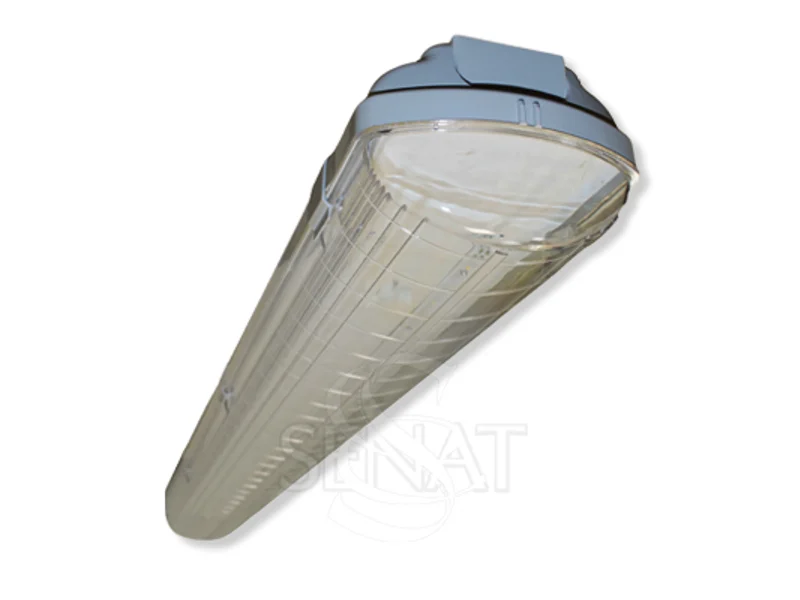
Replacing outdated lighting with LED is one of the rare industrial projects where savings and safety move together: the payback period is measured in months rather than years, while light quality directly affects staff injury rates and productivity. But "buy the brighter one" is a poor strategy: a workshop, an open yard, an office under an Armstrong ceiling, an emergency exit, and a gas station each demand a different fixture class and different protection parameters. This guide walks through choosing industrial LED lighting: what to check on a fixture's spec sheet, which class covers which task, and how to calculate real savings compared with legacy sodium and fluorescent lighting.
Why you can't choose a fixture by wattage alone
Watts are the least reliable metric for comparing fixtures. One manufacturer honestly states the real light output of its LEDs; another inflates the wattage rating to look "more powerful" on paper. Two fixtures both rated at 40W can differ in actual workspace illumination by as much as 50–100%.
The correct selection order runs from the task to the specification — not from price to wattage:
- Identify the application zone — workshop, warehouse, outdoor area, office, hazardous or food-production zone
- Calculate the required illuminance in lux for that zone per applicable codes and standards
- Select the fixture class engineered for that exact zone
- Verify spec-sheet parameters — luminous flux, IP rating, color temperature, chip quality, service life, warranty
- Compare total cost of ownership (TCO), including energy consumption and maintenance
The full range of industrial and outdoor fixtures is in the LED lighting section, covering every class from workshop high-bays to emergency and specialty solutions.
Key selection parameters
Luminous flux (lm)
Luminous flux, measured in lumens, is the actual amount of visible light a fixture emits — unlike wattage, which only describes power draw. Lumens, not watts, determine how well a workspace is actually lit. The lm/W ratio (luminous efficacy) is the key indicator of chip efficiency: quality LEDs exceed 120–130 lm/W, while budget alternatives often fall short of 90.
IP protection rating
The IP class (Ingress Protection) rates enclosure protection against dust and moisture with two digits: the first for solid particles (0–6), the second for water (0–9). For industrial use this isn't a formality — it's a survival requirement:
| IP class | Protection | Typical application |
|---|---|---|
| IP20 | Basic dust protection, no moisture | Offices, administrative spaces |
| IP54 | Limited dust ingress, water splashes | Warehouse spaces without direct water contact |
| IP65 | Full dust protection, water jets | Workshops, production lines, gas stations |
| IP67 | Full dust protection, temporary immersion | Outdoor lighting, open sites |
Color temperature
Color temperature, in kelvin (K), determines the tone of the light and directly affects how a workspace is perceived:
- 4000K (neutral white) — comfortable for prolonged work, reduces eye fatigue, used in workshops, offices, warehouses
- 5000K (cool white, close to daylight) — maximum contrast and detail clarity, used for visual-inspection stations, outdoor areas, and gas stations
LED chip quality
The service life and stability of the light output are determined not by the fixture housing but by the quality of the LED chip itself. Samsung and Osram chips hold their rated luminous flux throughout the full service life with minimal degradation (typically no more than 10% over 100,000 hours), whereas unbranded chips lose brightness far faster and sometimes fail within the first year of operation.
Service life and warranty
The rated service life of quality industrial fixtures is 100,000 hours — more than 11 years of continuous operation, or over 20 years on a 12-hour-per-day schedule. A manufacturer's warranty is a practical indicator of confidence in that rated life: across the Senat line, warranty terms range from 3 years on base workshop and specialty fixtures up to 5 years on outdoor, office, and gas-station fixtures.
Equipment covered in this article
Ares 40W Industrial LED Luminaire
Industrial Ares 40W LED luminaire with 64 diodes for lighting production facilities
Fixture classes: which one fits which zone
| Fixture class | Primary application | Typical IP | Key features |
|---|---|---|---|
| Workshop high-bay | Production workshops, hangars, high-ceiling warehouses | IP65 | Wide beam distribution, mounted at 6–20 m, vibration resistance |
| Outdoor / area | Open sites, roads, parking lots, site perimeter | IP67 | Narrow or asymmetric optics, protection from precipitation and temperature swings |
| Office (Armstrong grid) | Administrative buildings, suspended-ceiling offices | IP20 | Standard 600×600 mm grid cell, even, glare-free illumination |
| Emergency | Evacuation routes, stairwells, communication hubs | IP65 | Built-in battery, automatic switch-on during a power outage |
| Specialty (gas station, plant growth) | Fuel stations, greenhouses, food production | IP65 | Explosion-safe canopy rating, task-specific spectrum |
Workshop and warehouse lighting: high-bay fixtures
Workshops, warehouses, and hangars with ceiling heights of 6 meters and up need powerful fixtures with a wide beam distribution that evenly illuminate a large floor area from a significant mounting height. A line example is Ares 40W: 64 Samsung/Osram LEDs, luminous flux up to 5,200 lm, IP65 protection, 4000K/5000K color temperature, 100,000-hour service life, 3-year warranty. Fixtures like this are used across mining and metallurgical production sites, where resistance to dust, vibration, and temperature swings is critical — see the mining and metallurgy application sections for the equipment requirements typical of these industries.
Sizing the number of fixtures for a workshop factors in floor area, mounting height, the required illuminance per code (typically 150–300 lux for production zones, depending on the precision of the work performed), and a maintenance factor for optics soiling.
Outdoor and site-wide lighting
Open areas, roadways, parking lots, and the perimeter of an industrial site call for fixtures with a higher IP rating — IP67 — since they're continuously exposed to precipitation, dust, and temperature extremes. An example is Atlant-K Optic 80W: 128 LEDs, luminous flux up to 12,000 lm, IP67, 4000K/5000K color temperature, 100,000-hour service life, 5-year warranty, and operation on 176–265V AC — a voltage margin that matters on remote sites with unstable power supply. These fixtures cover main roads, vehicle thoroughfares, and industrial site territories, including facilities across general industry — see the general industry section.
Office lighting for Armstrong-grid ceilings
Administrative buildings and office spaces on an industrial site use a different fixture class entirely — compact panels sized for the standard 600×600 mm suspended-ceiling grid cell. The Armstrong office fixture line is rated for 18–72W, IP20 (sufficient for dry, dust-free spaces), 4000K/5000K color temperature, and a 5-year warranty. Here the priority isn't dust or moisture protection but even light distribution and glare-free screens — parameters that matter for long office hours rather than industrial loads.
Emergency lighting: requirements and code compliance
Emergency lighting for evacuation routes, stairwells, and communication hubs isn't optional — it's a requirement under fire and industrial safety codes. When the main power supply fails, these fixtures must switch automatically to a backup source and keep evacuation routes visible for a code-mandated duration.
Senat's emergency lighting fixtures carry a built-in battery with 3 hours of runtime, covering most regulatory requirements for evacuation lighting. Specifications: 18W power draw, 4000K/5000K color temperature, 3-year warranty, Samsung/Osram LEDs. When designing an emergency lighting system, it's important to:
- Maintain an unbroken light path along the entire evacuation route with no dark spots
- Position fixtures at exits, at route turns, and at floor-level changes (stairs, ramps)
- Regularly test automatic switchover and remaining battery capacity
- Document maintenance intervals in line with the facility's internal regulations and inspecting-authority requirements
Special zones: gas stations and plant growth
Not every task fits the standard "workshop / outdoor / office / emergency" lineup. Two notable examples of specialty lighting:
Gas stations. Gas station fixtures are integrated into canopies above fuel dispensers and operate in a zone with elevated fire-safety requirements. Specifications: 50–100W power draw, 5000K color temperature (maximum contrast for staff and driver visibility), IP65 protection, 5-year warranty.
Plant growth and greenhouses. Plant-growth fixtures use a specialized spectrum rather than standard white light, tuned to a specific plant growth phase — vegetative, flowering, or fruiting. Power draw is 50W, IP65 for the humid greenhouse environment, 3-year warranty. Here color temperature as a single metric doesn't apply at all — what matters is the spectral composition itself.
Comparison by key specifications
| Use case | Luminous flux | IP | Color temperature | Warranty |
|---|---|---|---|---|
| Workshop, production | 5,000–5,200 lm (Ares 40W) | IP65 | 4000K / 5000K | 3 years |
| Outdoor, main road | up to 12,000 lm (Atlant-K Optic 80W) | IP67 | 4000K / 5000K | 5 years |
| Office (Armstrong) | rated 18–72W | IP20 | 4000K / 5000K | 5 years |
| Emergency routes | — (18W, 3h runtime) | IP65 | 4000K / 5000K | 3 years |
| Gas station | rated 50–100W | IP65 | 5000K | 5 years |
| Greenhouse, plant growth | rated 50W | IP65 | specialty spectrum | 3 years |
The economics: LED versus sodium and fluorescent lighting
The main case for switching to LED isn't environmental or trend-driven — it's straightforward economics. Sodium discharge lamps (HPS) and linear fluorescent fixtures, still common on industrial sites, lose to LED across every operating metric:
| Parameter | Sodium / fluorescent | LED fixtures |
|---|---|---|
| Luminous efficacy | 60–90 lm/W | 120–140 lm/W |
| Service life | 10,000–20,000 hours | up to 100,000 hours |
| Time to full brightness | 3–10 minutes (sodium) | instant |
| Sensitivity to switching cycles | Shortens lamp life | No effect on service life |
| Maintenance | Frequent lamp and ballast replacement | Minimal for the entire warranty term |
| Low-temperature performance | Degraded ignition | No restrictions |
Replacing, for example, 250W sodium fixtures with an LED equivalent of comparable luminous flux typically cuts energy consumption by 50–65%. Combined with a service life several times longer and near-zero maintenance costs, the payback period on a multi-shift industrial site usually falls within 12–24 months. An added, often-overlooked benefit is reduced spending on lift equipment and line downtime for relamping at height — especially significant on mining and metallurgical sites where access to lighting structures is difficult.
Checklist for selecting an industrial fixture
- The zone is identified: workshop, warehouse, outdoor area, emergency route, gas station, or specialty task
- The required illuminance (lux) is calculated for the specific type of work
- The spec-sheet luminous flux (lm) has been checked, not just the stated wattage (W)
- The IP rating matches the actual operating conditions
- The color temperature fits the task (4000K for comfortable work, 5000K for detail inspection)
- The chip manufacturer is verified — Samsung or Osram over unbranded alternatives
- The rated service life (100,000 hours) has been weighed against the manufacturer's actual warranty
- For emergency lighting, runtime and route coverage have been confirmed against code requirements
- The payback period versus current lighting (sodium or fluorescent) has been calculated
The full fixture catalog and equipment manufacturer information is on the LED lighting manufacturer page.
Conclusion
Choosing industrial LED lighting isn't about finding the highest wattage for the lowest price — it's about matching fixture class, IP protection, color temperature, and chip quality to the specific application zone: a workshop, an open site, an office, an emergency route, or a specialty zone like a gas station or greenhouse. The right selection delivers a dual benefit: it cuts energy consumption by 50–65% compared with sodium and fluorescent lighting, while also improving safety through even, stable, and sufficiently bright illumination of work areas. With a rated service life of up to 100,000 hours and a manufacturer's warranty of 3–5 years, quality industrial lighting pays for itself faster than most other facility upgrades — typically within one to two years of operation.
Equipment in this article
KEG TRK quotes prices and delivery times to Kazakhstan on request. We will prepare a commercial offer for your application.
Ares 40W Industrial LED Luminaire
Industrial Ares 40W LED luminaire with 64 diodes for lighting production facilities
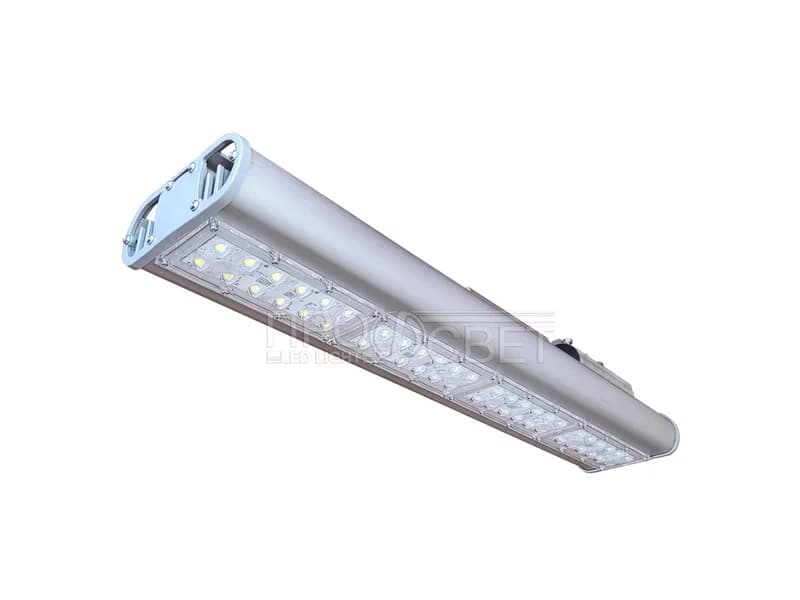
Atlant K Optic 80W Outdoor LED Luminaire
Atlant K Optic 80W outdoor LED luminaire with 128 diodes and luminous flux up to 12,000 lm for highway lighting
Also in this article: Senat Emergency LED Luminaire, Senat Gas Station LED Luminaire
Read also
10/10/2026
What Is Machinery Vibration Analysis and How to Start
Vibration analysis checks machine condition from bearing housing vibration: what is measured, route-based vs online monitoring, which faults show in the spectrum, how to start.
10/10/2026
Electric Motor Diagnostics: Which Method Shows What
Vibration, ultrasound, thermography, current analysis (MCSA/ESA), motor circuit analysis (MCA), megohmmeter and oil analysis: which faults each method sees, where it stops and how to combine them.
10/10/2026
How to Find Compressed Air Leaks in a Plant: 5 Methods
Compressed air leaks are found in two steps: estimate losses from the compressor, then locate the points with an ultrasonic detector or camera. Five methods compared.