
The Mysterious 0.6× Frequency — a Frequency That Shouldn't Exist (But Does)
A peak at 0.6× in the spectrum isn't always BPFO. A thought experiment on changing reference frames, and how to confirm the hypothesis with SDT340 ultrasound and Artesis electrical signatures.
Introduction
You know the rule: in a bearing with a stationary outer race, the cage rotates at roughly 0.4× of shaft speed. So when a peak appears at 0.4× in the spectrum, the first thought is a cage or rolling-element defect. But what if you see a clean peak at 0.6× instead? Not 0.4×, not 1×. Just a lone peak at 0.6×. Where does it come from? SDT340 ultrasound, which catches early-stage friction, and Artesis e-MCM electrical signatures can help confirm the hypothesis.
A thought experiment: changing the reference frame
Normally we stand on the ground — the outer race is stationary. The inner race rotates at 1×. The cage rotates at 0.4×.
Now imagine "sitting" on the inner race — as if the shaft weren't moving.
In this reference frame, the outer race rotates backward at −1×. The cage's speed relative to you: 0.4× − 1× = −0.6×. In other words, in this frame, the cage and rolling elements pass a fixed point on the inner race at a frequency of 0.6×.
Equipment covered in this article
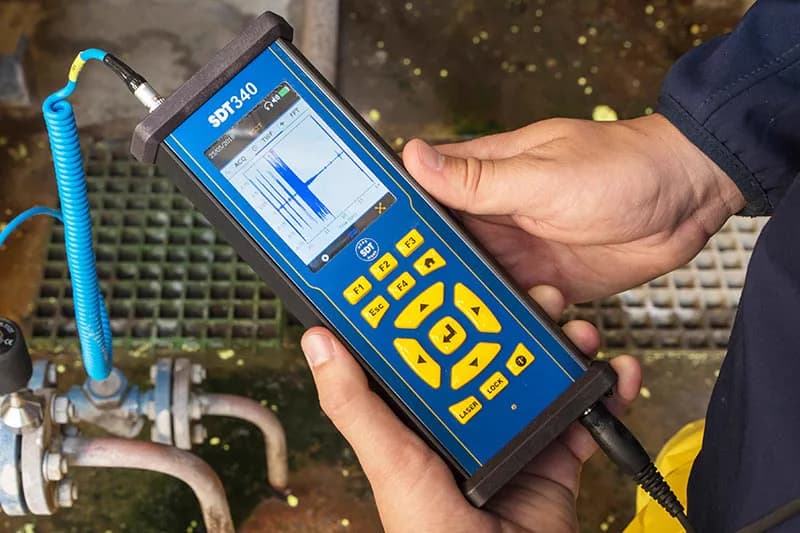
SDT340 - Advanced Ultrasound Detector
The most advanced ultrasound detector for collecting, analysing and trending data
Where does the 0.6× vibration come from?
Even with no damage on the inner race, any asymmetry between rolling elements creates a disturbance every time the "odd one out" rolling element passes a fixed point on the inner race.
Examples of asymmetry that generate excitation at 0.6×:
- One rolling element is slightly larger or smaller than the rest
- One rolling element has a small spall
- A cage pocket is worn or cracked, so one rolling element sits differently than the others
Every time this rolling element completes its cycle — at an interval of 0.6× — it slightly lifts or displaces the shaft. This micro-impact repeats at the 0.6× frequency.
Why isn't 0.6× always visible?
If the asymmetry is always present, why is 0.6× so rarely seen in spectra? It comes down to the signal transmission path.
| Signal path | Description |
|---|---|
| Outer race defect — short path | Outer race → housing → sensor. Direct transmission, minimal attenuation. |
| Rolling-element asymmetry — long path | Rolling element → outer race → housing → sensor. Significantly more attenuation. |
0.6× shows up in the spectrum only when the signal energy is sufficient to "survive" this longer path.
That's exactly why cylindrical roller bearings show 0.6× more often than ball bearings: the line contact of rollers transmits energy more efficiently than the point contact of balls.
What can cause 0.6×?
| Cause | Description |
|---|---|
| Rolling-element size variation | Manufacturing tolerances or progressive wear that leaves one element larger or smaller than the rest. |
| A spall on one rolling element | A localized defect that periodically disrupts the load zone at an interval of 0.6×. |
| Cage pocket wear | Excessive clearance in one pocket causes that rolling element to move differently than its neighbors. |
| Cage crack | Structural damage that changes the position or motion of one or more rolling elements. |
Diagnostic tip
If you see a clean peak at 0.6× with no other harmonics, don't rush to diagnose a "cage defect" (that's 0.4×). Think instead about an asymmetric rolling element viewed from a reference frame fixed to the inner race.
And check the bearing type: if it's a roller bearing, the probability of seeing 0.6× is significantly higher.
A question for discussion
If 0.6× appears in the spectrum, what other signatures might be present? Share what you've observed in practice — get in touch with our engineers.
Equipment in this article
KEG TRK quotes prices and delivery times to Kazakhstan on request. We will prepare a commercial offer for your application.
SDT340 - Advanced Ultrasound Detector
The most advanced ultrasound detector for collecting, analysing and trending data
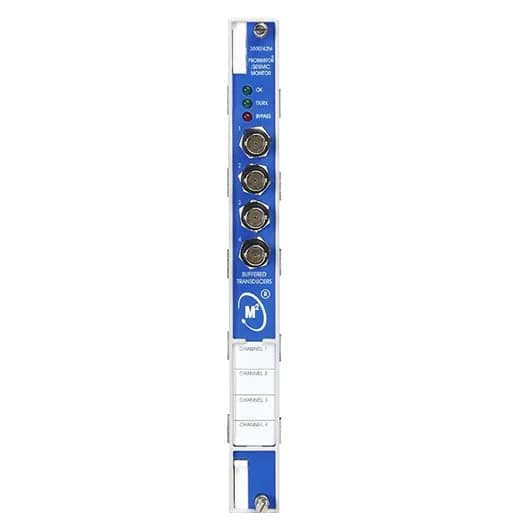
3500/42M Proximitor/Seismic Monitor
3500/42M Proximitor/Seismic Monitor: 4 channels for proximity and seismic sensors, vibration and position, 4–20 mA outputs
Also in this article: 330500 Series — Velomitor Velocity Sensor
Read also
6/23/2026
Why Vibration Analysis Alone Isn't Enough: SDT Ultrasound and Artesis Electrical Monitoring
Vibration analysis doesn't see everything. Here's what SDT 340 ultrasound, LUBExpert and Artesis e-MCM online motor monitoring add — and why they're installed alongside vibration, not instead of it.
6/16/2026
10 Equipment Maintenance Strategies That Cut Downtime in 2026
10 maintenance strategies that genuinely reduce downtime in 2026: predictive maintenance, RCM, TPM, and tools like Artesis e-MCM and SDT340, with KPIs you can roll out in stages at plants across Kazakhstan.
6/11/2026
Shaft Misalignment: the Hidden Killer of Bearings, Couplings and Seals
Up to half of all rotating equipment failures are linked to shaft misalignment. We break down the types of misalignment, its consequences, and how vibration analysis and current analysis detect it before it destroys couplings and bearings.