
Gas Testing Before Confined Space Entry: Why a Multi-Gas Detector Is Not Enough and Why You Need a PID
Tanks, manholes, vessels, holds: which gases to test before entry, why an LEL sensor does not see toxic vapours, how to test at different heights with Tiger and protect the worker with Cub during the job.
In this article
Prepared by the KEG TRK team · How we prepare our content
Work in confined spaces such as tanks, vessels, manholes, sewers, holds and pits remains one of the leading causes of workplace fatalities. A typical scenario: the pre-entry test "showed normal", a person went down and lost consciousness a few minutes later. Often the cause is not that no test was done, but that it was done with the wrong instrument or at the wrong point.
Let us look at which gases need testing, why a standard four-gas detector is not enough when organic vapours may be present, and how to organise testing with Ion Science instruments.
Four hazards in a confined space
| Hazard | What happens | Detected by |
|---|---|---|
| Oxygen deficiency | Displacement by nitrogen or CO₂, oxidation of walls | Electrochemical O₂ sensor |
| Flammable atmosphere | Vapours and gases near the LEL | Catalytic or IR %LEL sensor |
| Toxic inorganic gases | H₂S, CO | Electrochemical sensors |
| Toxic organic vapours (VOCs) | Benzene, toluene, solvents, product residues | PID detector |
A standard multi-gas detector covers the first three. Not the fourth.
Why an LEL sensor does not protect against toxic vapours
A flammable gas sensor measures concentration as a percentage of the lower explosive limit (%LEL). That is a flammability scale, not a toxicity scale.
Benzene example:
- benzene LEL ≈ 1.2% vol = 12,000 ppm;
- 1% LEL ≈ 120 ppm;
- a typical 10% LEL alarm ≈ 1,200 ppm;
- the exposure limit is single-digit ppm (see the article on benzene monitoring).
An LEL detector will show "0%" or "1%", and that is true for flammability. Meanwhile the benzene concentration may exceed the exposure limit dozens of times over. The same applies to toluene, xylenes and most solvents.
Conclusion: if the space has held or may hold organic products such as petroleum products, solvents or chemical reagents, a PID is needed alongside the multi-gas detector.
Equipment covered in this article
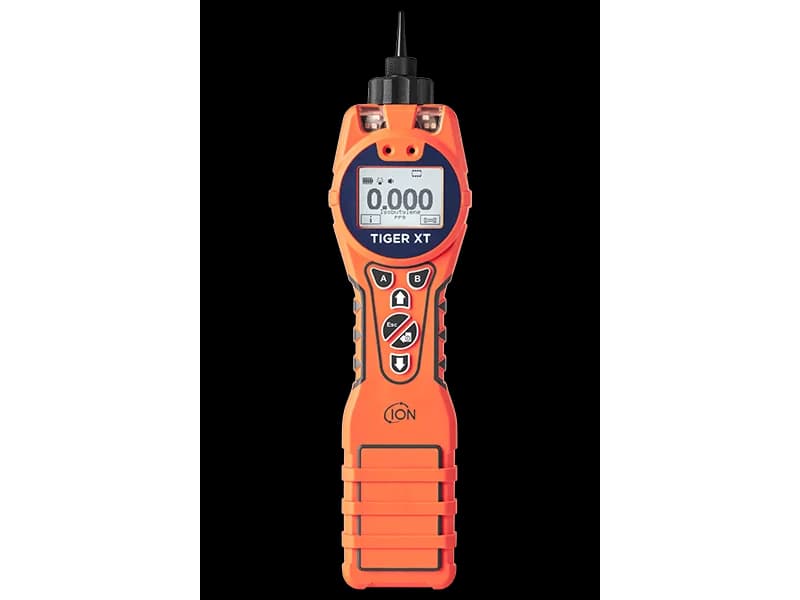
Ion Science Tiger XT — handheld PID detector for volatile organic compounds
Intrinsically safe Ion Science photoionisation detector for over 750 volatile organic compounds: 1 ppb to 20,000 ppm, T90 under 2 s, Fence Electrode technology against…
Gas testing procedure
1. Before opening: what was inside
Find out what product was stored or processed in the vessel, which reagents were used for cleaning and what it was purged with. This determines which substances to look for and whether a selective instrument is needed.
2. Test from outside, before entry
Testing is done from outside, through the hatch, with a sampling probe or hose. The portable Tiger XT with its built-in pump suits this: it draws the sample from depth through the hose.
Allow for hose delay. A sample takes longer through a long hose. At each point, hold the probe until the reading stabilises, no less than the time for the sample to travel the hose plus the instrument response time.
3. Test at different heights
Gases and vapours stratify:
- heavier than air: gasoline and benzene vapours, most solvents, H₂S, CO₂ collect at the bottom;
- lighter than air: methane, hydrogen at the top;
- close to air: CO, nitrogen spread through the volume.
Test at a minimum of three levels (top, middle, bottom) and in areas far from the hatch where ventilation is weaker.
4. Selective test if benzene may be present
If total VOC is above zero and the product may contain benzene, take a selective reading with Tiger Select. An entry decision cannot be based on a total PID reading when benzene may be present.
5. Monitoring during the work
A pre-entry test is a snapshot. Conditions change during the job: product residues evaporate from deposits during cleaning, walls heat up, welding starts. Therefore:
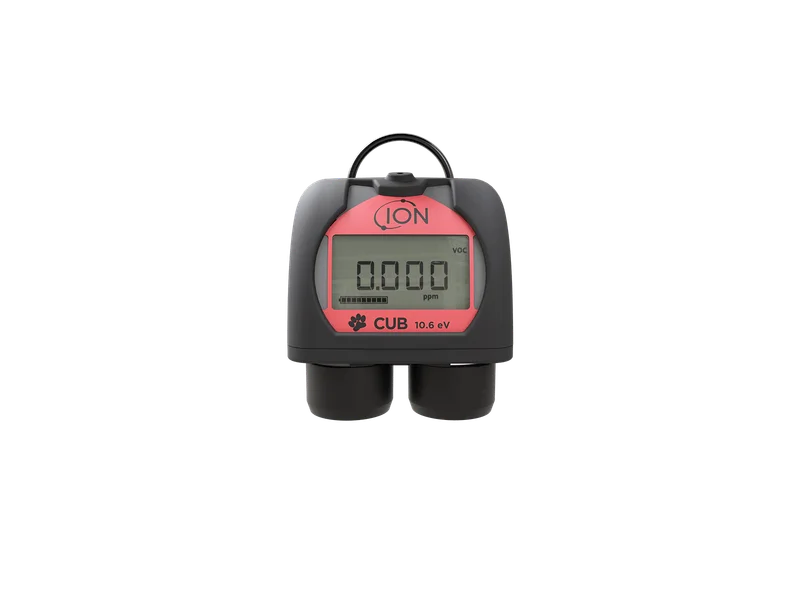
- the worker wears a Cub personal monitor in the breathing zone alongside a multi-gas detector;
- the attendant outside periodically repeats the test;
- ventilation runs continuously, not just before entry.
Example: cleaning a former gasoline tank
| Stage | Action | Instrument |
|---|---|---|
| Preparation | Draining, steaming or washing, ventilation | — |
| Before opening | Check that the hatch can be opened safely | Multi-gas detector |
| Before entry | O₂, %LEL, H₂S from outside at three levels | Multi-gas detector with sampling pump |
| Before entry | Total VOC at three levels | Tiger XT |
| Before entry | Benzene, if total VOC is above the trigger | Tiger Select |
| During work | Personal monitoring | Multi-gas + Cub |
| During work | Periodic testing from the hatch | Tiger XT |
Typical mistakes
- Testing at the hatch instead of inside. The air at the hatch is fresh; at the bottom it is different. A probe or hose reaching the full depth is needed.
- Too little time on the hose. The instrument has not yet received the sample from depth, so the reading reflects the air in the hose.
- Only a four-gas instrument with organic products. Blind to toxic VOCs at ppm levels.
- Testing once before entry. Conditions change during the work.
- An instrument without a bump test. A dirty PID lamp reads zero. The routine is in the article on PID calibration and maintenance.
Summary
Safe entry into a confined space with organic products requires four levels of control: oxygen, flammability, inorganic toxic gases and organic vapours. A multi-gas detector covers the first three; only a PID covers the fourth. Testing from outside at different heights with Tiger XT, selective benzene measurement with Tiger Select and a personal Cub on the worker close the gap that turns a "normal" test into a fatal one.
KEG TRK supplies Ion Science instruments in Kazakhstan and helps put together a kit for gas hazardous work at your plant. The procedure for gas hazardous work is defined by current Kazakhstan industrial safety rules and your plant's own instructions; this article does not replace them. Kit selection is covered in the article on choosing a PID detector.
Equipment in this article
KEG TRK quotes prices and delivery times to Kazakhstan on request. We will prepare a commercial offer for your application.
Ion Science Tiger XT — handheld PID detector for volatile organic compounds
Intrinsically safe Ion Science photoionisation detector for over 750 volatile organic compounds: 1 ppb to 20,000 ppm, T90 under 2 s, Fence Electrode technology against…

Ion Science Tiger XT Select — handheld benzene detector
Intrinsically safe Ion Science PID detector for selective benzene measurement from 0.01 ppm with pre-filter tubes, total aromatic compounds (TAC) with STEL and TWA, and…
Also in this article: Ion Science Cub — personal VOC monitor
Read also
9/25/2026
Tiger, Tiger Select, Titan 2, Falco or Cub: How to Choose an Ion Science PID Detector for the Job
A comparison of the Ion Science range: portable Tiger XT and Tiger XTL, selective Tiger Select, fixed Falco and Titan 2, personal Cub. A selection table and typical kits for a refinery, a chemical plant and a solvent store.
8/24/2026
Gas and VOC Leak Detection on Industrial Sites: Ion Science PID Detectors
How to choose a PID detector for gas and volatile organic compound leaks: Ion Science personal, portable and fixed instruments, LDAR programmes and the pairing with ultrasound.
10/23/2026
Photoionization detector (PID): how it works and what it measures
A PID exposes the sample to UV light and measures the ion current. It sees compounds with ionization energy below the lamp energy (10.0-11.7 eV): aromatics, solvents, fuels. Not methane.