
Tiger, Tiger Select, Titan 2, Falco or Cub: How to Choose an Ion Science PID Detector for the Job
A comparison of the Ion Science range: portable Tiger XT and Tiger XTL, selective Tiger Select, fixed Falco and Titan 2, personal Cub. A selection table and typical kits for a refinery, a chemical plant and a solvent store.
In this article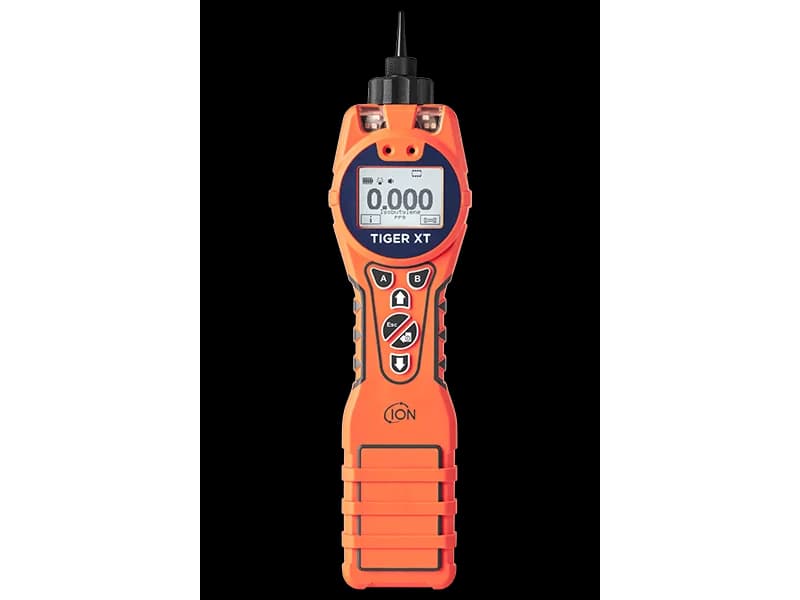
Prepared by the KEG TRK team · How we prepare our content
When a customer comes to us asking for "a VOC gas detector", our first question is: what exactly is it for? Finding a leak at a flange, protecting a worker during a shift, continuously monitoring a pump house or measuring benzene against a gasoline background are four different tasks, and the Ion Science range has a dedicated instrument for each. Buying one "universal" detector to cover everything does not work.
Below is how the range is structured, how the models differ and which kit suits typical sites.
Three questions that drive the choice
- Who or what is being protected? A person (personal instrument), a zone (fixed) or a survey task (portable).
- What is being measured? Total volatile organic compounds (TVOC) or a specific substance, benzene.
- For how long? A 2–3 hour walkdown, an 8–12 hour shift or around the clock.
The Ion Science range at a glance
| Model | Type | Measures | Main task |
|---|---|---|---|
| Tiger XT | Portable, pumped | TVOC, 1 ppb to 20,000 ppm | Surveys, leak detection, LDAR, confined space entry |
| Tiger XTL | Portable, pumped | TVOC, typical industrial ranges | Routine walkdowns, less critical points, training |
| Tiger Select | Portable, pumped | TVOC + benzene / total aromatics (TAC) | Selective benzene monitoring at refineries, fuel stations, chemical plants |
| Cub | Personal, wearable | TVOC | Protecting an individual worker, exposure logging |
| Falco | Fixed | TVOC | Continuous zone monitoring, signal to SCADA |
| Titan 2 | Fixed | Benzene | Continuous selective benzene monitoring |
All Ion Science PID instruments share a sensor with Fence Electrode technology, which reduces the effect of humidity and contamination on readings. In Kazakhstan, with its temperature swings, fog on the Caspian coast and dust, this is no small thing: a conventional PID drifts in such conditions.
Equipment covered in this article
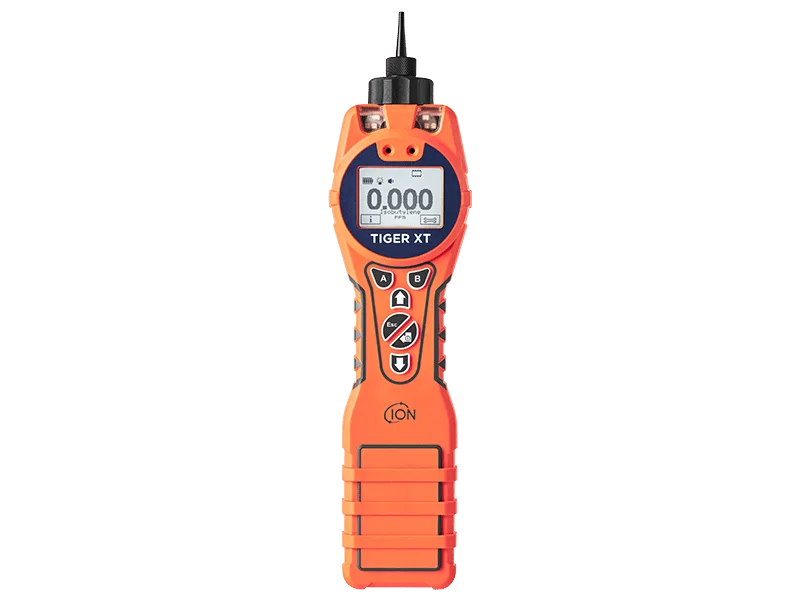
Ion Science Tiger XT — handheld PID detector for volatile organic compounds
Intrinsically safe Ion Science photoionisation detector for over 750 volatile organic compounds: 1 ppb to 20,000 ppm, T90 under 2 s, Fence Electrode technology against…
Portable: Tiger XT, Tiger XTL, Tiger Select
Tiger XT is the main survey instrument. Its wide range from 1 ppb to 20,000 ppm lets one instrument find trace leaks and high concentrations at the source. A response time under 2 seconds means the operator sees the change while the probe is still at the flange. ATEX / IECEx certification allows work in hazardous areas. Memory for 120,000 data points supports LDAR programmes and reporting.
Tiger XTL is a simplified model on the same sensor. It suits routine walkdowns where extreme ranges and extended logging are not needed, and works as a second or third instrument in the fleet so that every area does not need the top model.
Tiger Select is for when you need to know not "how much organics in total" but "how much benzene". It works in TVOC mode for screening and in Select mode with a selective tube to measure benzene. More in the article on benzene monitoring at refineries.
Choosing between them: if the site has benzene and aromatics, at least one Tiger Select is essential. For general surveys and LDAR, Tiger XT. For high-volume walkdowns in addition to the XT, XTL.
Personal: Cub
Cub does not look for leaks; it protects a person. Clipped to clothing in the breathing zone, it runs the whole shift, gives audible, vibrating and visual alarms when a threshold is exceeded and logs individual exposure for occupational health reports.
Where it is needed: workers in zones with VOC risk, contractors cleaning tanks, laboratory staff, personnel in paint shops and solvent stores. If a worker already carries a multi-gas detector (O₂, LEL, H₂S, CO), Cub does not replace it but complements it: a multi-gas detector does not see toxic VOCs at ppm levels.
Fixed: Falco and Titan 2
Falco is a fixed PID for continuous TVOC monitoring of a zone. Typhoon technology protects the sensor from condensation, allowing installation on open-air sites. 4–20 mA, Modbus and relay outputs integrate it into the site gas safety system. It suits tank farms, loading racks and solvent workshops.
Titan 2 is a fixed monitor specifically for benzene. It is needed where the hydrocarbon background is high but benzene is what must be controlled: aromatics pump houses, gasoline and reformate loading points, sampling points.
Choosing between them: if the controlled substance is a single one and it is benzene against other hydrocarbons, Titan 2. If the task is general control of organics in a zone, Falco.
Typical kits by site
| Site | Portable | Personal | Fixed |
|---|---|---|---|
| Refinery, units with aromatics | Tiger XT + Tiger Select | Cub for unit personnel | Titan 2 at pump houses and loading, Falco across the site |
| Fuel terminal | Tiger Select | Cub for loading operators | Titan 2 / Falco at the rack |
| Chemical plant, solvents | Tiger XT | Cub | Falco in workshops |
| Paint and solvent store | Tiger XTL | Cub as needed | Falco |
| Environmental team, soil surveys | Tiger XT | — | — |
| Gas rescue service | Tiger XT + Tiger Select | Cub | — |
The number of instruments depends on the number of shifts, areas and spare requirements during calibration. For every instrument that goes out for verification or repair there should be a spare, otherwise walkdowns stop.
What a PID does not measure and how to cover it
A PID with a 10.6 eV lamp does not see methane, ethane or propane, nor inorganic gases such as CO and H₂S in the ranges covered by electrochemical sensors. These tasks need other instruments:
- methane and flammable gases: catalytic and IR sensors in multi-gas detectors;
- helium, hydrogen, refrigerants: the Panther PRO thermal conductivity leak detector;
- SF6: dedicated Ion Science leak detectors and Rapidox SF6 gas analysers;
- compressed gas leaks of any composition: ultrasonic leak detection.
Summary
Choosing a PID detector means choosing for the task, not for the budget. Portable Tiger XT for surveys, Tiger Select for benzene, Cub to protect a person, Falco and Titan 2 for continuous zone monitoring. The right kit almost always includes instruments from two or three groups.
KEG TRK is the Ion Science supplier in Kazakhstan. We will help put together a kit for your site, select consumables and arrange calibration. More on the technology in the article on Ion Science PID detectors.
Equipment in this article
KEG TRK quotes prices and delivery times to Kazakhstan on request. We will prepare a commercial offer for your application.
Ion Science Tiger XT — handheld PID detector for volatile organic compounds
Intrinsically safe Ion Science photoionisation detector for over 750 volatile organic compounds: 1 ppb to 20,000 ppm, T90 under 2 s, Fence Electrode technology against…

Ion Science Tiger XTL — handheld PID VOC detector for routine rounds
Simplified version of the Tiger photoionisation detector: 0.1–5,000 ppm range, T90 under 2 s, 80,000 data points in 128 zones, ATEX and IECEx certified, IP65, up to 24 h…
Also in this article: Ion Science Tiger XT Select — handheld benzene detector, Ion Science Titan 2 — fixed benzene monitor, Ion Science Falco 2 — fixed PID VOC detector, Ion Science Cub — personal VOC monitor
Read also
11/3/2026
Which Ion Science instrument to choose: VOC, benzene, mercury, SF6, helium
Choosing an Ion Science gas instrument by task: PID detectors for VOC and benzene, mercury vapor indicator, SF6 leak detectors, helium and hydrogen detector. Tables of instruments, lamps and ranges.
8/24/2026
Gas and VOC Leak Detection on Industrial Sites: Ion Science PID Detectors
How to choose a PID detector for gas and volatile organic compound leaks: Ion Science personal, portable and fixed instruments, LDAR programmes and the pairing with ultrasound.
9/29/2026
Calibrating and Maintaining a Tiger PID Detector: Bump Test, Lamp Cleaning, Electrode Replacement
A maintenance routine for photoionisation detectors: how calibration differs from a bump test, how often to do each, how to clean the UV lamp and replace the electrode stack, and which records to keep for audits and verification.