
Benzene Monitoring at Refineries: Pairing Tiger Select and Titan 2 from Walkdown to Fixed Monitoring
Why a standard PID cannot tell benzene from other hydrocarbons, how Tiger Select measures benzene selectively, where a fixed Titan 2 monitor is needed and how to build a benzene monitoring system at a refinery or fuel terminal.
In this article
Prepared by the KEG TRK team · How we prepare our content
Benzene is one of the few substances at a refinery where a measurement error means not product loss but a direct risk to workers' health. It is a recognised carcinogen, and permissible workplace concentrations are orders of magnitude lower than for most hydrocarbons. And benzene is almost never alone: it comes mixed with toluene, xylenes, hexane and dozens of other compounds.
Hence the core problem: a standard photoionisation detector shows total volatile organic compounds and cannot say how much of that is benzene. Below is how Ion Science Tiger Select and Titan 2 solve this, and how to build a monitoring system on site.
Why benzene is a separate task
Low exposure limits
Benzene limits vary between countries, but they are all very low:
| Limit | Value | Conversion |
|---|---|---|
| Russian workplace limit, shift average (used as a reference in some CIS countries) | 5 mg/m³ | ≈ 1.6 ppm |
| Russian workplace limit, short-term maximum | 15 mg/m³ | ≈ 4.7 ppm |
| EU binding limit (Directive 2004/37/EC as amended by 2022/431), from April 2026 | 0.66 mg/m³ | 0.2 ppm |
Conversion: mg/m³ = ppm × 78.11 / 24.45 (at 25 °C), so 1 ppm of benzene ≈ 3.2 mg/m³. Kazakhstan has its own hygiene standards; check the current edition and your corporate standards for your site (many international operators apply stricter internal limits).
Note that we are talking about single ppm and fractions of a ppm. A flammable gas detector set to LEL does not see benzene at these levels: benzene's lower explosive limit is about 1.2% vol, so 1% LEL is roughly 120 ppm, dozens of times above the exposure limit.
A mixture, not a pure substance
A PID with a 10.6 eV lamp ionises benzene (ionisation potential 9.24 eV), but it equally ionises toluene, xylenes and most heavy hydrocarbons. A reading of "5 ppm" over an open hatch on a gasoline tank could mean 0.1 ppm of benzene or 3 ppm of benzene. A work permit decision cannot be made on a total reading alone.
How Tiger Select measures selectively
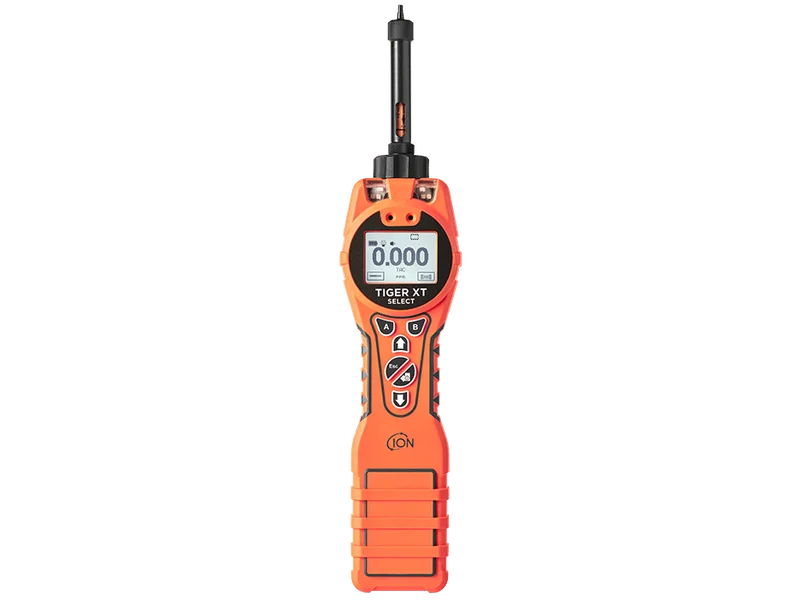
Tiger Select is a portable PID from the Tiger range with two modes:
- TVOC mode: total volatile organic compounds, like a standard Tiger. Used for rapid screening.
- Select mode: measurement of benzene (or total aromatic compounds, TAC) using a single-use selective pre-filter tube. The tube retains interfering compounds and lets the target substance through to the sensor. The result is the concentration of benzene specifically.
The practical workflow:
- the operator walks the area in TVOC mode, which is fast and uses no tubes;
- if TVOC exceeds the level at which benzene could exceed the limit, a tube is fitted and a selective measurement taken;
- the result is logged in the instrument with location and time.
This two-step approach saves consumables and time: a selective measurement is needed only where the overall background calls for it.
Equipment covered in this article
Ion Science Tiger XT Select — handheld benzene detector
Intrinsically safe Ion Science PID detector for selective benzene measurement from 0.01 ppm with pre-filter tubes, total aromatic compounds (TAC) with STEL and TWA, and…
Where a fixed Titan 2 is needed
A portable instrument shows the picture at the time of the walkdown. But there are zones where benzene can appear at any moment and where people are present constantly or regularly:
- loading and unloading points for gasoline, reformate and aromatic fractions;
- pump houses for aromatic products, with leaks through mechanical seals;
- sampling points and laboratory rooms near units;
- tank cleaning areas and drain systems.
These places call for a fixed selective monitor, Titan 2. It runs continuously without an operator and sends data to the DCS / SCADA. The key difference from a fixed total VOC PID monitor (Falco) is that Titan 2 measures benzene specifically, not the sum of compounds. Where the hydrocarbon background is high and benzene is what must be controlled, this is fundamental.
A benzene monitoring system: four levels
| Level | Task | Instrument | Who uses it |
|---|---|---|---|
| Area screening | Quickly find places with elevated VOC | Tiger XT / Tiger Select in TVOC mode | Gas rescue teams, walkdown operators |
| Selective measurement | Determine benzene concentration at a point | Tiger Select in Select mode | Gas rescue teams, HSE |
| Fixed monitoring | Continuously monitor permanent-risk zones | Titan 2 | Automatic, signal to DCS |
| Personal protection | Warn an individual worker | Cub | Personnel in the zone |
No level replaces another. A fixed monitor does not see a leak in the next pump house, a portable instrument does not work at night without an operator, and a personal monitor protects a person but does not find the source.
Typical scenarios at a refinery or terminal
Permit for work inside a tank or vessel. Before opening and entry: a total VOC reading, then a selective benzene reading at several heights (benzene vapour is heavier than air and collects at the bottom). During work: personal monitors on people. More in the article on gas testing for confined spaces.
Aromatics pump house walkdown. TVOC screening at every mechanical seal and flange; on exceedance, a selective measurement and a seal repair request.
Loading rack. A fixed Titan 2 at operators' breathing height with an alarm to the control room; periodic checks with a portable instrument.
Fenceline environmental monitoring. Readings at the site boundary to confirm benzene is not leaving the site.
Mistakes to avoid
- Treating TVOC as benzene. A total PID reading is a "check this" signal, not a benzene result.
- Converting TVOC using the benzene correction factor. A correction factor applies to a pure substance, not to a mixture of unknown composition. Details are in the article on PID correction factors.
- Skipping the bump test. An instrument not checked with gas before the shift may show zero with a dirty lamp. The routine is covered in the article on PID calibration and maintenance.
- Installing a fixed monitor "where convenient". The location is chosen by leak sources, air movement and where people are, not by proximity to a cable route.
Summary
Benzene monitoring is a task where "roughly" does not work. A general PID finds problem areas, the selective Tiger Select gives the concentration of benzene specifically, the fixed Titan 2 covers permanent-risk zones, and the personal Cub protects the worker. Together they form a system you can show both to inspectors and to your own occupational safety team.
KEG TRK supplies Ion Science instruments in Kazakhstan and helps choose a configuration for your site: the number of portable and fixed instruments, installation points, consumables and a calibration routine. A general overview of PID technology is in the article on gas and VOC leak detection.
Equipment in this article
KEG TRK quotes prices and delivery times to Kazakhstan on request. We will prepare a commercial offer for your application.
Ion Science Tiger XT Select — handheld benzene detector
Intrinsically safe Ion Science PID detector for selective benzene measurement from 0.01 ppm with pre-filter tubes, total aromatic compounds (TAC) with STEL and TWA, and…

Ion Science Titan 2 — fixed benzene monitor
Flameproof fixed benzene monitor: MiniPID sensor with a proprietary separation method, 20 ppb – 20 ppm range, one reading per minute, 4–20 mA, RS485 Modbus and two…
Also in this article: Ion Science Tiger XT — handheld PID detector for volatile organic compounds, Ion Science Cub — personal VOC monitor
Read also
9/25/2026
Tiger, Tiger Select, Titan 2, Falco or Cub: How to Choose an Ion Science PID Detector for the Job
A comparison of the Ion Science range: portable Tiger XT and Tiger XTL, selective Tiger Select, fixed Falco and Titan 2, personal Cub. A selection table and typical kits for a refinery, a chemical plant and a solvent store.
11/3/2026
Which Ion Science instrument to choose: VOC, benzene, mercury, SF6, helium
Choosing an Ion Science gas instrument by task: PID detectors for VOC and benzene, mercury vapor indicator, SF6 leak detectors, helium and hydrogen detector. Tables of instruments, lamps and ranges.
10/1/2026
Gas Testing Before Confined Space Entry: Why a Multi-Gas Detector Is Not Enough and Why You Need a PID
Tanks, manholes, vessels, holds: which gases to test before entry, why an LEL sensor does not see toxic vapours, how to test at different heights with Tiger and protect the worker with Cub during the job.