
PID Response Factors: How Tiger Measures a Specific Compound When Calibrated with Isobutylene
What a photoionisation detector response factor is, why PIDs are calibrated with isobutylene, how to convert readings to toluene, acetone or hexane, how to handle mixtures and where errors begin.
In this article
Prepared by the KEG TRK team · How we prepare our content
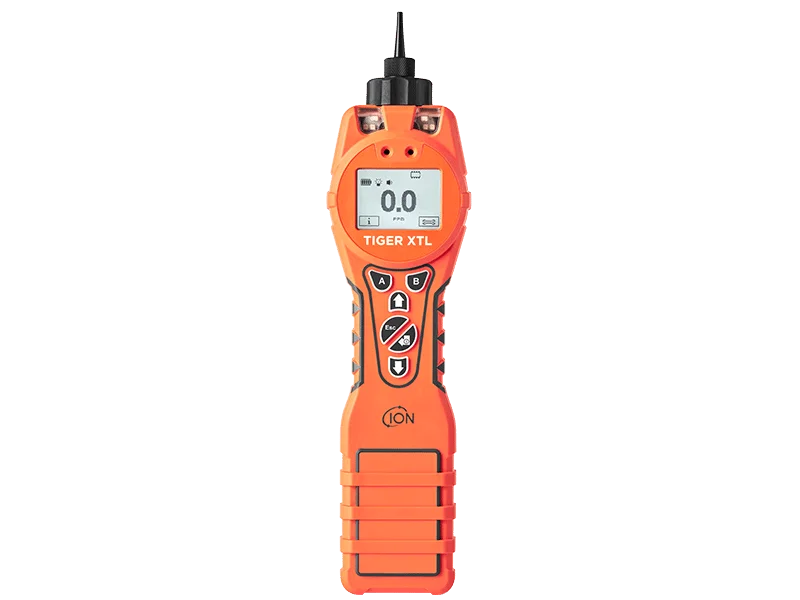
A photoionisation detector (PID) responds to hundreds of volatile organic compounds. Yet it is almost always calibrated with a single gas: isobutylene. Hence the natural question from site: "The instrument reads 50 ppm, but our workshop uses toluene. How much toluene is there really?"
The answer is the response factor (RF). Below: what it is, how to use it with Tiger and other Ion Science PIDs, and where conversion stops working.
Why PIDs are calibrated with isobutylene
Isobutylene is used as the reference for practical reasons: it is non-toxic at calibration concentrations, stable in a cylinder, ionised by a 10.6 eV lamp and gives a mid-range response. The calibration mixture is usually 100 ppm isobutylene in air.
After calibration the instrument reads in isobutylene equivalent: "this many ppm of isobutylene would give the same signal". For any other substance the signal per 1 ppm will be different, higher or lower.
What a response factor is
A response factor is a multiplier that converts a reading in isobutylene equivalent into the concentration of a specific substance:
C(substance) = Reading × RF
- RF < 1: the substance ionises more easily than isobutylene, so the instrument "sees" it more strongly. The reading is high and the correction reduces it.
- RF > 1: the substance ionises less easily, the reading is low and the correction increases it.
- RF undefined: the substance's ionisation potential is above the lamp energy and the PID does not see it.
Equipment covered in this article
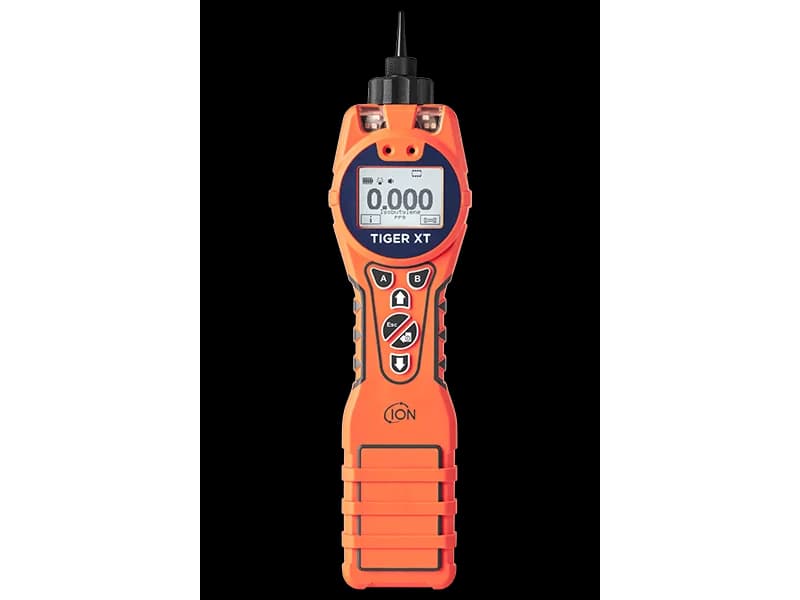
Ion Science Tiger XT — handheld PID detector for volatile organic compounds
Intrinsically safe Ion Science photoionisation detector for over 750 volatile organic compounds: 1 ppb to 20,000 ppm, T90 under 2 s, Fence Electrode technology against…
Indicative response factors for a 10.6 eV lamp
| Substance | Ionisation potential, eV | RF (indicative) | What it means |
|---|---|---|---|
| Benzene | 9.24 | ~0.5 | Instrument reads about twice the actual value |
| Toluene | 8.82 | ~0.5 | Similar to benzene |
| Xylenes | ~8.5 | ~0.4–0.6 | Strong response |
| Styrene | 8.43 | ~0.4 | Strong response |
| Acetone | 9.70 | ~1.2 | Close to isobutylene |
| Methyl ethyl ketone | 9.52 | ~0.8 | Close to isobutylene |
| n-Hexane | 10.13 | ~4 | Weak response, reading much too low |
| Ethanol | 10.47 | ~10 | Very weak response |
| Ammonia | 10.07 | ~9–10 | Very weak response |
| Methane | 12.6 | — | Not detected |
Important: the values in the table are indicative. Response factors differ between manufacturers and even between sensor designs. For actual work, use the Ion Science table built into the instrument: on a Tiger you simply select the substance from the library and it converts the reading itself.
How to use it: an example
A paint shop uses toluene. A Tiger calibrated with isobutylene reads 40 ppm.
Without correction: 40 ppm. With correction: 40 × 0.5 = 20 ppm of toluene.
Now the opposite case, a hexane store. The instrument reads 25 ppm.
With correction: 25 × 4 = 100 ppm of hexane, four times what is on the display. Without correction the hazard would have been underestimated.
Conclusion: for substances with an RF above 1, working without correction systematically underestimates risk. That is why it makes sense to select the target substance in the Tiger library when it is known.
How to handle a mixture
If the air contains a mixture of known composition, the mixture response factor is calculated as:
RF(mix) = 1 / (x₁/RF₁ + x₂/RF₂ + … + xₙ/RFₙ)
where xᵢ is the mole (volume) fraction of the component in the vapour phase.
Example: solvent vapour of 50% toluene (RF 0.5) and 50% acetone (RF 1.2).
RF(mix) = 1 / (0.5/0.5 + 0.5/1.2) = 1 / (1 + 0.417) ≈ 0.71
With a reading of 30 ppm, the mixture concentration ≈ 30 × 0.71 ≈ 21 ppm.
Limitation: the formula works only if the vapour composition is known and stable. Liquid composition is not vapour composition; lighter components evaporate faster.
When conversion does not work
- Unknown composition. Over gasoline, crude oil or condensate at a refinery there are dozens of compounds with different RFs. The PID reading is an indicator that "organics are present here", not a quantitative concentration of a specific substance.
- Monitoring a specific toxic component in a mixture. You cannot convert TVOC using the benzene factor: benzene is only part of the mixture. This needs a selective instrument, Tiger Select or the fixed Titan 2. More in the article on benzene monitoring.
- The substance is not ionised by the lamp. Methane, ethane, propane: the PID does not see them with any factor.
- Very high concentrations. PID response is linear within the working range; at the edge of the range and in high humidity deviations are possible.
Choosing a lamp
The lamp energy determines which substances the PID sees:
| Lamp | What it additionally sees | Notes |
|---|---|---|
| 10.0 eV | A narrow set of easily ionised substances | More selective, fewer interfering components |
| 10.6 eV | Most VOCs: aromatics, ketones, most solvents | Standard, long service life |
| 11.7 eV | Additionally some chlorinated compounds, methanol, formaldehyde | Short lamp life, needs careful storage |
For most oil, gas and chemical tasks a 10.6 eV lamp is sufficient. An 11.7 eV lamp is chosen for specific substances that a 10.6 eV lamp cannot see.
Practical recommendations
- Know what you are measuring. Before a walkdown, find out which substances are present in the area and select the target substance in the instrument library.
- Record the mode. State in the report whether the reading was in isobutylene equivalent or converted to a substance.
- Compare like with like. Trends at a point only make sense with identical instrument settings.
- Calibrate regularly. A response factor is useless if the instrument itself is wrong. The routine is in the article on PID calibration and maintenance.
Summary
A response factor turns a PID reading into the concentration of a specific substance, but only when the substance is known and the composition is stable. For substances with a high RF (hexane, alcohols, ammonia), working without correction dangerously understates concentration. Mixtures of unknown composition and monitoring of a specific toxic component need a selective instrument.
KEG TRK supplies Ion Science PID detectors in Kazakhstan and helps configure instruments for the substances at your plant. Model selection is covered in the article on choosing a PID detector.
Equipment in this article
KEG TRK quotes prices and delivery times to Kazakhstan on request. We will prepare a commercial offer for your application.
Ion Science Tiger XT — handheld PID detector for volatile organic compounds
Intrinsically safe Ion Science photoionisation detector for over 750 volatile organic compounds: 1 ppb to 20,000 ppm, T90 under 2 s, Fence Electrode technology against…
Ion Science Tiger XTL — handheld PID VOC detector for routine rounds
Simplified version of the Tiger photoionisation detector: 0.1–5,000 ppm range, T90 under 2 s, 80,000 data points in 128 zones, ATEX and IECEx certified, IP65, up to 24 h…
Also in this article: Ion Science Cub — personal VOC monitor, Ion Science Falco 2 — fixed PID VOC detector
Read also
9/29/2026
Calibrating and Maintaining a Tiger PID Detector: Bump Test, Lamp Cleaning, Electrode Replacement
A maintenance routine for photoionisation detectors: how calibration differs from a bump test, how often to do each, how to clean the UV lamp and replace the electrode stack, and which records to keep for audits and verification.
9/25/2026
Tiger, Tiger Select, Titan 2, Falco or Cub: How to Choose an Ion Science PID Detector for the Job
A comparison of the Ion Science range: portable Tiger XT and Tiger XTL, selective Tiger Select, fixed Falco and Titan 2, personal Cub. A selection table and typical kits for a refinery, a chemical plant and a solvent store.
9/19/2026
KEG TRK becomes the official representative of Ion Science in Kazakhstan
As of September 2026, KEG TRK LLP is the official representative of British gas-detection manufacturer Ion Science in Kazakhstan: SF6 leak detectors, VOC detectors, supply, service and training.