
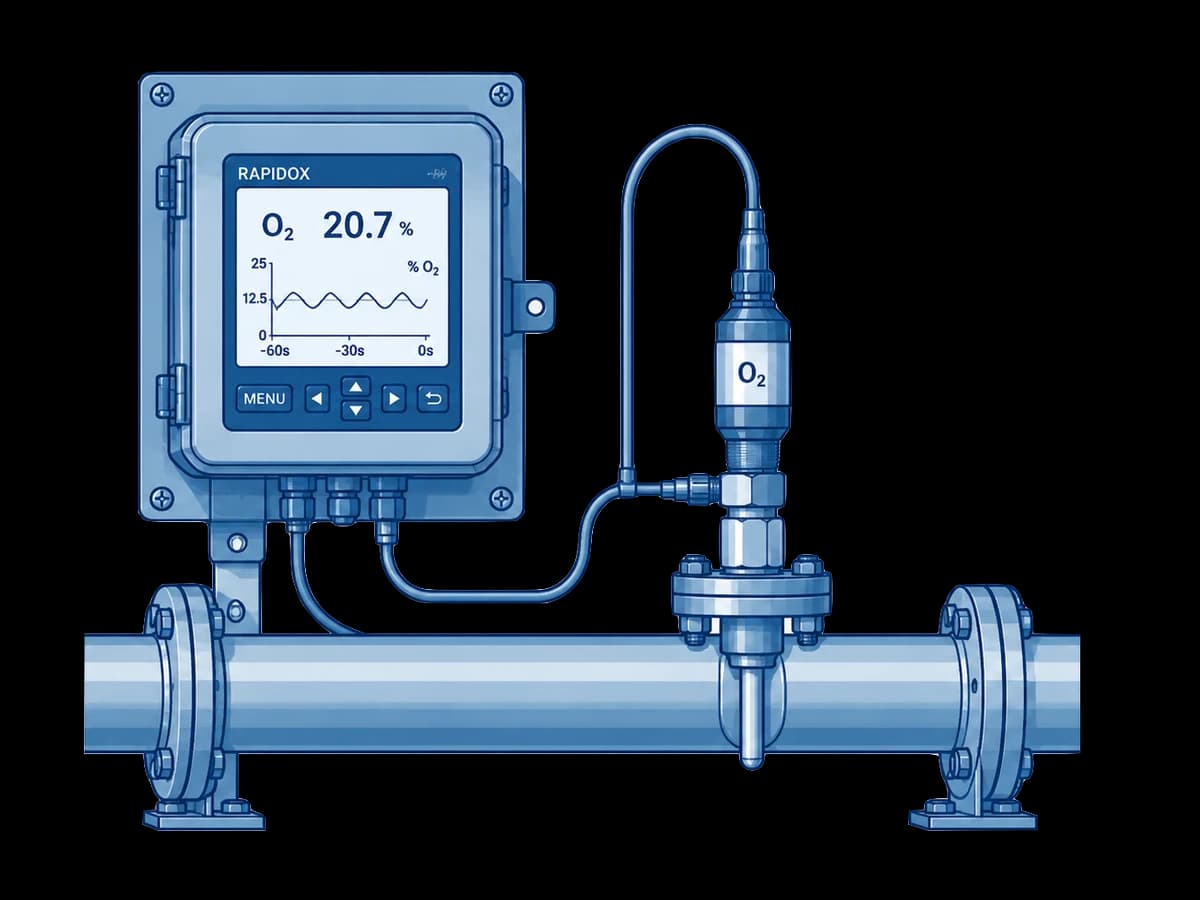
Oxygen gas analyser: where O₂ control is needed and how to choose
Choose an O₂ analyser by task, range and sample composition: zirconia for ppm in inert gas, electrochemical for samples with hydrogen or hydrocarbons, optical for percent levels with low drift.
An oxygen analyser is chosen by answering three questions: where you measure (a drawn sample or directly in the process), which range you need (ppm or percent), and what else is in the sample. According to Cambridge Sensotec, a zirconia sensor suits ppm in inert gas, an electrochemical sensor suits samples with hydrogen, helium and hydrocarbons, and an optical sensor suits percent measurements with low drift.
Where oxygen control is needed
Oxygen is monitored in two different situations, and they need different instruments.
Process gas. Nitrogen or argon is fed into a chamber, furnace or vessel to displace oxygen. Cambridge Sensotec puts it this way: the key to nitrogen blanketing is to make sure the critical oxygen level is not exceeded. The manufacturer lists these nitrogen blanketing applications:
- modified atmosphere packaging;
- welding stainless steel and titanium;
- flow soldering and solder reflow ovens;
- semiconductor manufacturing;
- protecting flammable cargoes;
- avoiding oxidation of metals;
- additive manufacturing (metal 3D printing).
The Rapidox 1100 application list on the manufacturer's site also includes heat treatment, electrical switchgear, hydrogen production, seal integrity and medical gas analysis. A separate power-sector task, oxygen in a transformer gas blanket, is covered in Oxygen in the transformer headspace.
Workplace air. Nitrogen, argon and SF₆ displace oxygen in enclosed rooms. Under OSHA 29 CFR 1910.146:
| O₂ in air, % by volume | Atmosphere under OSHA 1910.146 |
|---|---|
| below 19.5 | oxygen deficient |
| above 23.5 | oxygen enriched |
People are protected with gas detectors approved under the site's safety rules, not with a process analyser. Monitoring in rooms with SF₆ switchgear is described in Oxygen displacement in enclosed GIS rooms.
Types of oxygen sensor
Cambridge Sensotec uses three sensor types in Rapidox analysers.
| Sensor | Strengths (manufacturer data) | Limitations | When to choose |
|---|---|---|---|
| Zirconia | Fast response, accuracy at ultra-low O₂ levels, works in vacuum and with pressurised gas, lifespan over 35,000 hours | Operates at a very high temperature, so less suited to hazardous areas | ppm O₂ in nitrogen or argon: furnaces, chambers, vacuum |
| Electrochemical | Suitable for samples with hydrocarbons and VOCs, performs well in helium and hydrogen | The manufacturer names zirconia as the main choice for ppm | Samples with flammable gases, hydrogen, helium; hazardous areas |
| Optical | Range 0.01–100 %, very low drift, life up to 10 years | More expensive than electrochemical | Percent measurements where infrequent calibration is wanted |
The most common selection mistake is fitting a zirconia sensor where the sample contains hydrogen or hydrocarbons. For such samples the manufacturer recommends an electrochemical sensor.
Equipment covered in this article
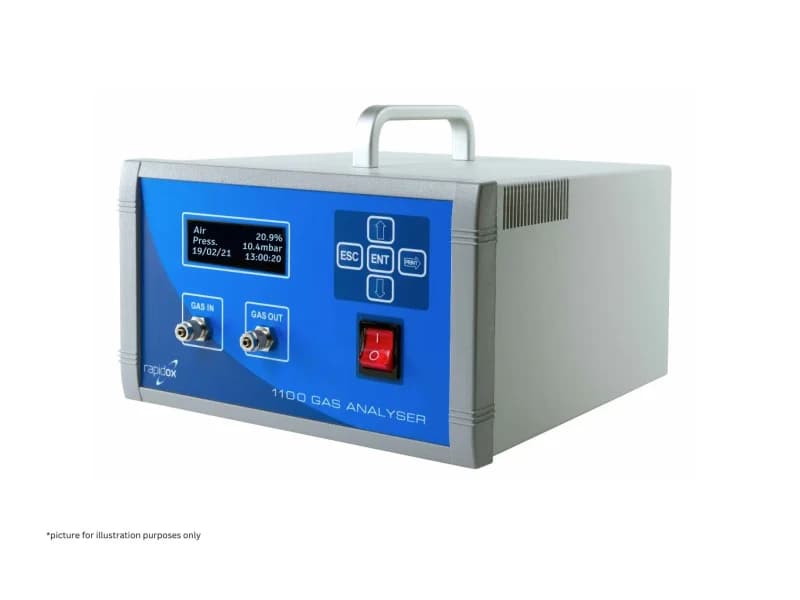
Rapidox 1100 — oxygen analyser
Versatile O₂ analyser with zirconia, electrochemical or optical sensor for ppm and percent measurements
Rapidox models and their ranges
| Model | Sensor and O₂ range | Sampling | Outputs |
|---|---|---|---|
| Rapidox 1100 | Zirconia 0.5 ppm – 30 %; electrochemical L 0.1 ppm – 1 %; electrochemical E 0.1–100 %; optical 0.01–100 % | Diaphragm pump 0–1.2 l/min or vacuum ejector; sample temperature up to 50 °C | 0–10 V, 4–20 mA, RS232 (RS485 optional), Modbus RTU, Ethernet; two programmable alarm relays |
| Rapidox 1100 OPT-MAX | Optical + electrochemical, 0.1 ppm – 100 % | Sampling inside the instrument | 0–10 V, 4–20 mA, RS232/Modbus |
| Rapidox 2100 | Zirconia on a remote cable, 10⁻²⁰ ppm – 30 %; electrochemical 0–100 % | Sensor in the process, up to 650 °C; 2 m cable, up to 25 m with extensions; type K thermocouple 0–1250 °C | 0–5 V, 4–20 mA, RS232 (RS485 optional), Modbus RTU, Ethernet; two alarm relays |
Rapidox 1100 and 2100 data are from the manufacturer's pages. The dual-sensor Rapidox 1100 switches between sensors with solenoid valves: the optical sensor handles percent levels, the electrochemical one handles ppm.
How to choose an analyser, step by step
- Define the task. Process gas (inerting, nitrogen blanketing, furnace) needs a process analyser. Breathing air for personnel needs a gas detector under the safety rules.
- Define the range. Residual oxygen in inert gas is ppm; purging, gas mixtures and air are percent; if the process passes through both, use a dual-sensor instrument.
- Check the sample composition. Hydrogen, helium, hydrocarbons, VOCs: electrochemical. Pure nitrogen or argon, vacuum, pressure: zirconia.
- Decide where the sensor sits. A pumped sample (Rapidox 1100, sample temperature up to 50 °C) or a sensor directly in the hot zone (Rapidox 2100, up to 650 °C).
- Check integration. Do you need analogue outputs, Modbus, alarm relays to control gas supply? Cambridge Sensotec notes that controlling nitrogen flow from Rapidox readings reduces nitrogen consumption.
- Check whether people are at risk in the room. If inert gas can escape into the room, personnel protection is needed in addition to the process analyser.
Which instrument to choose
- General-purpose benchtop or portable analyser with sample draw: Rapidox 1100, zirconia for ppm in inert gas or electrochemical for samples with hydrogen and hydrocarbons.
- Sensor directly in a furnace, chamber or high-temperature zone: Rapidox 2100 with a remote zirconia sensor.
KEG TRK supplies Cambridge Sensotec Rapidox gas analysers in Kazakhstan. Price on request.
Sources
- Cambridge Sensotec. The Difference Between Zirconia and Electrochemical Oxygen Gas Sensors.
- Cambridge Sensotec. Rapidox 1100 Oxygen Analyser.
- Cambridge Sensotec. Rapidox 2100 Oxygen Analyser.
- Cambridge Sensotec. Nitrogen Blanketing in Industrial Applications.
- OSHA. 29 CFR 1910.146 Permit-required confined spaces.
Frequently asked questions
Equipment in this article
KEG TRK quotes prices and delivery times to Kazakhstan on request. We will prepare a commercial offer for your application.
Rapidox 1100 — oxygen analyser
Versatile O₂ analyser with zirconia, electrochemical or optical sensor for ppm and percent measurements
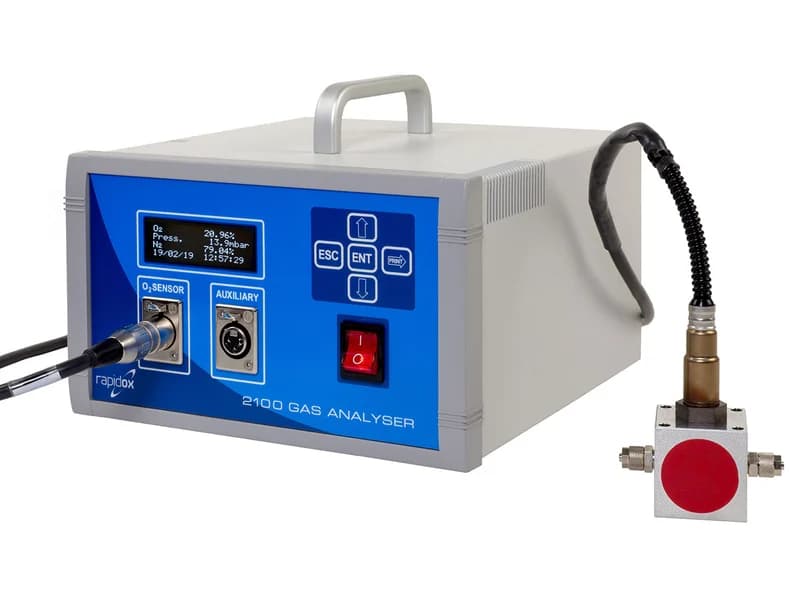
Rapidox 2100 — in-process oxygen analyser
Zirconia O₂ analyser with remote sensor to 650°C and Type K thermocouple for transformers and furnaces
Also in this article: Rapidox 1100 OPT-MAX — full-range O₂
Read also
10/13/2026
How to find a gas leak at an industrial site: methods and instruments
Pressurised gas leaks are located with ultrasound, VOCs measured with a PID, SF₆ found with an SF₆ detector, helium and hydrogen with a thermal conductivity detector, concentration with an analyser.
8/24/2026
Why Artesis Omnisight Is a Revolutionary Solution for Predictive Maintenance
Most condition monitoring programs split assets into "critical" and "everything else" with incompatible tools and no shared data model. Artesis Omnisight collapses that split at the signal level — here is how and why it works.
8/24/2026
Verification and Calibration of Measuring Instruments: How to Choose Reference Equipment
How to choose reference pressure and temperature calibrators, why periodic sensor verification matters, and how calibration drift quietly corrupts predictive-maintenance data.