
SF6 Leak Accounting: How to Calculate Losses in Kilograms and Emissions in CO₂ Equivalent
Why every kilogram of leaked SF6 matters to a utility, how to calculate leak rate from density and top-ups, how to convert it to CO₂ equivalent and which instruments the accounting needs.
In this article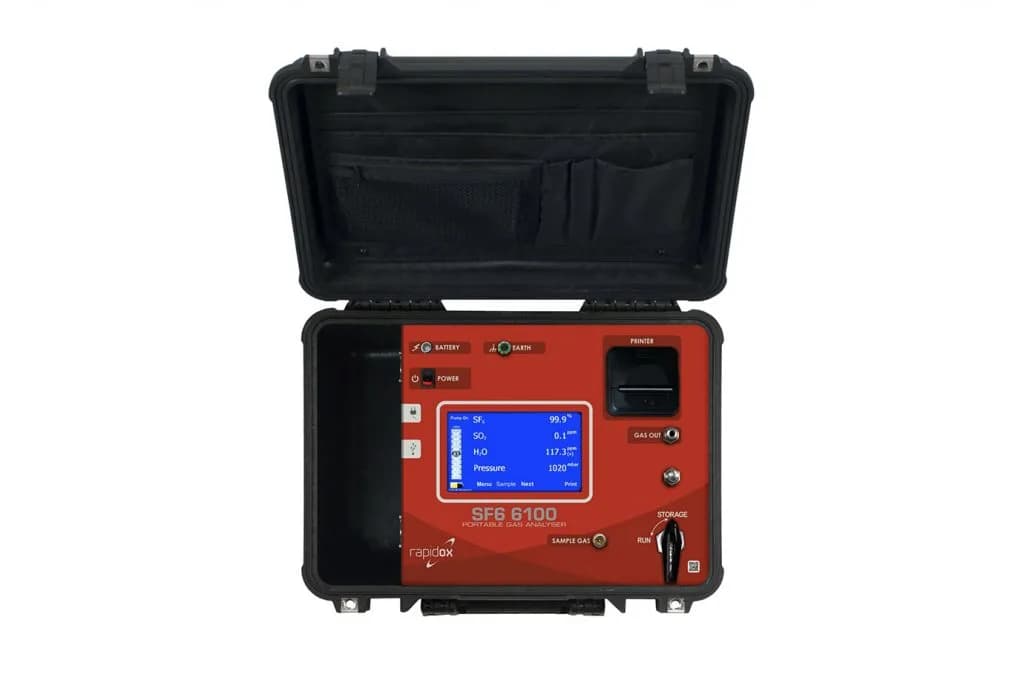
Prepared by the KEG TRK team · How we prepare our content
SF6 is an excellent insulating and arc-quenching gas and at the same time the most potent greenhouse gas known. Its global warming potential (GWP) is estimated by the IPCC at around 23,500 over a 100-year horizon: one kilogram of SF6 in the atmosphere is equivalent to about 23.5 tonnes of CO₂. SF6 leak accounting is therefore no longer an internal matter for the substation team: it feeds environmental reporting, ESG reports and the requirements of international partners.
Below is how to organise the accounting: where to get data, how to calculate leak rate and emissions, and which instruments are needed.
Where SF6 losses come from
| Source | Nature | How to control |
|---|---|---|
| Leaks through seals and enclosures | Continuous, slow | Density trends, leak detector |
| Maintenance: connecting, sampling | One-off, every operation | Equipment with gas return, trained staff |
| Gas quality analysis that vents the sample | One-off | Pump-back analysers |
| Opening a compartment, repairs | Large one-off | Gas recovery and storage, mass accounting |
| Accidental releases | Rare, large | Accounting by refill after the event |
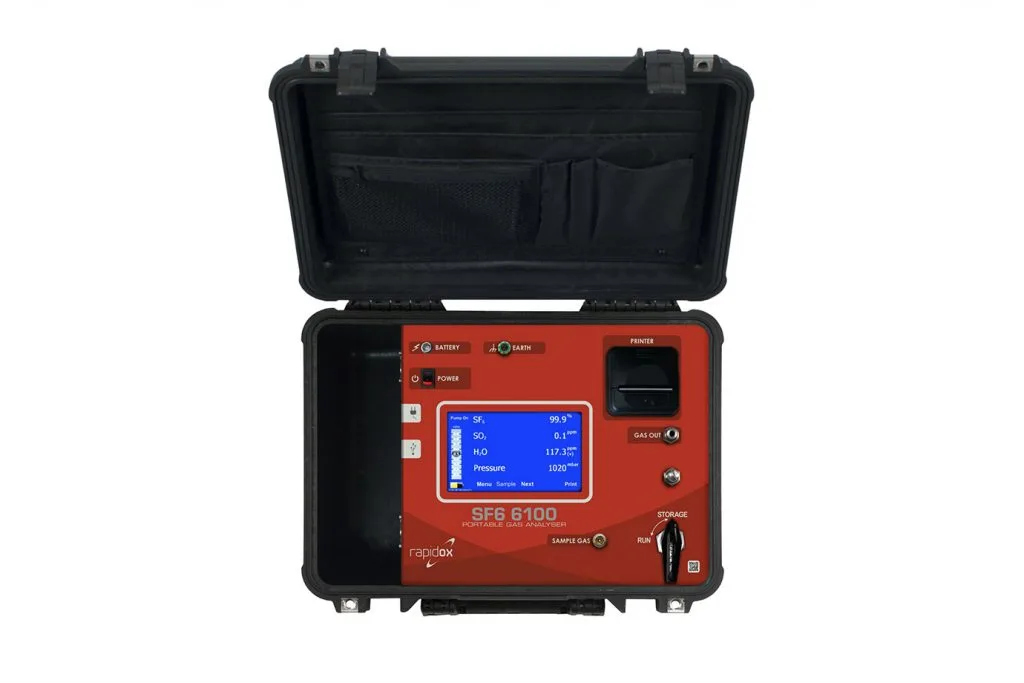
A significant share of losses is not leakage but maintenance operations. Every gas quality measurement with an instrument that vents its sample is a small emission. Analysers with gas return, such as the Rapidox SF6 6100 Pump Back, pump the sample back into the equipment.
Reference value for tightness
The high-voltage switchgear standard IEC 62271-1 sets a relative leakage rate for new SF6 equipment of about 0.5% of gas mass per year (values up to 1% per year appear for earlier generations of equipment). The exact value is in the manufacturer's documentation for each device; check the nameplate data.
A compartment losing noticeably more than declared needs a leak search, even if the "low pressure" alarm is still far off.
Equipment covered in this article
Rapidox SF6 6100 Portable — Portable SF6 Gas Analyser
Lightweight (8.5 kg) SF6 analyser for medium and high voltage GIS and breakers: purity, moisture and decomposition products, up to 8 gases at once.
How to calculate the leak rate
Method 1. From density (pressure referred to 20 °C)
A density monitor (or temperature-compensated gauge) shows pressure referred to 20 °C. If a compartment holds gas mass M (kg) at rated pressure P₀, then for a drop ΔP in referred pressure over time t:
Mass lost ≈ M × ΔP / P₀
Leak rate, % per year = (ΔP / P₀) × (365 / t in days) × 100%
Example. A GIS compartment holds 25 kg of SF6 at a rated pressure of 0.60 MPa (abs). Over 120 days the referred pressure fell by 0.012 MPa.
- Mass lost ≈ 25 × 0.012 / 0.60 = 0.5 kg in 120 days;
- annualised ≈ 0.5 × 365 / 120 ≈ 1.5 kg/year;
- relative rate ≈ 1.5 / 25 ≈ 6% per year, several times the nameplate value, so a leak search is needed.
Limitation: the method is sensitive to temperature compensation errors. Use a long-term trend, not two readings.
Method 2. From top-ups
If compartments are topped up, the gas mass added over a year is a direct estimate of the compartment's annual losses. Each top-up is weighed (cylinder mass before and after) and recorded against the compartment. This method is more reliable for reporting.
Method 3. Company-wide balance
Environmental reporting often uses a balance: gas in stock at the start of the year + purchases − gas in stock at year end − gas filled into new equipment + gas sent for disposal. The difference is the emissions. It requires careful cylinder accounting.
Converting to CO₂ equivalent
Emissions, t CO₂e = SF6 mass, kg × GWP / 1000
For the compartment in the example: 1.5 kg × 23,500 / 1000 ≈ 35 t CO₂e per year, comparable to the annual emissions of several passenger cars. For a substation with dozens of compartments and a few "problem" ones, the contribution becomes visible in company reporting.
Which GWP value to use (from the IPCC Fifth or Sixth Assessment Report) is set by the methodology your company reports under. Use one value consistently in all reports.
Instruments needed for accounting
| Task | Instrument |
|---|---|
| Find and confirm a leak | SF6 LeakCheck P1 XTL leak detector |
| Room monitoring, early warning | Rapidox SF6 Fixed Detection System, SF6 AreaCheck P2 |
| Quality analysis without venting | Rapidox SF6 6100 Pump Back |
| Weighing during top-up | Cylinder scales, log book |
Building the accounting in 5 steps
- Equipment register: all compartments and devices with nameplate gas mass.
- Operations log: top-ups, sampling, openings, with gas mass.
- Density trends from the control system or walk-round logs, temperature-compensated.
- Annual calculation of leak rate per compartment and emissions in CO₂ equivalent.
- Repair plan: compartments above the nameplate leak rate go to search and repair.
The search method is in the article on finding an SF6 leak on GIS.
Summary
SF6 accounting rests on three things: density trends, weighed top-ups, and instruments that find leaks without creating new emissions during maintenance. The calculation is simple but needs discipline: one GWP value, every cylinder accounted for, records for every compartment.
KEG TRK supplies Rapidox SF6 analysers with gas return and Ion Science leak detectors in Kazakhstan. We will help choose a kit for accounting and reducing SF6 losses.
Equipment in this article
KEG TRK quotes prices and delivery times to Kazakhstan on request. We will prepare a commercial offer for your application.
Rapidox SF6 6100 Portable — Portable SF6 Gas Analyser
Lightweight (8.5 kg) SF6 analyser for medium and high voltage GIS and breakers: purity, moisture and decomposition products, up to 8 gases at once.
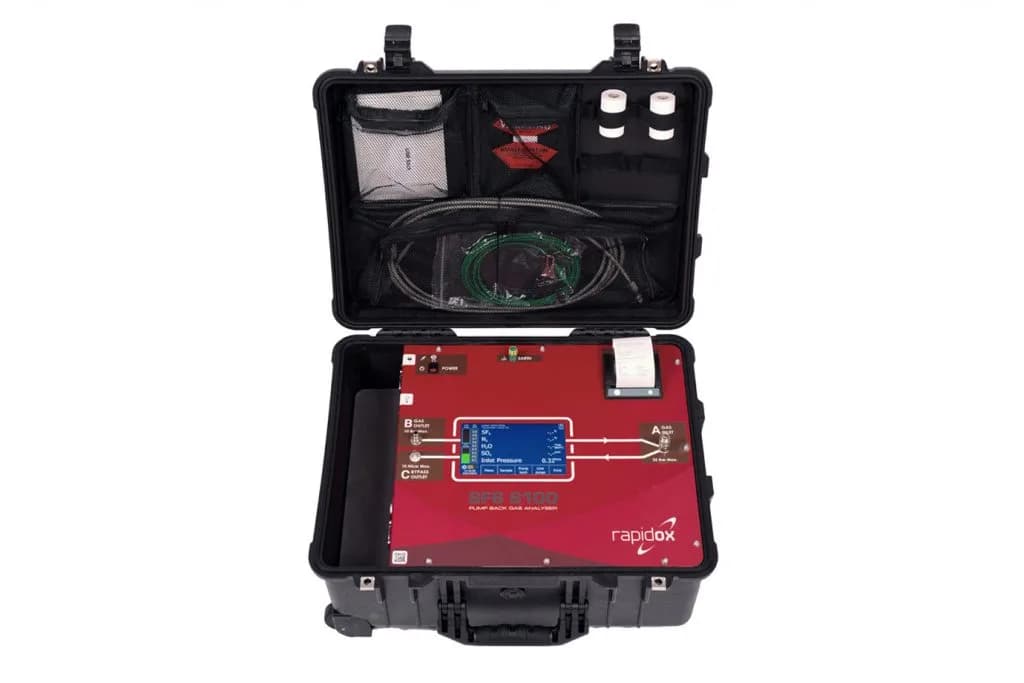
Rapidox SF6 6100 MK2 Pump Back — SF6 Analyser with Gas Return
Fully automatic zero-emissions SF6 analyser: purity, moisture and decomposition products in 2–8 minutes, then a compressor returns the gas to the equipment at up to 10…
Also in this article: Ion Science SF6 LeakCheck P1 XTL — SF6 leak detector, Rapidox SF6 Fixed Detection System — Permanent SF6 Leak Monitoring for Rooms
Read also
6/26/2026
Transformer DGA at CHP: What to Add Beyond Oil Chromatography
Dissolved gas analysis (DGA) is the gold standard for transformer diagnosis but not the only tool. Companion methods at CHP plants: cooling vibration, PD ultrasound, SF₆ and O₂ on adjacent switchgear.
10/13/2026
How to Test SF6 Gas Quality at a Substation: Step-by-Step Guide
SF6 gas quality is tested with an analyser connected directly to the compartment: SF6 purity, moisture and decomposition products. What to measure, how to connect, what to compare the result with and when to test the gas.
9/29/2026
Replacing SF6: C4-FN and C5-FK Mixtures and Clean Air — What Changes in Gas Monitoring
Why switchgear makers are moving away from SF6, how C4-FN and C5-FK gas mixtures and technical air differ, and which instruments are needed to monitor leaks and quality of the new gases.