
Replacing SF6: C4-FN and C5-FK Mixtures and Clean Air — What Changes in Gas Monitoring
Why switchgear makers are moving away from SF6, how C4-FN and C5-FK gas mixtures and technical air differ, and which instruments are needed to monitor leaks and quality of the new gases.
In this article
Prepared by the KEG TRK team · How we prepare our content
For decades SF6 was the standard for insulation and arc quenching in high-voltage equipment. Now the industry is moving away from it: SF6 is the most potent greenhouse gas, and the European Union's new fluorinated gases regulation (Regulation (EU) 2024/573) phases out its use in new switchgear in stages, starting with medium voltage. Major manufacturers already offer GIS and breakers on alternative gases.
For Kazakhstan this is not a distant prospect: equipment on new gases arrives as part of international companies' projects, and suppliers are gradually reducing SF6 ranges. Substation teams need to understand how the new gases differ and how to monitor them.
Which gases replace SF6
| Solution | Composition | Where it is used |
|---|---|---|
| C4-FN-based mixtures | Fluoronitrile (Novec 4710) mixed with CO₂ and O₂ | High-voltage GIS and breakers |
| C5-FK-based mixtures | Fluoroketone (Novec 5110) with technical air | Medium-voltage switchgear |
| Technical (clean) air | Dried air, N₂ and O₂ | Medium- and high-voltage switchgear with vacuum interruption |
The key difference: SF6 was a single-component gas, while most alternatives are mixtures. Insulating properties depend on the exact ratio of components, so quality control gets more complex: you measure not only purity and moisture but also the share of each component.
What changes in gas quality control
For SF6 the standard set is purity (% SF6), moisture (dew point) and decomposition products. For mixtures, add:
- concentration of the main component (C4-FN or C5-FK), usually a few percent, which drives dielectric strength;
- CO₂ and O₂, the carrier components of the mixture;
- CO, one of the indicators of mixture decomposition after arcing;
- moisture, still critical.
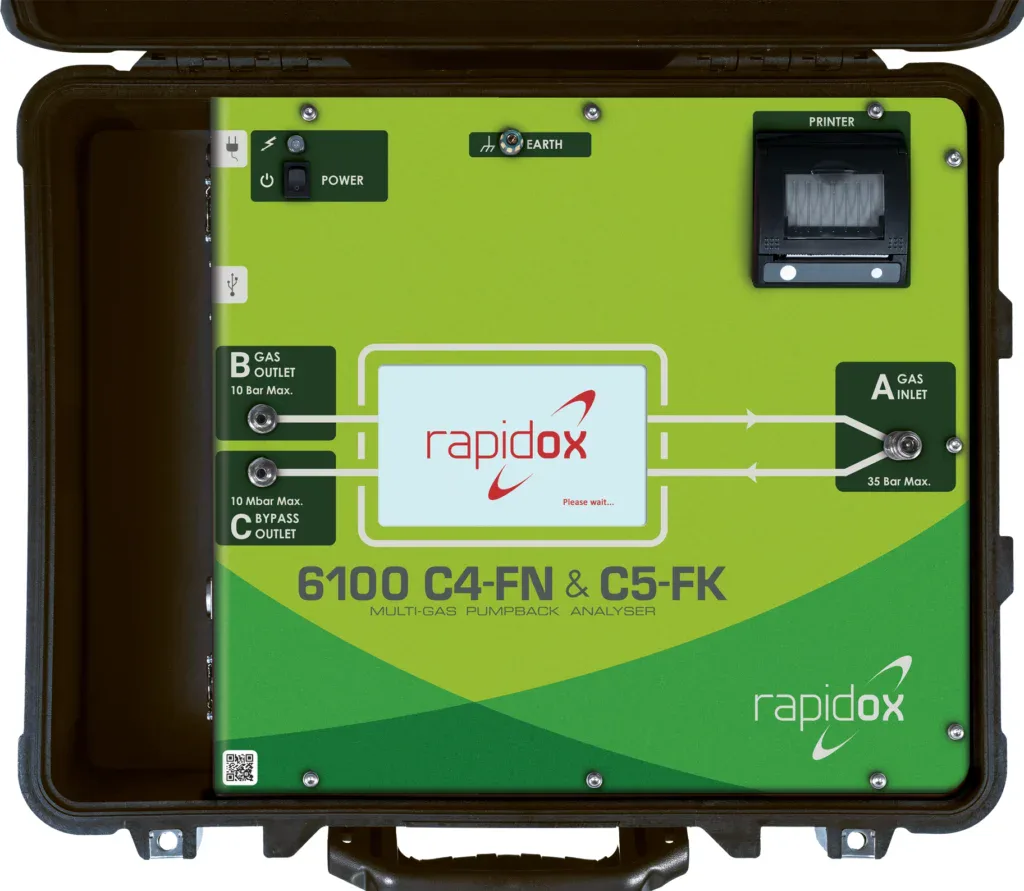
The Rapidox 6100 C4-FN & C5-FK Multi-Gas Pumpback measures C4-FN and C5-FK with infrared sensors (0–20%), CO₂ (0–100%), O₂ (0–30%), CO (up to 5000 ppm) and dew point from −60 to +20 °C. Gas return pumps the sample back, which matters because the mixtures are expensive and emissions are undesirable.
For equipment on technical air there is the Rapidox 6100 Clean Air Pumpback: it monitors air composition (O₂, N₂) and moisture and also handles SF6, which is convenient at substations running both generations of equipment.
Equipment covered in this article
Rapidox 6100 C4-FN & C5-FK Multi-Gas Pumpback — Analyser for SF6-Alternative Gas Mixtures
Portable automatic pump-back analyser for C4-FN (g3, Novec 4710) and C5-FK (AirPlus, Novec 5110) mixtures with CO₂ and O₂.
What changes in leak detection
A leak detector set up only for SF6 will not necessarily see the new mixture. When choosing an instrument, check the list of detectable gases. The Ion Science SF6 LeakCheck P1 XTL detects both SF6 and C4-FN, so one instrument covers both generations of equipment.
For equipment on technical air a gas leak detector is not applicable: you cannot find an air leak into air by composition. Pressure monitoring and ultrasonic leak detection do the job here: an ultrasonic detector hears the turbulent jet of gas escaping under pressure, whatever its composition.
Summary table: which instrument for which gas
| Gas in equipment | Gas quality | Leak detection |
|---|---|---|
| SF6 | Rapidox SF6 6100 | SF6 LeakCheck P1 XTL, SF6 Leakmate |
| C4-FN mixtures | Rapidox 6100 C4-FN & C5-FK | SF6 LeakCheck P1 XTL (detects C4-FN) |
| C5-FK mixtures | Rapidox 6100 C4-FN & C5-FK | Check by gas and instrument |
| Technical air | Rapidox 6100 Clean Air | Pressure monitoring, ultrasound |
What substation teams should do now
- Inventory: which devices run on which gas and what is coming in near-term projects.
- Procurement requirement: buy monitoring instruments for the new gas together with the new equipment, otherwise maintenance will be impossible.
- Staff training: working with mixtures, sampling and gas return rules.
- SF6 accounting on existing equipment, which will stay in service for decades. How to organise it is in the article on SF6 leak accounting.
Summary
Moving from SF6 to C4-FN, C5-FK mixtures and technical air changes diagnostics as well as equipment: instead of one gas, mixtures with each component monitored; instead of one leak detector, an instrument chosen for the gas. Substations will run both generations for a long time, so instruments covering both SF6 and the new gases are a sensible choice.
KEG TRK supplies Rapidox (Cambridge Sensotec) analysers and Ion Science leak detectors in Kazakhstan and helps choose a kit for substations with SF6 and alternative-gas equipment.
Equipment in this article
KEG TRK quotes prices and delivery times to Kazakhstan on request. We will prepare a commercial offer for your application.
Rapidox 6100 C4-FN & C5-FK Multi-Gas Pumpback — Analyser for SF6-Alternative Gas Mixtures
Portable automatic pump-back analyser for C4-FN (g3, Novec 4710) and C5-FK (AirPlus, Novec 5110) mixtures with CO₂ and O₂.

Rapidox 6100 Clean Air Pumpback — Clean Air Insulation Gas Analyser
Portable pump-back analyser for Clean Air insulated equipment (N₂ and O₂ blend): composition, moisture and NO₂ in 2–8 minutes without the sample touching ambient air.
Also in this article: Ion Science SF6 LeakCheck P1 XTL — SF6 leak detector
Read also
9/25/2026
SF6 Leak Accounting: How to Calculate Losses in Kilograms and Emissions in CO₂ Equivalent
Why every kilogram of leaked SF6 matters to a utility, how to calculate leak rate from density and top-ups, how to convert it to CO₂ equivalent and which instruments the accounting needs.
6/26/2026
Clean Air and Oxygen in SF₆-Free Switchgear: Monitoring at CHP During the SF₆ Transition
New dry-air (Clean Air) switchgear at CHP plants needs O₂, humidity and purity control. Rapidox 6100 Clean Air Pumpback for mixed SF₆ and SF₆-free fleets.
6/26/2026
Oxygen Depletion in Enclosed MV Switchgear: O₂ and SF₆ Monitoring at CHP Substations
SF₆ leaks in enclosed switchgear displace oxygen below safe levels with no smell or visible warning. How to combine SF₆ and O₂ monitoring with Rapidox at combined heat and power substations.