
How to check a hydraulic cylinder for internal leakage (piston seal bypass)
A cylinder drifts under load but the outside is dry: is it the piston seal or the directional valve? A step-by-step contact ultrasound check on a running machine, and the limits of the method.
In this article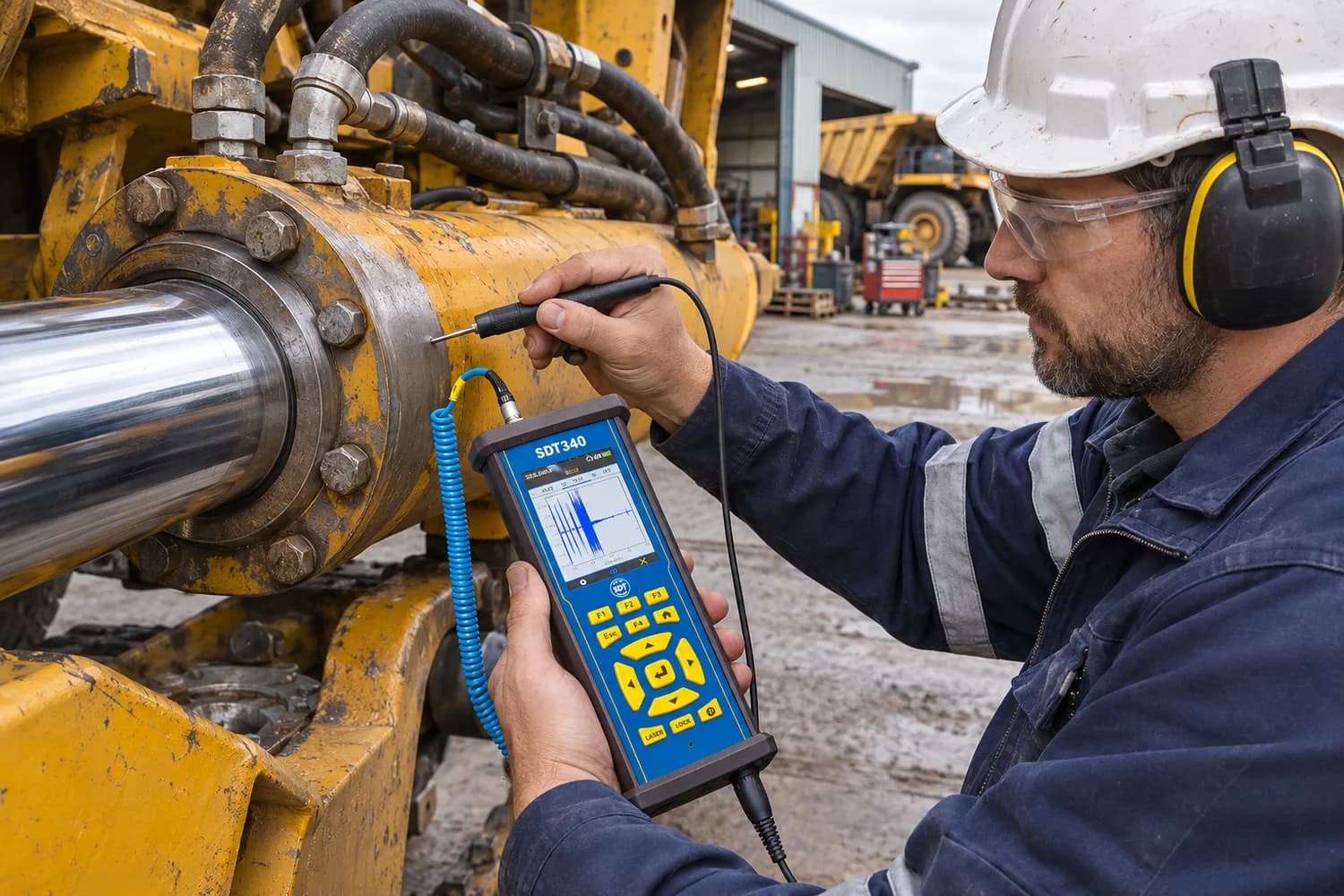
SDT340 at a hydraulic cylinder head by the rod: contact sensor on the housing, the signal is read on the instrument screen. The scene is recreated from the manufacturer image of the instrument.
KEG TRKAuthor: Georgy Cheredeev, Technical Director, KEG TRK · Updated: November 24, 2026 · How we prepare our content
To check a hydraulic cylinder for internal leakage, hold pressure in one chamber and compare the ultrasound signal on the barrel at the piston, on the directional valve body and on the valve's tank line with an identical healthy unit. A rise at the piston points to its seal; a rise at the valve and on the tank line points to the spool or seat. The machine is neither stopped nor dismantled.
This guide covers one task: finding which element passes oil. For a general overview of ultrasound in hydraulics see Ultrasonic monitoring of hydraulic systems with SDT 340; a noisy pump is covered separately in A hydraulic pump is noisy: cavitation, aeration or wear.
What does internal leakage in a hydraulic cylinder look like?
Oil moves from the high-pressure chamber into the other chamber around the piston, and nothing drips outside. That is why the problem goes unnoticed for a long time. The indirect signs are:
- the cylinder slowly drifts under load and does not hold position;
- force and speed fall, and the cycle gets longer;
- the oil in the system heats more than usual, because pressure energy turns into heat at the leak;
- the oil ages faster from overheating.
These signs are not specific. They appear with a worn piston seal, a passing directional valve or a leaking load-holding valve. Replacing seals "just in case" risks opening a healthy cylinder while the valve is the real culprit.
Where else can oil go, besides the piston seal?
| Element | How it shows |
|---|---|
| Piston seal | Flow between cylinder chambers, drift under load |
| Worn or scored barrel | Bypass along the stroke, different in different zones |
| Directional valve spool or seat | Flow into the tank line, cylinder "creeps" in neutral |
| Load-holding valve or pilot-operated check valve | Cylinder lowers while the valve is closed |
| Relief valve | Oil goes to tank before the set pressure, force drops |
This is why the check starts with the question "where does it leak", not with replacing a seal kit.
Equipment covered in this article
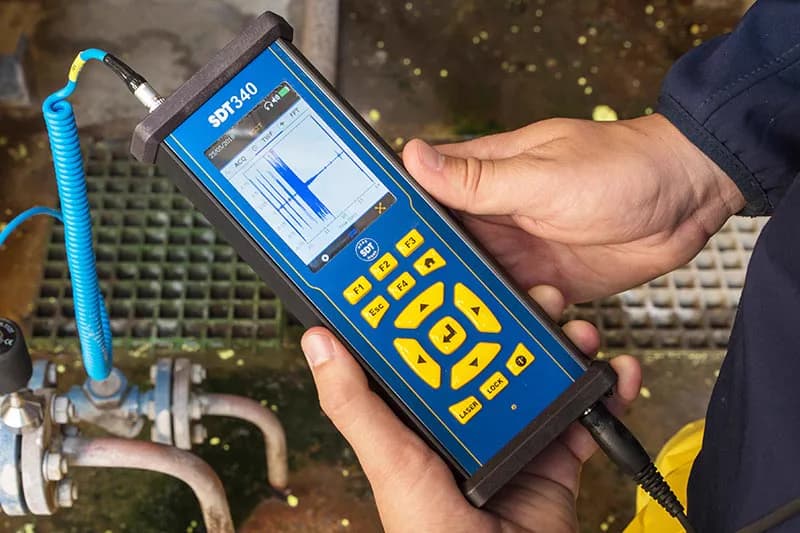
SDT340 - Advanced Ultrasound Detector
The most advanced ultrasound detector for collecting, analysing and trending data
How do you find the leaking element, step by step?
The order follows the SDT hydraulic inspection method and the three-point method for valves (see checking valves for leakage). You need an ultrasound instrument with a contact sensor, such as the SDT340 or SDT270, the hydraulic diagram, and access to the cylinder and valve.
- Make it safe. Support the load mechanically, not with cylinder pressure. Work near pressurised parts and hot housings only under the site procedure.
- Choose the points. The cylinder barrel at piston level, the directional valve body at the spool, and the valve's tank (return) line. Mark the spots so you can return to exactly the same places.
- Record the mode. Write down pressure, oil temperature, rod position and control position. Without them two readings cannot be compared.
- Create a pressure difference across the piston. Put the cylinder in a state where the piston is loaded: against a stop at the end of stroke, or holding a load. Pressure is held in one working chamber.
- Measure on the barrel. Press the contact sensor against the barrel at the piston, with the same orientation each time. Note the level and listen in the headphones: flow through a narrow gap sounds like a steady hiss.
- Measure on the valve and the tank line. The same technique on the valve body and the return line. If the spool passes, the signal rises toward the tank.
- Compare. Compare with an identical cylinder on the same machine under the same conditions, and with this cylinder at another stroke position or with the other chamber pressurised. The difference decides, not the absolute number.
- Confirm with a second method. Measure rod drift over a set time while holding the load, or test the cylinder on a bench. Record the result in the log with the points and the mode.
How do you read the readings?
There is no dBµV norm that fits every hydraulic system. The level depends on pressure, oil viscosity and temperature, the geometry of the gap and the distance from the sensor to the leak. Only comparison works:
- a cylinder against an identical healthy cylinder;
- the same cylinder before and after repair;
- a directional valve before and after replacement.
SDT340 and SDT270 store results against the measuring point, and the trend per point is built in the SDT software. A rising trend at one point is more useful than a single high value.
What will ultrasound not prove?
- The size of the leak. Flow through a gap cannot be calculated from the signal level: a change in level is not a direct flow measurement.
- The cause of wear. The signal does not tell a worn seal from a scored barrel. That only shows on teardown.
- Tightness where there is no signal. Oil is viscous, and a weak signal does not guarantee a tight component. This is why a second method is needed.
- The source when neighbouring parts are noisy. In a high-pressure system noise from a pump or a nearby valve travels through the metal. Repeating the measurement in another mode and comparing several points helps separate foreign noise from your own.
When should you replace the seals, and when keep looking?
Open the cylinder when the signal at the piston is consistently higher than the reference in the same mode, the directional valve and the load-holding valve have been ruled out, and a second method has confirmed drift or loss of force. The permissible leakage comes from the cylinder documentation. For acceptance testing of cylinders, ISO 10100:2020 contains a separate optional module for piston seal leakage.
If a cylinder is tested under pressure on a bench, remember pressure intensification between the chambers. According to Power & Motion, flow must not be directed to the piston side with the isolating ball valve closed, otherwise the cylinder can fail and cause injury.
On teardown inspect the barrel and the rod: new seals fail quickly on a scored surface. If the cause is contaminated oil, add an analysis to the repair: laboratory analysis of hydraulic oil. After repair repeat the measurement at the same points and in the same mode; it becomes the new baseline.
Where to start at a plant?
For mobile equipment, presses and drilling rigs at mining, metallurgical and oil and gas sites, start with critical cylinders: booms, buckets, clamps, lifting mechanisms. Take baseline readings on a healthy machine, then repeat the route on a schedule. More about the direction: ultrasonic hydraulics inspection. To select an instrument and sensor kit, contact KEG TRK. Useful input: the hydraulic diagram, working pressure, symptoms and access to the units.
Sources
- SDT Ultrasound Solutions, KEG TRK: application materials for hydraulics (product brochures SDT340, SDT270, SDT ULTRAChecker).
- Power & Motion, How To Test A Hydraulic Cylinder: piston bypass testing, pressure intensification, safety.
- ISO 10100:2020, Hydraulic fluid power, Cylinders, Acceptance tests.
See also
Frequently asked questions
Equipment in this article
KEG TRK quotes prices and delivery times to Kazakhstan on request. We will prepare a commercial offer for your application.
SDT340 - Advanced Ultrasound Detector
The most advanced ultrasound detector for collecting, analysing and trending data
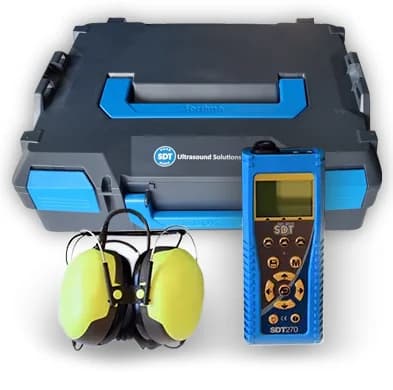
SDT270 — SDT Ultrasound Detector and Data Collector
Handheld SDT ultrasound data collector: 2 channels, up to 100 kHz bandwidth, built-in IR thermometer and laser tachometer, ICP accelerometer input, signal recording for…
Read also
11/24/2026
A hydraulic pump is noisy: cavitation, aeration or wear, and how to tell them apart
A hydraulic pump whines or rattles: is it starved of oil, sucking air or worn out? How to separate the three causes by symptoms and ultrasound, where to put the sensor and what to fix first.
10/22/2026
Which sensor to choose for SDT: contact, airborne, flexible or parabolic
How to choose an ultrasonic sensor for the SDT270, SDT340 and Checker instruments: RS2N and RS2T contact sensors for bearings and valves, FlexID2, AIRSense and RS2A airborne sensors, and the ParaDish2 parabolic sensor for leaks and distant sources.
11/24/2026
How to check a pressure relief valve for leakage without shutting the line down
A relief valve can pass across its seat while the line stays in service. How to find the leak with ultrasound at points on the body and the discharge pipe, how steam differs from gas and liquid, and what to do with the result.