
A hydraulic pump is noisy: cavitation, aeration or wear, and how to tell them apart
A hydraulic pump whines or rattles: is it starved of oil, sucking air or worn out? How to separate the three causes by symptoms and ultrasound, where to put the sensor and what to fix first.
In this article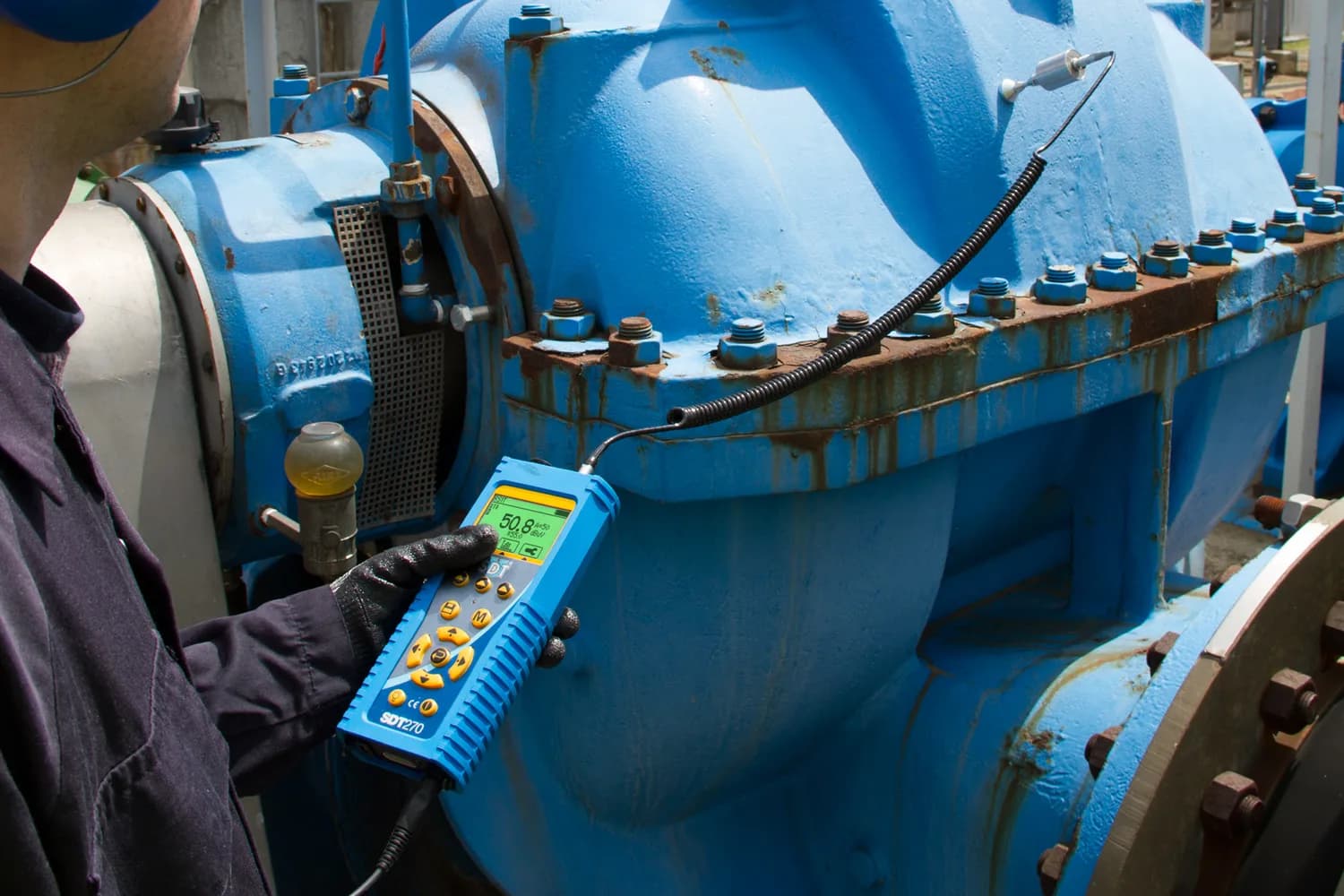
Photograph from the SDT Ultrasound Solutions library: a contact sensor on the pump casing, SDT270. The reading on the screen belongs to the photo and is not a norm.
SDT Ultrasound SolutionsAuthor: Georgy Cheredeev, Technical Director, KEG TRK · Updated: November 24, 2026 · How we prepare our content
A noisy hydraulic pump is most often starved of oil (cavitation), sucking in air (aeration) or worn. Cavitation gives a steady high whine and gets worse on cold oil and at higher speed. Aeration gives an uneven noise and foam in the tank. Wear gives lost flow and heat. Ultrasound shows where air enters the suction line and helps separate a suction-side fault from wear of the pump itself.
This article is about positive-displacement hydraulic pumps (gear, vane, piston) in the hydraulics of presses, mobile mining equipment, drilling rigs and machine tools. For centrifugal pumps read Pump cavitation: 6 signs; a general overview of ultrasound in hydraulics is in the SDT 340 article.
How do cavitation, aeration and wear of a hydraulic pump differ?
| Sign | Cavitation | Aeration | Wear |
|---|---|---|---|
| What happens | The pump is short of oil at the inlet, cavities form in the fluid | Air gets into the oil | Internal clearances and leakage grow |
| Sound | Steady high whine | Uneven noise, sometimes rattling | Builds up gradually, with falling flow |
| Tank | Usually no foam | Foam, bubbles, sluggish operation | Hot oil, foam may be absent |
| What the noise depends on | Grows on cold oil, at higher speed, with a clogged filter | Appears after repair, hose changes or at low level | Not tied to a cold start, grows with load |
| What ultrasound shows | Rising signal at the pump inlet, no point source on the suction line | Point turbulent noise at a fitting, joint or shaft seal | Higher level on the housing than an identical healthy pump, no source on the suction side |
| First action | Check filter, level, viscosity | Find and remove the air leak | Measure flow and pressure, assess repair |
Sound and conditions are taken from industry hydraulics sources (Power & Motion, Machinery Lubrication). The authors describe the sound differently: cavitation as a whine or as a noise like rolling marbles. It is hard to separate causes by ear, so conclusions rest on several signs at once.
Why does a hydraulic pump cavitate?
Cavitation means less oil arrives at the inlet than the pump wants to take. Typical causes:
- a clogged suction strainer or filter;
- a clogged tank breather, so air cannot enter the tank and vacuum on the suction side grows;
- cold, and therefore thick, oil, especially on a frosty start;
- oil temperature that is too high;
- drive speed above what the pump allows;
- a pump mounted above the oil level, or a long or narrow suction line;
- restrictions and pinched hoses on the suction side.
Permitted speed, inlet pressure and line sizes are given by the pump manufacturer. Universal figures cannot be quoted: they differ between designs.
Equipment covered in this article

SDT340 - Advanced Ultrasound Detector
The most advanced ultrasound detector for collecting, analysing and trending data
Where does air in a hydraulic system come from?
Aeration means air has entered the oil, most often on the suction side. The main paths:
- loose or misaligned fittings and clamps on the suction line;
- a worn pump shaft seal;
- low oil level in the tank, when a vortex forms above the inlet;
- wrong pump rotation after repair or connection;
- a return line that ends above the oil level and whips the oil into foam (a general hydraulics rule; check it against each circuit's documentation).
Air used to be found by eye: squirt oil on the joints and see whether the noise stops. An ultrasound detector finds the leak without stopping the machine and without spills, because air drawn into a line under vacuum makes a turbulent jet noise. The same principle for centrifugal pumps is described in Shaft seal and suction.
How do you diagnose a hydraulic pump with ultrasound, step by step?
You need an instrument with a contact sensor: SDT340 or SDT270.
- Simple things first. Check oil level, foam in the tank, rotation direction and the breather. It takes minutes and excludes part of the causes.
- Record the mode. Pressure, oil temperature, speed, load. Only readings in the same mode can be compared.
- Walk the suction line. Press the sensor in turn against fittings, hose joints, clamps, the suction filter housing and the shaft seal area. Listen in the headphones. A spot where the level is clearly higher than its neighbours points to an air leak.
- Measure on the pump housing. Points near the inlet port, near the outlet port and at the bearing area. A steady rise near the inlet without a point source on the line points to cavitation: the pump is not getting enough oil.
- Listen to the character of the signal. Cavitation is typically marked by random pops in the signal, an air leak by a constant turbulent noise at one spot. In doubtful cases record the dynamic signal and look at it in the software, as for valves in the article on checking valves for leakage.
- Compare. With the baseline of this same pump taken when healthy, and with an identical pump in the same mode. Keep results in the SDT software against the points.
- Remove the cause and measure again. Tighten the joint, clean the strainer, replace the shaft seal, then measure the same points in the same mode.
If there is no air leak and no sign of starvation, but heat rises and flow falls, suspect wear and move on to measuring flow and pressure.
What will ultrasound not prove?
- How much air is in the oil and how it affects the pump. The signal shows where it is noisy, not the share of air.
- Wear from a single measurement. Wear is confirmed by lower flow, higher case drain leakage (for piston pumps) and temperature. Permitted values come from the manufacturer.
- The cause when other sources are noisy. A pump or high-pressure valve running nearby makes noise that travels through the metal. A repeat measurement and comparison of several points help separate foreign noise from your own.
- Insufficient drive power. A drive slowing under load looks like a worn pump from the outside; it is checked separately.
What should you fix first?
The order goes from simplest and cheapest:
- Tank oil level above the pump inlet.
- Suction strainer and filter clean, no pressure drop on the suction side.
- Tank breather clear.
- Viscosity and temperature of the oil match the documentation; oil warmed before a cold start.
- Fittings, clamps and hoses on the suction side tight.
- Shaft seal intact, no air leak.
- Rotation direction correct.
- Drive speed within the pump's limits.
- Return line enters the tank below the oil level.
On equipment that works outdoors the points about viscosity and warm-up matter most: in winter the oil cools and thickens, and the pump may be starved at start-up. Take specific temperature limits from the oil and pump data sheets. If the oil looks or smells suspicious or contains particles, add laboratory oil analysis.
When is the pump really worn?
When air leaks and starvation are ruled out, flow is falling, the oil is heating and the noise grows with load. The signal on the housing is then above the baseline without a point source on the suction side. The decision to replace is made from flow and pressure measurements and the manufacturer's permitted values. If the problem lies in other hydraulic units, for example internal leakage in a cylinder, see how to check a hydraulic cylinder for bypass.
What to provide to select a kit
Pump type and manufacturer, pressure and flow, the suction arrangement, symptoms and access to measuring points. More on the direction: ultrasonic hydraulics inspection. To choose an instrument, contact KEG TRK.
Sources
- Power & Motion, Cavitation or Aeration? You Can Hear the Difference: sound, causes and checks.
- Power & Motion, Common Modes of Failure for Hydraulic Piston Pumps: cavitation, wear and case drain monitoring in piston pumps.
- SDT Ultrasound Solutions, KEG TRK: application materials for hydraulics and pump diagnostics.
See also
Frequently asked questions
Equipment in this article
KEG TRK quotes prices and delivery times to Kazakhstan on request. We will prepare a commercial offer for your application.
SDT340 - Advanced Ultrasound Detector
The most advanced ultrasound detector for collecting, analysing and trending data

SDT270 — SDT Ultrasound Detector and Data Collector
Handheld SDT ultrasound data collector: 2 channels, up to 100 kHz bandwidth, built-in IR thermometer and laser tachometer, ICP accelerometer input, signal recording for…
Read also
11/24/2026
How to check a hydraulic cylinder for internal leakage (piston seal bypass)
A cylinder drifts under load but the outside is dry: is it the piston seal or the directional valve? A step-by-step contact ultrasound check on a running machine, and the limits of the method.
10/22/2026
Which sensor to choose for SDT: contact, airborne, flexible or parabolic
How to choose an ultrasonic sensor for the SDT270, SDT340 and Checker instruments: RS2N and RS2T contact sensors for bearings and valves, FlexID2, AIRSense and RS2A airborne sensors, and the ParaDish2 parabolic sensor for leaks and distant sources.
11/24/2026
How to check a pressure relief valve for leakage without shutting the line down
A relief valve can pass across its seat while the line stays in service. How to find the leak with ultrasound at points on the body and the discharge pipe, how steam differs from gas and liquid, and what to do with the result.