
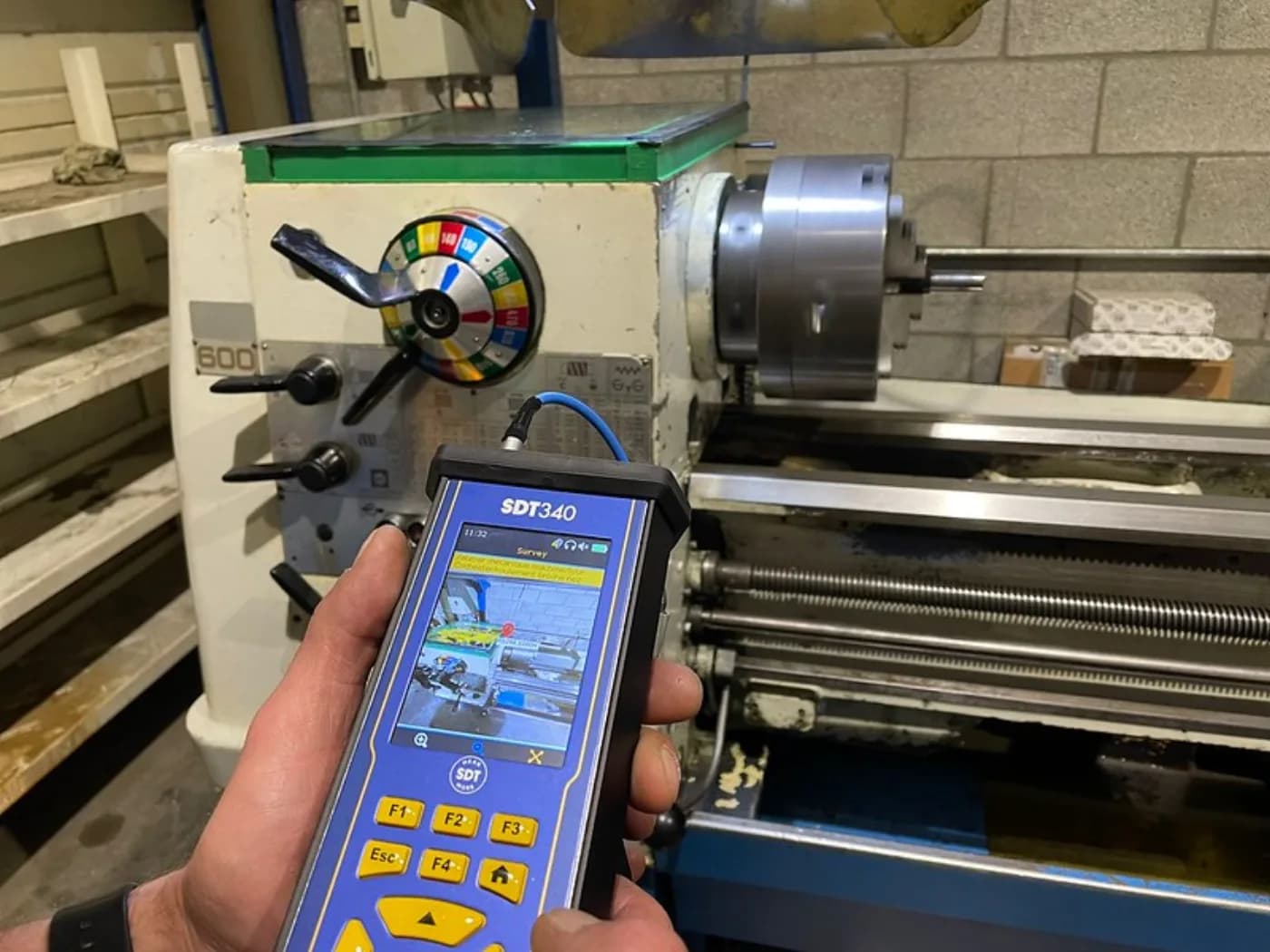
Vibration Meter or Vibration Analyser: Which to Choose
A vibration meter shows the overall level and tells you if there is a problem. An analyser adds the spectrum and waveform and shows the cause. A comparison by task, function and example instruments.
A vibration meter measures the overall vibration level, usually RMS velocity in mm/s, and answers "is there a problem". A vibration analyser also records the time waveform and builds a spectrum, so it answers "what exactly is wrong". If you only need to compare machines with the limits, a meter is enough; if you need to find causes and plan repairs, you need an analyser.
What a vibration meter does
A meter gives one or a few numbers per measurement point:
- RMS velocity in mm/s, the main parameter for ISO 10816-3 assessment (10–1000 Hz band);
- sometimes RMS and peak acceleration in g, peak velocity and crest factor.
With these numbers you can compare a machine with the standard's zones A–D (tables in "Electric motor vibration limits per ISO 10816-3") and keep a trend: if the level at the same point grows from reading to reading, the machine needs a closer look.
What a meter will not show is the frequency at which the vibration is concentrated. The same 4 mm/s can come from unbalance, misalignment, looseness or resonance, and the repair is different in each case.
What a vibration analyser does
Besides the overall level, an analyser works with the signal:
- Spectrum (FFT) shows peaks at running speed 1x, at 2x, at harmonics and at bearing frequencies. It separates unbalance from misalignment and looseness. How to read it: "How to read an FFT spectrum".
- Time waveform: a non-sinusoidal shape points to looseness, impacts point to bearing and gear defects.
- Envelope (demodulation) isolates weak repeating impacts and helps find early bearing defects.
- Phase and multiple channels help separate unbalance from misalignment, perform field balancing and run bump tests to find resonances.
- Routes and database: points, reading history, trends and alarms in PC software.
I-care divides portable instruments into data collectors for routine rounds and analysers with onboard processing that show the spectrum and waveform at the machine. Modern instruments usually combine both.
Equipment covered in this article
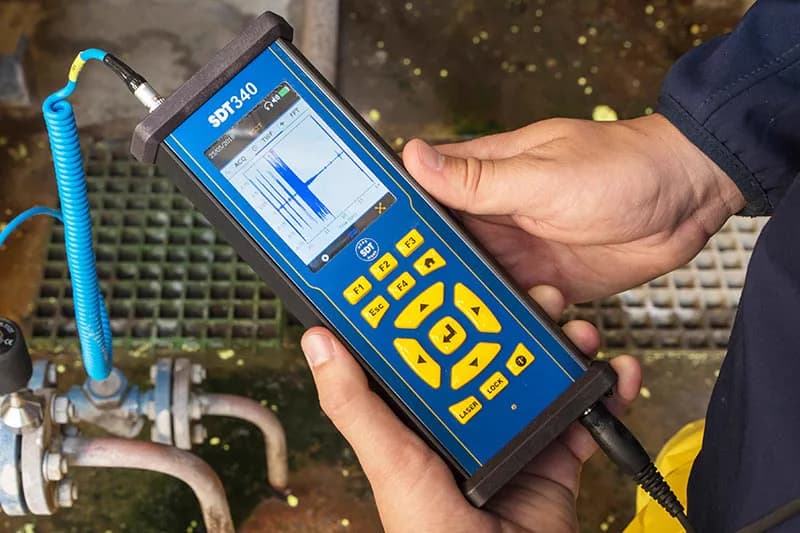
SDT340 - Advanced Ultrasound Detector
The most advanced ultrasound detector for collecting, analysing and trending data
Comparison
| Vibration meter | Vibration analyser | |
|---|---|---|
| Main question | Is there a problem | What is wrong |
| Output | Overall level (mm/s, g) | Overall level, spectrum, time waveform, envelope |
| ISO 10816-3 assessment | Yes, if it measures RMS velocity in 10–1000 Hz | Yes |
| Finding the cause | No | Yes |
| Field balancing | No | In models with a balancing function |
| Routes and trends in software | Usually none or limited | Yes |
| Who uses it | Mechanic, operator, rounds technician | Condition monitoring specialist |
Example instruments
| Instrument | What it is | Key manufacturer data |
|---|---|---|
| SDT340 (SDT) | Ultrasound instrument with a vibration channel | Indicators: RMS and peak velocity, RMS and peak acceleration, crest factor. Filters 5 Hz – 1 kHz, 10 Hz – 1 kHz (ISO 10816-3), 10 Hz – 10 kHz. On-screen time waveform and spectrum, on-route and off-route modes |
| vb7 (Bently Nevada) | Data collector, analyser and balancer | 2 simultaneous channels, up to 6,400 lines, Fmax up to 40 kHz, demodulation, two-plane balancing, bump test, laser speed sensor |
| SCOUT220-IS (Bently Nevada) | Intrinsically safe data collector and analyser | 2 channels (SCOUT240-IS: 4), up to 12,800 lines, Fmax up to 80 kHz, two-plane balancing, routes from System 1 software |
How to choose
- You only need limit checks and overall trends on a small number of machines: an instrument with RMS velocity in the 10–1000 Hz band is enough. The SDT340 covers this and also gives ultrasound checks of bearings, leaks and electrical equipment.
- You need to find causes, run routes and balance in the field: you need an analyser with spectrum, envelope and phase, such as the vb7.
- Work in hazardous areas (oil and gas, chemicals): you need an instrument with the right certification, such as the SCOUT220-IS.
- Critical or hard-to-reach machines: instead of a portable instrument consider online sensors: "Wi-care wireless vibration monitoring".
The instrument is only part of a programme. What else you need to start is in "What is machinery vibration analysis", and how to find the cause of motor vibration from the spectrum is in "Causes of electric motor vibration".
Which instrument to choose
For rounds with limit checks and ultrasound bearing inspection: the SDT340. For full spectrum analysis and balancing: the Bently Nevada vb7.
KEG TRK supplies SDT and Bently Nevada instruments in Kazakhstan and trains personnel. Price on request.
Sources
- SDT Ultrasound Solutions. Datasheet SDT 340, DC.R340.DAT.001 — https://www.sdtultrasound.com
- Bently Nevada. vb7 Portable Data Collector, Analyzer and Balancer Datasheet 116M5255 — https://dam.bakerhughes.com/m/7993c3932a156e18/original/vb7-Portable-Data-Collector-Analyzer-and-Balancer-Datasheet-116M5255-pdf.pdf
- Bently Nevada. SCOUT220-IS and SCOUT240-IS Portable Data Collectors Datasheet 109M0226 — https://dam.bakerhughes.com/m/54b98a9e1e80eaf6/original/SCOUT220-IS-and-SCOUT240-IS-Portable-Data-Collectors-Datasheet-109M0226-pdf.pdf
- I-care. What is Vibration Analysis in Predictive Maintenance? — https://www.icareweb.com/knowledge/predictive-maintenance/what-is-vibration-analysis-predictive-maintenance/
- ISO 10816-3:1998 — via "Electric motor vibration limits".
Frequently asked questions
Equipment in this article
KEG TRK quotes prices and delivery times to Kazakhstan on request. We will prepare a commercial offer for your application.
SDT340 - Advanced Ultrasound Detector
The most advanced ultrasound detector for collecting, analysing and trending data
vb7 — collector, analyzer and balancer
Dual channel simultaneous recording, two-plane balancing, IP65
Also in this article: SCOUT220-IS — intrinsically safe collector
Read also
10/10/2026
What Is Machinery Vibration Analysis and How to Start
Vibration analysis checks machine condition from bearing housing vibration: what is measured, route-based vs online monitoring, which faults show in the spectrum, how to start.
10/10/2026
Causes of Electric Motor Vibration and How to Tell Them Apart
Unbalance, misalignment, looseness, bearings, resonance, rotor and stator faults, driven machine problems. Which spectrum and waveform signs separate one cause from another.
10/10/2026
Electric Motor Diagnostics: Which Method Shows What
Vibration, ultrasound, thermography, current analysis (MCSA/ESA), motor circuit analysis (MCA), megohmmeter and oil analysis: which faults each method sees, where it stops and how to combine them.