
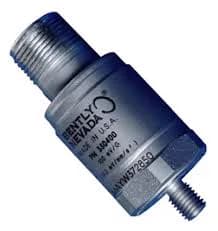
Vibration Sensor: How to Choose (Accelerometer, Velocity Sensor, Proximity Probe)
A proximity probe measures shaft motion in fluid-film bearings, a velocity sensor gives overall casing vibration, an accelerometer covers high frequencies of rolling bearings and gearboxes.
A vibration sensor is chosen by what you need to measure. Shaft motion in fluid-film bearings is measured with a proximity (eddy current) probe. Overall casing vibration in the mid-frequency range comes from a velocity sensor. Rolling bearings and gearboxes, where high frequencies matter, need an accelerometer. The mounting method also limits the usable upper frequency: stud, adhesive, magnet or probe tip.
Three sensor types and what they measure
| Type | Quantity | Location | Purpose |
|---|---|---|---|
| Proximity probe (non-contact) | Shaft displacement relative to the probe | Facing the shaft, in the bearing housing | Radial shaft vibration, axial position, phase reference and speed |
| Velocity sensor | Casing vibration velocity | Bearing housing, machine casing | Overall casing vibration, protection and monitoring |
| Accelerometer | Casing acceleration | Bearing housing, machine casing | High frequencies: early rolling bearing defects, gear mesh |
Forbes Marshall reduces this to a simple rule: proximity probes measure shaft displacement, velocity probes measure mid-frequency casing vibration, accelerometers measure high-frequency faults. Velocity works well as an overall machine health metric, acceleration for early detection of rolling bearing and gear defects.
Proximity probe
The Bently Nevada 3300 XL 8 mm system has three parts: probe, extension cable and Proximitor sensor. The output voltage is proportional to the distance between the probe tip and the conductive surface, so the system measures both the static component (position) and the dynamic one (vibration).
| 3300 XL 8 mm parameter | Datasheet value |
|---|---|
| Sensitivity | 7.87 V/mm (200 mV/mil) |
| Linear range | 2 mm (80 mils), approximately 0.25 to 2.3 mm from target |
| Frequency response | 0–10 kHz, +0/−3 dB, with up to 305 m of field wiring |
| Shaft diameter | minimum 50.8 mm, recommended minimum 76.2 mm |
| Probe tip separation | at least 38 mm for radial vibration, 40 mm for axial position |
According to Bently Nevada, the primary applications are vibration and position measurements on fluid-film bearing machines, plus Keyphasor reference and speed measurements. The standard 3300 XL 8 mm 5-metre system complies with API 670 for mechanical configuration, linear range, accuracy and temperature stability.
When a proximity probe is a must
- Fluid-film bearings. You need shaft motion relative to the bearing, not casing motion. Bently Nevada names fluid-film bearing machines as the primary application of the 3300 XL system.
- Turbines. According to Forbes Marshall, proximity probes are mandatory for monitoring shaft movement inside the bearing: radial vibration, axial thrust and differential expansion. A casing accelerometer does not provide these quantities.
- Phase and speed are needed. The Keyphasor phase reference and speed measurement are also done with a proximity probe, as the 3300 XL datasheet states directly.
An example installation on large fans is covered in 3300 XL proximity probes on large fans.
Equipment covered in this article
330400 / 330425 — Accelerometers for API 670 Machinery Protection
Casing acceleration transducers for critical machinery: 330400 (100 mV/g, 50 g peak, designed for API 670) and 330425 (25 mV/g, 75 g peak)
Velocity sensor
A classic velocity sensor is a coil and a magnet: their relative motion under vibration induces a voltage proportional to velocity. The Bently Nevada Velomitor 330500 works differently: it is a piezoelectric accelerometer with embedded electronics that output a velocity signal. There are no moving parts, so it does not wear and can be mounted at any orientation.
| Velomitor 330500 parameter | Datasheet value |
|---|---|
| Measures | Absolute vibration of bearing housing, casing or structure |
| Sensitivity | 3.94 mV/(mm/s) (100 mV/(in/s)) ±5% |
| Frequency response | 4.5 Hz – 5 kHz (±3 dB); 6 Hz – 2.5 kHz (±0.9 dB) |
| Velocity range | 1270 mm/s peak |
| Mounted resonant frequency | greater than 12 kHz |
| Mounting torque | 32–46 kg·cm (24–40 in·lb) maximum |
Accelerometer
An accelerometer outputs a signal proportional to acceleration. It is chosen for high frequencies: early rolling bearing defects and gear mesh. Bearing defect frequencies and how to find them in the envelope are covered in Bearing defect frequencies BPFO, BPFI, BSF, FTF.
| Parameter | 330400 | 330425 |
|---|---|---|
| Sensitivity | 10.2 mV/(m/s²) (100 mV/g) ±5% | 2.5 mV/(m/s²) (25 mV/g) ±5% |
| Amplitude range | 50 g peak | 75 g peak |
| Frequency response | 10 Hz – 15 kHz (±3 dB); 30 Hz – 10 kHz (±10%) | same |
| Mounted resonant frequency | greater than 30 kHz | greater than 30 kHz |
| Transverse sensitivity | less than 5% of axial | less than 5% of axial |
| Power | −24 ±0.5 Vdc | −24 ±0.5 Vdc |
According to Bently Nevada, the 330400 is designed to address the API 670 requirements for accelerometers and is intended for casing acceleration measurements such as gear mesh monitoring.
How to read sensitivity
A sensitivity of 100 mV/g means 1 g of acceleration gives 100 mV at the output. Higher sensitivity picks out weak signals better but reduces the range. The 330400 and 330425 pair shows this clearly: 100 mV/g at 50 g versus 25 mV/g at 75 g. For machines with strong impacts, choose a sensor with lower sensitivity and a larger range.
How mounting affects the usable frequency range
A sensor measures only what its mounting transmits. The stiffer and lighter the mounting, the higher the resonance of the system and the higher the frequency up to which the readings can be trusted.
| Mounting method | Approximate upper frequency (Istec) |
|---|---|
| Stud | 10,000–20,000 Hz |
| Adhesive | 7,000–10,000 Hz |
| Magnet on a flat surface | 5,000–7,000 Hz (a clean magnet with a drop of oil up to 10,000 Hz) |
| Magnet on a curved surface | 2,000–2,500 Hz |
| Probe tip extension | about 500 Hz |
These are guide values. The exact limit depends on the specific sensor, the magnet mass and the surface condition. Also important:
- A stud is the best option. Endevco: stud mounting provides higher transmissibility than any other method. For the 330400, Bently Nevada specifies a mounting surface finish of 32 microinch rms and a mounting torque of 4.1 N·m.
- A thin film of lubricant under the base. Endevco recommends a thin application of light lubricant: it fills voids and increases the stiffness of the joint. This matters particularly for measurements above 2 kHz.
- Adhesive. No adhesive is as stiff as a stud. Endevco notes that at room temperature cyanoacrylate has the best characteristics, while hot glue from a glue gun is the least effective.
- Magnet. Convenient on routes, but Endevco describes massive magnetic adapters as useful only for low frequencies below a few hundred hertz. During installation the magnet snaps on with a shock that can damage the sensor. Istec advises caution with data above 1000 Hz on lightweight machines because of the magnet mass.
- Probe tip. The narrowest range. Suitable for a quick overall check at low frequencies, not for bearing analysis.
If you plan to look for rolling bearing defects with enveloping, mount the sensor on a stud or a bonded pad, not on a probe tip.
How to choose: step by step
- Identify the bearing type. Fluid-film bearings on a critical machine — proximity probes on the shaft. Rolling bearings — sensors on the casing.
- Identify the frequencies. Overall casing vibration in the operating range — velocity sensor. Rolling bearings, gearboxes, high frequencies — accelerometer.
- Check the amplitude range. Strong impacts — a sensor with lower sensitivity and a larger range.
- Choose the mounting for the required upper frequency (table above).
- Check compatibility with the monitoring equipment: power (for example −24 V for the 330400), cable length, and API 670 requirements if the machine is protected to that standard.
If the sensor is for a portable instrument rather than a permanent system, first decide which instrument you need: see Vibration meter or vibration analyzer.
Which sensor to choose
- Casing acceleration, gearboxes, high frequencies — Bently Nevada 330400/330425 accelerometer.
- Overall bearing housing vibration — Velomitor velocity sensor.
- Shaft vibration and position on fluid-film bearings — 3300 XL proximity system.
KEG TRK supplies Bently Nevada sensors in Kazakhstan. Price on request.
Sources
- Bently Nevada. 3300 XL 8 mm Proximity Transducer System Datasheet 141194.
- Bently Nevada. 330400 and 330425 Accelerometer Datasheet 141638.
- Bently Nevada. 330500 Velomitor Piezo-velocity Sensor Datasheet 141632.
- Endevco (PCB Piezotronics). Guide to Accelerometer Installation, TP319.
- Istec. Choosing the right accelerometer mount: 6 effective methods explained.
- Forbes Marshall. Vibration sensor types.
Frequently asked questions
Equipment in this article
KEG TRK quotes prices and delivery times to Kazakhstan on request. We will prepare a commercial offer for your application.
330400 / 330425 — Accelerometers for API 670 Machinery Protection
Casing acceleration transducers for critical machinery: 330400 (100 mV/g, 50 g peak, designed for API 670) and 330425 (25 mV/g, 75 g peak)

330500 Series — Velomitor Velocity Sensor
Bently Nevada Velomitor velocity sensor for vibration and condition monitoring — supply and service in Kazakhstan.
Also in this article: 3300 XL Series — Eddy-Current Proximity Transducer System
Read also
4/8/2026
How to Read an FFT Spectrum: Five Vibration Signatures Every Mechanic Should Know
How to read an FFT vibration spectrum: unbalance (1x), misalignment (2x and axial 1x), mechanical looseness (harmonics), bearing defects (BPFO, BPFI, BSF, FTF). Criteria per the SKF guide.
10/22/2026
Bearing Defect Frequencies BPFO, BPFI, BSF, FTF: Formulas and Calculation
BPFO, BPFI, BSF and FTF are calculated from the number of rolling elements, ball diameter, pitch diameter, contact angle and shaft speed. For an SKF 6205 at 1500 rpm: BPFO 89.6 Hz, BPFI 135.4 Hz.
10/22/2026
Industrial Videoscope: How It Works and How to Choose One
A videoscope is a flexible probe with a camera and light at the tip, a steerable bending section and a display. Choose it by probe diameter and length, articulation, optics and measurement method.