
Leaks in heat exchangers and condensers: the ultrasonic detection method
Tube bundles in CHP and metals condensers and heat exchangers develop micro-leaks long before a visible vacuum drop. How the SDT340 and the compressed-air method pinpoint the faulty tube without a full teardown.
At a CHP plant, a drop in turbine condenser vacuum or rising make-up water consumption is often written off as the "general condition" of the system. In practice a micro-leak in one or two tubes of the bundle is already eating efficiency and blurring the intervals between overhauls. Dismantling and hydro-testing the whole bundle is expensive. Ultrasound localises the fault far faster.
Why tubes leak
| Cause | Where it is typical |
|---|---|
| Erosion / cavitation at the inlet | condensers, oil coolers |
| Corrosion (chlorides, ammonia) | chemicals, water treatment |
| Tube vibration in the baffles | large heat exchangers |
| Mechanical damage during cleaning | after maintenance |
A water-to-steam or water-to-oil leak stays masked for a long time, until conductivity or the make-up flow rate rises.
The ultrasonic method: two scenarios
1. Unit in place, access to the tube sheet
- Open the water chamber / water-side cover.
- Plug or isolate the circuit according to the manufacturer's procedure.
- Apply compressed air (or nitrogen) to the shell or tube side per the procedure (usually low pressure — around 0.5–2 bar, per the data sheet).
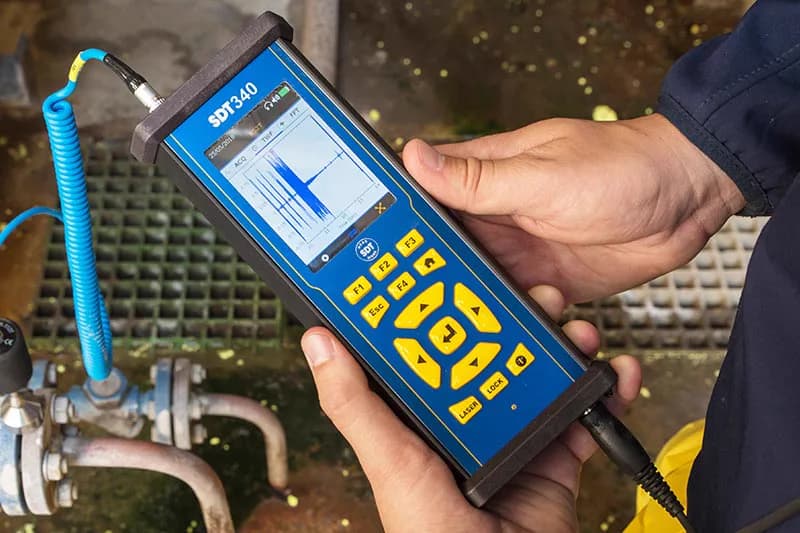
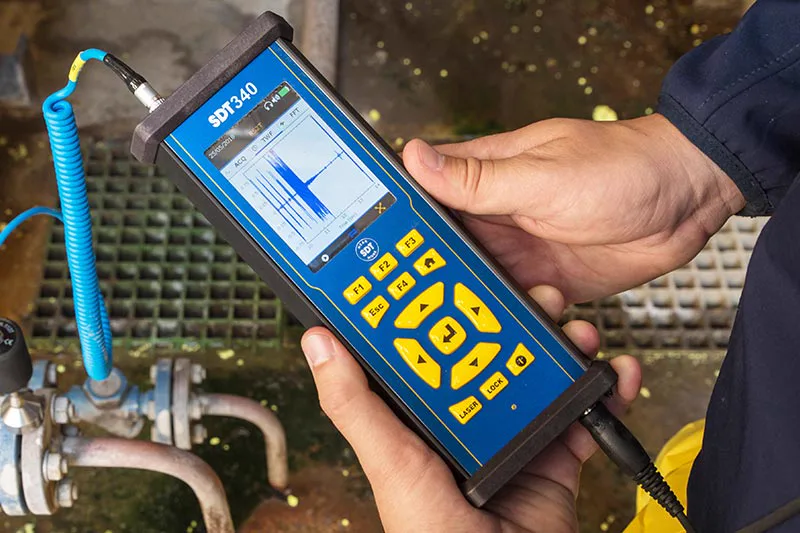
- Survey the tube sheet with the SDT340 or LEAKChecker: the faulty tube "whistles" in ultrasound.
2. Vacuum condenser in service
Under vacuum on the steam side, air is drawn in through the micro-hole. The SDT airborne sensor picks up the turbulent inflow at flanges, manways and, where accessible, at the tube sheet during a shutdown.
Related leak material: compressed air leaks.
Equipment covered in this article
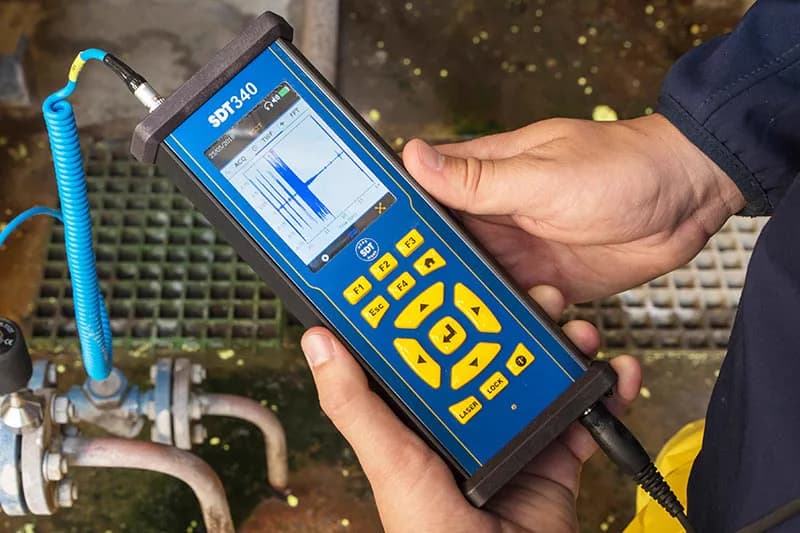
SDT340 - Advanced Ultrasound Detector
The most advanced ultrasound detector for collecting, analysing and trending data
Practical advice
- Mark every "loud" tube with a marker — photograph it for the report.
- Compare the dBµV level with neighbouring healthy tubes, not with an absolute threshold.
- After plugging — repeat the survey: the level must drop.
- For steam traps on the pipework, use a separate TRAPChecker / SDT270 route.
Where this is critical in Kazakhstan
- CHP / thermal power plants — turbine condensers, oil coolers, HP/LP feedwater heaters.
- Metals — rolling mill coolers, converter circuits.
- Chemicals — shell-and-tube exchangers on process media.
Application pages: power generation, metallurgy.
Relation to other methods
| Method | Role |
|---|---|
| SDT ultrasound | localises the tube / flange |
| Hydro test | confirms tightness after repair |
| Chemistry (conductivity) | early "there is a problem" signal |
| Vibration / ESA on pumps | indirect — rising load on circulation pumps |
For circulation and condensate pumps, add Artesis ESA and cavitation diagnostics.
Conclusion
An ultrasonic walkdown of the tube sheet is the fastest way to find a faulty tube without guessing across the whole bundle. In a CHP reliability programme it sits alongside steam trap and compressed-air leak audits — see SDT at CHP plants and the 8 pillars of ultrasound.
Equipment in this article
KEG TRK quotes prices and delivery times to Kazakhstan on request. We will prepare a commercial offer for your application.
SDT340 - Advanced Ultrasound Detector
The most advanced ultrasound detector for collecting, analysing and trending data
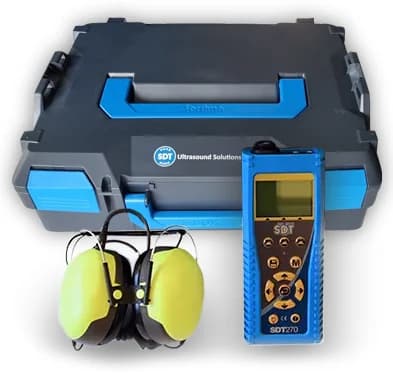
SDT270 — SDT Ultrasound Detector and Data Collector
Handheld SDT ultrasound data collector: 2 channels, up to 100 kHz bandwidth, built-in IR thermometer and laser tachometer, ICP accelerometer input, signal recording for…
Also in this article: LEAKChecker - Compressed-Air Leak Detector
Read also
7/17/2026
Ultrasonic diagnostics of couplings and shaft connections: early signs of failure
Elastomeric, gear and jaw couplings emit a characteristic ultrasonic signature long before a vibration alarm. The SDT340 inspection method for pumps, compressors and gearbox drives.
10/10/2026
Comparing ultrasonic leak detectors: what to look for
Ultrasonic leak detectors are compared by tasks, sensors and range, frequency band, data logging and reports, ATEX rating and operating conditions. Selection criteria and a table of SDT models.
10/6/2026
Finding air ingress in a vacuum system: inspection route and verification
Vacuum fails to reach its setpoint or drops under load: inspect joints, hoses, valves and seals, choose a method and verify the repair.