
How to Find Compressed Air Leaks in a Plant: 5 Methods
Compressed air leaks are found in two steps: estimate losses from the compressor, then locate the points with an ultrasonic detector or camera. Five methods compared.
In this article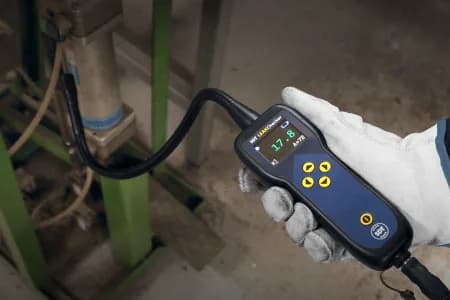
LEAKChecker uses an airborne sensor to locate an ultrasonic leak source. Flow and loss costs require a separate assessment of operating conditions.
SDT Ultrasound SolutionsAuthor: Georgy Cheredeev, Technical Director, KEG TRK · Updated: October 28, 2026 · How we prepare our content
Compressed air leaks are found in two steps. First, estimate whether there are losses and how large they are, from how the compressor runs while consumers are shut down. Then locate the actual points with an ultrasonic detector or an acoustic camera, and confirm them with soapy water on accessible joints. Below are five methods, what they can do and their limits.
How to tell that there are leaks
The simplest sign: the compressor keeps reloading when nobody is working (at night, at weekends, during breaks). Nobody is using air at that time, so it is escaping through leaks.
For compressors with load/unload control, the leak share can be estimated without instruments. Turn off the consumers, start the compressor and time several cycles:
leakage (%) = T × 100 / (T + t)
where T is the on-load time and t is the off-load time.
Example: the compressor loads for 4 minutes and runs unloaded for 12 minutes. Leakage = 4 × 100 / (4 + 12) = 25%, so a quarter of its output goes to leaks.
The method comes from U.S. Department of Energy (DOE) guidance. If the compressor also has a separate full-stop mode, check which time counts as t: the original method refers to off-load time.
For other control types, leakage is estimated from the pressure drop in the receiver. Bring the network to working pressure P1, stop the supply and time how long (T) it takes to fall to roughly half the working pressure, P2. Then:
leakage (m³/min free air) ≈ V × (P1 − P2) / (T × 1.013) × 1.25
where V is the volume of receivers, mains and piping in m³, P1 and P2 are gauge pressures in bar, T is the time in minutes, and 1.25 corrects for leakage falling as the pressure drops.
Both estimates show the size of the losses but not where they are. DOE recommends repeating them quarterly as part of a leak detection and repair programme. To find the locations, use one of the methods below.
5 ways to find a leak
| Method | What it gives | Where it works | Limits |
|---|---|---|---|
| Compressor-based estimate | Loss as a percentage | The whole network at once | Does not show where the leak is |
| By ear | Large leaks | Quiet areas, stopped production | In a running plant only the strongest are audible |
| Soapy water or foam | Confirmation of a specific point | Accessible joints | Slow, awkward at height, not allowed everywhere |
| Ultrasonic detector | Leak location on a live network | Any plant, including noisy ones | You have to walk the route and check every joint |
| Acoustic camera | Source on screen, area overview | Large areas, overhead pipework, pipe racks | Costs more than a detector; the point is confirmed close up |
Why ultrasound works in a noisy plant
Air escaping through a gap under pressure creates turbulence, and turbulence produces ultrasound. An ultrasonic detector picks up this signal and converts it into audible sound in the headphones. Plant noise is mostly in the audible range, while ultrasound fades quickly with distance, so following the rising signal leads straight to the source. More on the method in Ultrasound Inspection: A Beginner's Guide.
When you need an acoustic camera
A camera collects ultrasound with a microphone array and overlays the source on a video image. It saves time where a detector would mean checking every joint from a ladder: overhead pipework, pipe racks, large halls. A model comparison is in SonaVu or Crysound: which acoustic camera to choose.
Equipment covered in this article
SDT LEAKChecker — Ultrasonic Leak Detector
Find compressed-air leaks and vacuum ingress with SDT LEAKChecker. Specifications, original kit, survey workflow and equipment selection in Kazakhstan.
Where to look first
- threaded and quick-disconnect fittings;
- hoses and their end fittings;
- air preparation units: filters, regulators, lubricators;
- valves, directional valves and pneumatic cylinders (rod seals; more in how to find a leak in a pneumatic cylinder and actuator);
- pressure regulators and shut-off valves;
- drains and condensate traps stuck open;
- pipe joints with poor or badly applied thread sealant;
- capped and unused branches still under pressure: isolate them with a valve.
Survey order
- Estimate the leak share from the compressor so you have a baseline for after the repairs.
- Walk the network from the compressor room to the consumers: mains, branches, points of use.
- Tag and photograph every leak found, and record the location, equipment and signal strength.
- Repair, starting with the strongest leaks.
- Repeat the compressor estimate: the difference shows the effect of the repairs.
A detailed procedure with a log and repair follow-up is in Compressed air leak detection: survey route.
What leaks cost
According to DOE, plants without regular maintenance typically leak about 20% of compressor output, sometimes 20–30%. Regular detection and repair keeps leakage below 10%. Network pressure is another lever: the lower it is, the less air escapes through the same gap, so keeping pressure at the lowest level the consumers need pays off. The cost depends on compressor power, operating hours and the electricity tariff; you can work it out in the compressed air leak calculator.
Which instrument to choose
- A one-off survey of a small network: the dedicated LEAKChecker detector. Switch it on and walk the route; it needs almost no training.
- A regular programme with reports and history: SDT270 or SDT340 detectors with LEAKReporter software.
- Large areas, height, hazardous zones: SonaVu acoustic cameras, including the ATEX version.
KEG TRK supplies these instruments in Kazakhstan and helps choose them for the task. Price on request.
More on specific tasks. Petrochemical plant case with LEAKChecker and SDT270: Finding Compressed Air Leaks at a Petrochemical Plant.
Sources
- U.S. Department of Energy, Compressed Air Challenge. Compressed Air System Leaks (Fact Sheet 7).
See also
Frequently asked questions
Equipment in this article
KEG TRK quotes prices and delivery times to Kazakhstan on request. We will prepare a commercial offer for your application.
SDT LEAKChecker — Ultrasonic Leak Detector
Find compressed-air leaks and vacuum ingress with SDT LEAKChecker. Specifications, original kit, survey workflow and equipment selection in Kazakhstan.
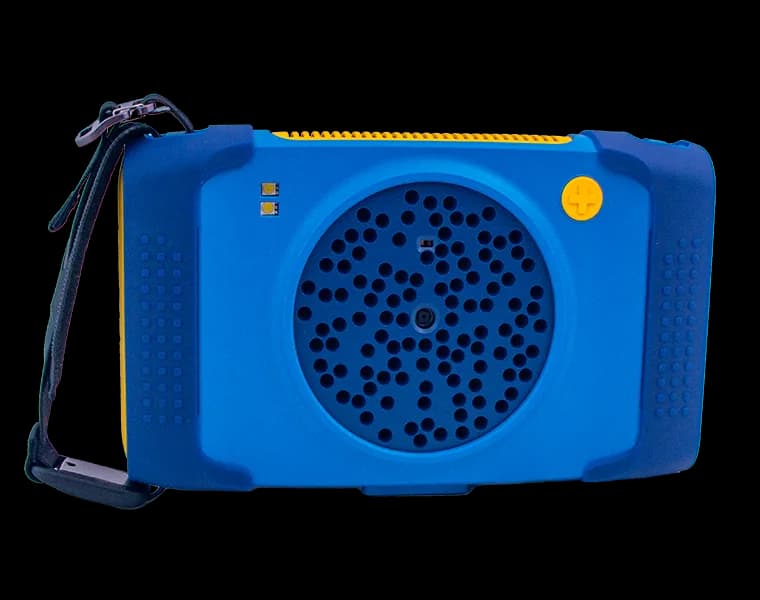
SDT SonaVu+ - Next-Generation Acoustic Camera
SonaVu+ acoustic camera with 112 sensors, a built-in display and a detection range of up to 200 metres — for leak detection, electrical inspection and mechanical-defect…
Also in this article: Hikmicro AI series — acoustic cameras AI56L, AI56 and AI76 for compressed-air, gas leaks and partial discharge
Read also
10/10/2026
Comparing ultrasonic leak detectors: what to look for
Ultrasonic leak detectors are compared by tasks, sensors and range, frequency band, data logging and reports, ATEX rating and operating conditions. Selection criteria and a table of SDT models.
10/10/2026
Ultrasonic leak detector: how it works and what it finds
An ultrasonic leak detector hears the hiss of gas escaping through a leak and turns it into sound in headphones and a dB reading. How it works, which sensors it uses and what it finds.
10/23/2026
Vibration Units: Displacement, Velocity, Acceleration and How to Convert Them
Vibration is expressed as displacement (µm, mil), velocity (mm/s, in/s) and acceleration (m/s², g). For a sine wave at frequency f: v = 2πf·d, a = 2πf·v, peak = 1.414·RMS, peak-to-peak = 2.828·RMS.