

Steam Loss Through a Failed Steam Trap: How to Calculate It
Steam loss through a trap stuck open is estimated with Napier's formula: W (kg/h) = 0.24725 × P (bar abs) × D² (mm). At 10 bar and a 3 mm seat that is about 24.5 kg/h, or 215 t of steam a year.
Steam loss through a trap stuck in the open position is estimated with Napier's formula: W (kg/h) = 0.24725 × P × D², where P is the absolute steam pressure in bar and D is the seat diameter in millimetres. At 10 bar g and a 3 mm seat this gives about 24.5 kg/h, or roughly 215 t of steam a year in continuous operation. The money figure is the tonnes multiplied by the cost of steam.
Napier's formula
Every steam trap has an internal orifice (seat) that limits losses if the trap fails open. That is why losses are estimated with the formula for steam flow through a sharp-edged orifice developed by Napier. The Sustainable Energy Authority of Ireland (SEAI) recommends it as the method for calculating savings from trap replacement: it needs only two parameters that are known for every trap.
| Units | Formula | Symbols |
|---|---|---|
| SI | W = 0.24725 × P × D² | W: loss, kg/h; P: absolute pressure upstream of the orifice, bar (gauge + atmospheric); D: orifice diameter, mm |
| Imperial | W = 24.24 × P × D² | W: lb/h; P: psia; D: inches |
Important: use absolute pressure. Add atmospheric pressure, about 1.013 bar, to the gauge reading.
Loss table by Napier's formula
Calculated for a fully open trap discharging steam with no back pressure, kg/h:
| Pressure, bar g | 2 mm seat | 3 mm | 5 mm | 8 mm |
|---|---|---|---|---|
| 3 | 4.0 | 8.9 | 24.8 | 63.5 |
| 6 | 6.9 | 15.6 | 43.3 | 111.0 |
| 10 | 10.9 | 24.5 | 68.1 | 174.3 |
| 16 | 16.8 | 37.9 | 105.2 | 269.2 |
Losses grow with the square of the diameter: a seat twice as large loses four times as much steam.
Equipment covered in this article
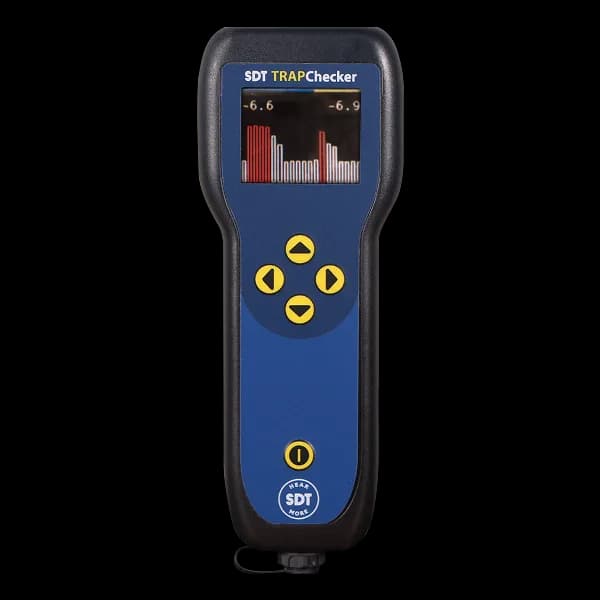
TRAPChecker - Steam Trap Testing
SDT ultrasound instrument for assessing the condition of steam traps and valves from a contact-sensor reading in dBµV
Cross-check with the DOE table
The US Department of Energy (DOE) Steam Tip Sheet #1 gives its own table based on Boiler Efficiency Institute data: steam discharges to atmosphere through an orifice with a discharge coefficient of 0.72.
| Orifice diameter, inches | 15 psig | 100 psig | 150 psig | 300 psig |
|---|---|---|---|---|
| 1/32 | 0.85 | 3.3 | 4.8 | - |
| 1/16 | 3.4 | 13.2 | 18.9 | 36.2 |
| 1/8 | 13.7 | 52.8 | 75.8 | 145 |
| 3/16 | 30.7 | 119 | 170 | 326 |
| 1/4 | 54.7 | 211 | 303 | 579 |
| 3/8 | 123 | 475 | 682 | 1,303 |
Values are in pounds of steam per hour. For comparison: 150 psig is about 10.3 bar g and 1/8 inch is 3.175 mm. The DOE table gives 75.8 lb/h (about 34 kg/h), while Napier's formula gives about 62 lb/h (about 28 kg/h). The methods produce different numbers, so any calculation is an estimate, not a measurement. What matters is to choose one method and apply it consistently to all traps.
Worked example
Inputs:
- steam pressure 10 bar g, i.e. P = 10 + 1.013 = 11.013 bar abs;
- trap seat 3 mm;
- the system runs around the clock, 8,760 h a year (as in the DOE example);
- steam cost: an assumed 10,000 KZT per tonne. This is not a tariff or a market price, only a number to demonstrate the calculation. Replace it with your boiler house's steam cost or the price of purchased steam.
Calculation:
- Hourly loss: W = 0.24725 × 11.013 × 3² = 24.5 kg/h.
- Annual loss: 24.5 kg/h × 8,760 h = 214.7 t of steam.
- Money, upper estimate: 214.7 t × 10,000 KZT/t ≈ 2.15 million KZT a year.
- With a partial-flow correction: SEAI uses 50% of the calculated value to allow for a trap that may not be fully open. That gives 107.4 t of steam and about 1.07 million KZT a year for one trap.
The same trap with a 6 mm seat at 10 bar loses four times as much: about 98 kg/h, or 859 t of steam a year before correction.
For comparison, in the DOE example a trap on a 150 psig line with a 1/8 inch orifice loses 75.8 lb/h, and at a steam cost of $10.00 per 1,000 lb the repair saves $6,640 a year.
Why the calculation is an upper bound
The formula describes steam flowing through a fully open sharp-edged orifice. In practice:
- The trap is partly open. According to SEAI, a trap stuck open does not necessarily leak 100% of the calculated flow, because the seat design limits the leakage. SEAI applies a 50% correction for savings claims and mentions a manufacturer that uses 33% in its steam trap audit reports.
- Direct measurement is usually not possible. SEAI notes that measuring steam losses through traps is not feasible on most sites, so they are estimated by engineering calculation, and any calculation remains an estimate.
That is why a loss report should give a range: the calculated value and the corrected value.
How many traps are typically failed
According to DOE (Steam Tip Sheet #1):
- in systems not maintained for 3 to 5 years, 15% to 30% of installed traps may have failed, letting live steam escape into the condensate return system;
- with a regularly scheduled maintenance program, leaking traps should be less than 5% of the trap population;
- if a system has more than 500 traps, a survey will probably reveal significant steam losses.
SEAI adds that failure rates as high as 20% have been reported from audits, and even more reliable traps have shown failure rates of 12.5%.
How often to test
| Steam pressure | DOE testing interval |
|---|---|
| High, 150 psig (about 10.3 bar g) and above | weekly to monthly |
| Medium, 30-150 psig (about 2-10 bar g) | monthly to quarterly |
| Low, below 30 psig (about 2 bar g) | annually |
DOE also suggests considering online monitoring for the most important traps and keeping records of faults found, to document savings in money terms.
How to find a failed trap with ultrasound
DOE lists four ways of testing traps: temperature, sound, visual and electronic. Ultrasonic testing as recommended by SDT works like this:
- Listen to a healthy cycle. Before making a diagnosis, touch the installation with the contact sensor and learn how the trap sounds in normal operation.
- Place the contact sensor on the trap body. A healthy trap is heard cycling open and closed.
- Assess the signal:
| What you hear | Trap condition |
|---|---|
| Silence alternating with discharge | Working, cycling |
| Constant turbulent noise | Stuck open, passing steam |
| Silence | Stuck closed |
| Mechanical clattering | Valve fluttering, opening and closing rapidly |
- Measure temperature upstream and downstream of the trap. This is the second indicator: according to SDT, a complete inspection combines ultrasound and temperature.
- Record the result for every trap: location, type, pressure, seat diameter and diagnosis. These data are then used to calculate losses with the formula above.
A detailed method by trap type is in Checking Steam Traps with Ultrasound and Steam Trap Diagnostics: Types and Failures. How to link a survey to an energy calculation is covered in SDT270 and TRAPChecker: Steam Trap Energy Audit.
Loss calculator
Losses for a whole trap population can be calculated in the steam trap loss calculator. It uses the same Napier formula and converts to money through the heat tariff in tenge per Gcal and the boiler house efficiency.
Which instrument to choose
- Surveying a trap population: TRAPChecker: according to SDT, a simple ultrasound instrument for assessing steam traps and valves; it detects the internal turbulence of a defective trap or a passing valve.
- Survey programme with routes and history: SDT270.
- Traps plus other tasks (bearings, lubrication, electrical): SDT340, SDT's versatile ultrasound instrument.
KEG TRK supplies these instruments in Kazakhstan and helps select them for the task. Price on request.
Sources
- U.S. Department of Energy, Advanced Manufacturing Office. Inspect and Repair Steam Traps, Steam Tip Sheet #1 (DOE/GO-102012-3401, January 2012): https://www.energy.gov/sites/prod/files/2014/05/f16/steam1_traps.pdf
- Sustainable Energy Authority of Ireland (SEAI). Guidelines for claiming energy savings from steam trap replacement (2023): https://www.seai.ie/publications/SEAI-Guidelines-for-claiming-energy-savings-from-steam-trap-replacement.pdf
- SDT Ultrasound Solutions. Steam Trap Testing and Maintenance: https://sdtultrasound.com/applications/steam-trap-testing/
- SDT Ultrasound Solutions. TRAPChecker: https://sdtultrasound.com/products/checker-range/trapchecker/
Frequently asked questions
Equipment in this article
KEG TRK quotes prices and delivery times to Kazakhstan on request. We will prepare a commercial offer for your application.
TRAPChecker - Steam Trap Testing
SDT ultrasound instrument for assessing the condition of steam traps and valves from a contact-sensor reading in dBµV
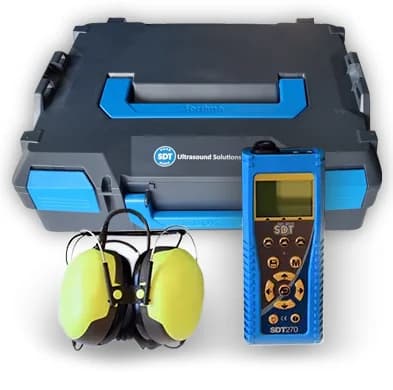
SDT270 — SDT Ultrasound Detector and Data Collector
Handheld SDT ultrasound data collector: 2 channels, up to 100 kHz bandwidth, built-in IR thermometer and laser tachometer, ICP accelerometer input, signal recording for…
Also in this article: SDT340 - Advanced Ultrasound Detector
Read also
10/10/2026
Comparing ultrasonic leak detectors: what to look for
Ultrasonic leak detectors are compared by tasks, sensors and range, frequency band, data logging and reports, ATEX rating and operating conditions. Selection criteria and a table of SDT models.
10/14/2026
Centrifugal Pump Vibration Analysis: Measurement Points, Faults, Limits
Pump vibration is measured on pump and motor bearing housings in three directions, compared with ISO 10816-7 zones, and diagnosed from the spectrum: 1x, 2x, harmonics, vane pass.
10/10/2026
Ultrasonic leak detector: how it works and what it finds
An ultrasonic leak detector hears the hiss of gas escaping through a leak and turns it into sound in headphones and a dB reading. How it works, which sensors it uses and what it finds.