
Electric Motor Bearing Noise: Causes and What to Do
Whistling, humming, rumbling or knocking in a motor bearing: what each sound means, five groups of causes per SKF, and the steps from checking lubrication to replacing the bearing.
Electric motor bearing noise comes from five groups of causes identified by SKF: metal-to-metal contact from poor lubrication, contamination, looseness, raceway damage and rubbing of adjacent parts. Whistling usually means too little lubricant; rumbling and knocking point to contamination or damage. Check lubrication and measure ultrasound first, then decide whether replacement is needed.
Which sound is normal and which is not
The SKF Bearing Installation and Maintenance Guide describes the sound as follows:
| Sound | Meaning |
|---|---|
| Even "purring" | Normal operation |
| Whistling or screeching | Inadequate lubrication |
| Uneven rumbling or hammering | In most cases contaminants in the bearing or damage during mounting |
Listening is useful as a first signal, not as a diagnosis. SKF notes that fatigue starts with a microcrack below the raceway surface that cannot be seen or heard on a running machine. By the time noise appears, the defect is already developing. How to check a bearing with instruments is covered in How to check a motor bearing without disassembly.
Five groups of noise causes
The SKF troubleshooting table lists these causes for the symptom "excessive noise":
| Group | Cause | What to do (per SKF) |
|---|---|---|
| Metal-to-metal contact | Oil film too thin: temperature too high or speed very slow | Choose lubricant viscosity and NLGI grade for the operating conditions |
| Insufficient lubricant: never lubricated, leakage through worn or improper seals | Check seals and oil level, replenish lubricant | |
| Rolling elements skidding: load below minimum or lubricant too stiff | Ensure minimum load, check grease consistency | |
| Contamination | Solid particles enter the bearing and dent the raceways | Inspect seals, shorten the relubrication interval, supply smaller quantities of fresh grease more often |
| Solids left in the housing from manufacturing or a previous failure | Clean the housing thoroughly before fitting a new bearing | |
| Liquid in the lubricant reduces its viscosity | Check seals, shorten the relubrication interval | |
| Looseness | Inner ring turning on the shaft (undersized or worn shaft) | Restore the correct fit |
| Outer ring turning in the housing (oversized or worn bore) | Restore the fit, eliminate unbalance | |
| Loose locknut on the shaft or adapter sleeve, bearing not clamped | Tighten and lock | |
| Too much radial or axial internal clearance | Keep rolling elements loaded, for example with springs | |
| Surface damage | Dents from impact (including hammering during mounting) | Never pass mounting force through the rolling elements; use a mounting sleeve |
| False brinelling from vibration while the machine stands idle | Rotate the shaft of standby equipment periodically | |
| Spalling from fatigue or from surface-initiated damage | Find the root cause: contamination, lubrication, impact, current | |
| Fluting from electric current passing through the bearing | Ground the equipment; if needed, an insulated or hybrid bearing | |
| Rubbing | Misaligned housing seals rubbing, locknut tabs touching the seal, sleeve or spacers not clamped | Align seals, check fasteners |
Equipment covered in this article
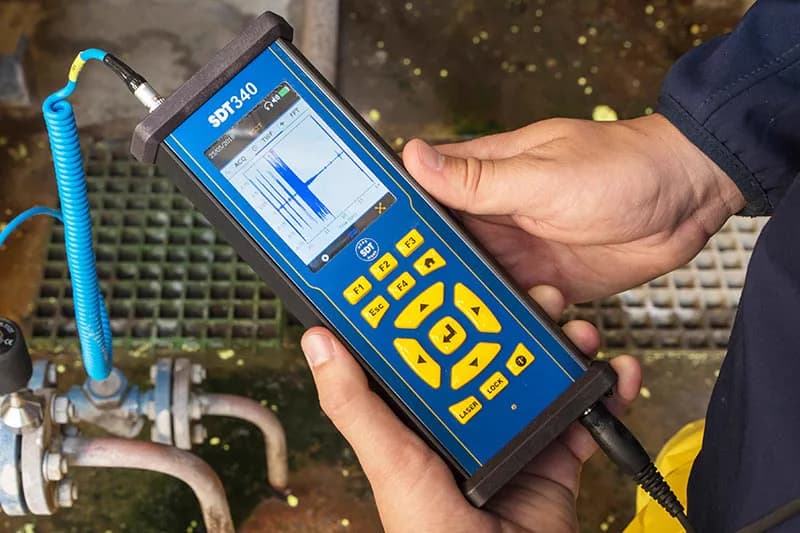
SDT340 - Advanced Ultrasound Detector
The most advanced ultrasound detector for collecting, analysing and trending data
Lubrication: check it first
Two of the three metal-to-metal causes are about lubrication. SKF specifically notes that extremely stiff greases contribute to rolling element skidding, especially in very cold climates, and skidding generates excessive heat and noise. For unheated pump houses and outdoor sites in Kazakhstan this matters when choosing a grease for winter: see Choosing a bearing grease.
Too much grease is also harmful. Per SKF, excessive lubrication causes churning and elevated temperatures. Signs and consequences of over-greasing are covered in Bearing over-lubrication: consequences, and the link to heat in Why an electric motor bearing overheats.
To avoid guesswork, SDT recommends relying on ultrasound: both under- and over-lubrication increase friction and therefore the ultrasound level above the baseline. SDT treats a gain of more than 8 dB over baseline as a reason to investigate.
Damage: when grease will no longer help
If the noise is caused by dents, spalling or fluting of the raceways, grease will not remove it. Per SDT, a gain of 12–16 dB over the baseline indicates bearing degradation, and above 30 dB warns of potential catastrophic failure. Consistent, repetitive spikes in the time waveform are typical of a surface defect. At this stage a replacement is planned, and the cause is removed during the replacement; otherwise the new bearing will repeat the fate of the old one. How damage progresses is shown in 4 stages of bearing failure.
On electrical erosion, SKF writes that fluting is most commonly attributed to electric current passing through the bearing. The first measure is proper grounding. If that does not help, the options are an insulating sleeve in the housing bore, a bearing with an insulated outer ring, or a hybrid bearing with ceramic rolling elements.
Bearing or electrical
A motor can be noisy without any bearing defect. SKF notes that many electrical problems appear at twice line frequency: 100 Hz on a 50 Hz supply. Bearing defects produce other frequencies, linked to running speed and bearing geometry. The sources can be separated with a vibration spectrum (How to read an FFT spectrum) or with current and voltage analysis, which shows both mechanical and electrical faults (ESA, MCSA and vibration analysis).
What to do if a bearing is noisy
- Find which bearing is noisy: drive end or non-drive end. Compare with a similar machine.
- Judge the character of the sound: whistling, rumbling, knocking, constant or intermittent.
- Measure ultrasound on both bearings and compare with the baseline.
- If it looks like lubrication (whistling, a gain around 8 dB, inconsistent spikes), add grease in small amounts while watching ultrasound. Per SDT, the dB level decreases as grease is added; once it begins to climb slightly, there is enough grease.
- If the signal does not decrease, lubrication is not the only cause. Check vibration: spectrum and enveloping. Look for bearing defect frequencies and twice line frequency.
- Check fits and seals at the next stop: signs of ring creep, seal rubbing, loose nuts.
- Plan a replacement if damage is confirmed. When replacing, clean the housing, mount without impact and check grounding.
What to use
The SDT340 measures ultrasound (20–50 kHz) and vibration (10 Hz – 10 kHz), has a built-in IR thermometer and tachometer, lets you listen to the bearing through headphones and records the signal for analysis. If the motor is inaccessible or mechanical causes need to be separated from electrical ones, the Artesis AMT Pro tester analyses current and voltage from the supply side; a test takes 7 minutes.
KEG TRK supplies SDT ultrasound detectors and Artesis motor testers in Kazakhstan. Price on request.
Sources
- SKF USA Inc. Bearing Installation and Maintenance Guide: "Test running", "Troubleshooting" and "Trouble conditions and their solutions" (codes 1–4, 12, 23, 27–42). https://cdn.skfmediahub.skf.com/api/public/0901d1968024f02a/pdf_preview_medium/0901d1968024f02a_pdf_preview_medium.pdf
- SKF. Spectrum Analysis: the key features of analyzing spectra (J. Mais), section 12 "Electrical problems". https://cdn.skfmediahub.skf.com/api/public/0901d1968024acef/pdf_preview_medium/0901d1968024acef_pdf_preview_medium.pdf
- SDT Ultrasound Solutions. Mechanical Condition Monitoring. https://sdtultrasound.com/applications/mechanical-condition-monitoring/
- SDT Ultrasound Solutions. Bearing Lubrication Monitoring. https://sdtultrasound.com/applications/bearing-lubrication-monitoring/
- Artesis. What is Condition Monitoring? A Technical Overview. https://artesis.com/condition-monitoring/
- KEG TRK product pages: SDT340, Artesis AMT Pro.
Frequently asked questions
Equipment in this article
KEG TRK quotes prices and delivery times to Kazakhstan on request. We will prepare a commercial offer for your application.
SDT340 - Advanced Ultrasound Detector
The most advanced ultrasound detector for collecting, analysing and trending data
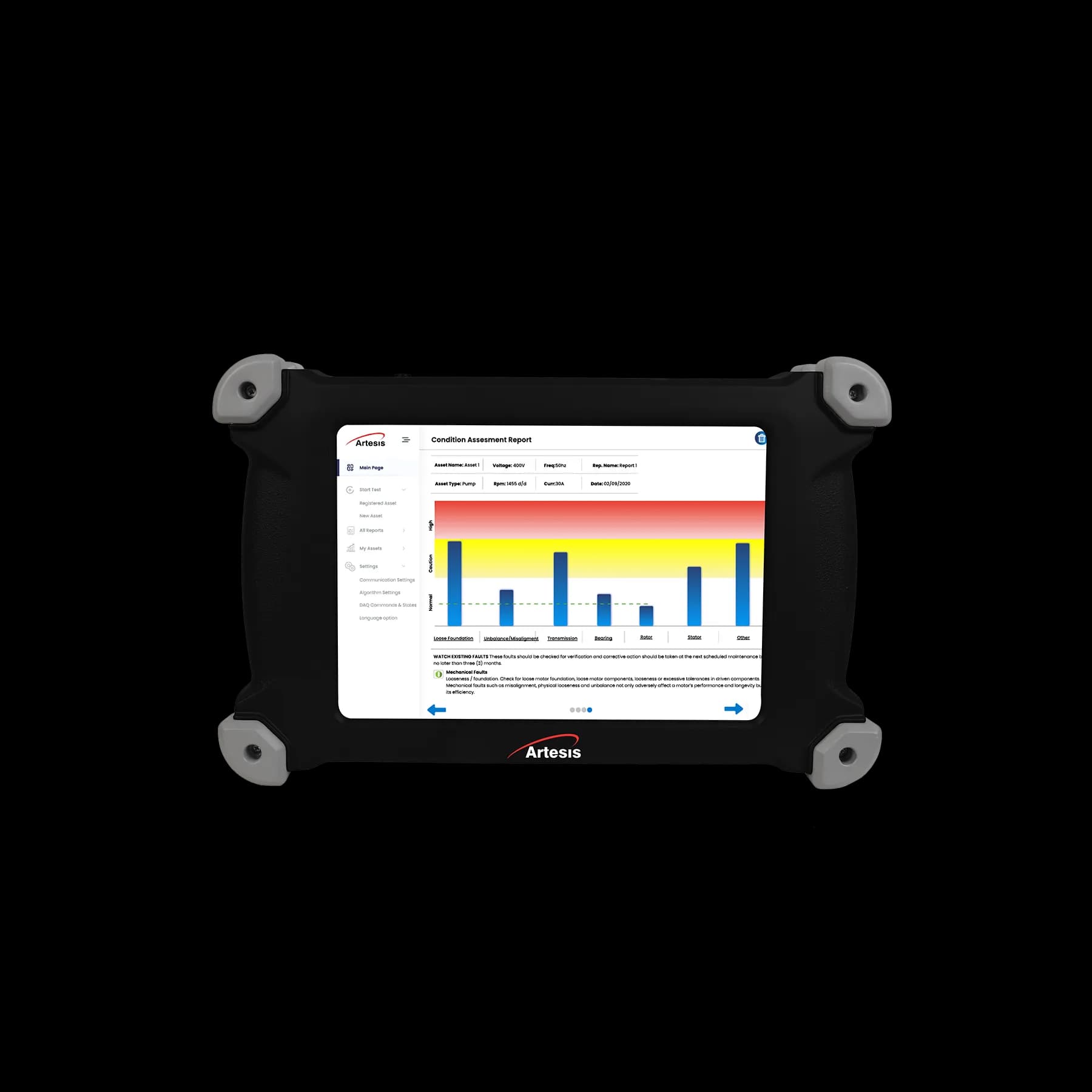
Artesis AMT Pro — Portable Electric Motor Tester
Portable sensorless motor diagnostics with AI analysis — full test in 7 minutes
Read also
10/10/2026
Electric Motor Diagnostics: Which Method Shows What
Vibration, ultrasound, thermography, current analysis (MCSA/ESA), motor circuit analysis (MCA), megohmmeter and oil analysis: which faults each method sees, where it stops and how to combine them.
10/10/2026
How to Check an Electric Motor Bearing Without Disassembly: 5 Methods
Five ways to check a bearing on a running motor: stethoscope, IR thermometer, vibration, ultrasound and current analysis. What each method shows, where it stops, and in what order to use them.
10/10/2026
Broken Rotor Bars: Symptoms and Diagnostics
How a broken rotor bar in an induction motor shows up in current (f ± 2sf sidebands) and vibration (pole pass frequency sidebands), how to calculate these frequencies and check a motor step by step.