
API 670 Turbine Vibration Protection System: What It Includes
API 670 covers protection on shaft and casing vibration, axial position, speed, overspeed, phase reference and temperatures. The system: transducers, a monitor rack, relays with voting logic.
An API 670 vibration protection system continuously monitors radial shaft vibration, casing vibration, rotor axial position, speed, overspeed, phase reference and critical temperatures. It consists of proximity and seismic transducers, a monitor rack with Alert and Danger setpoints, relay modules with voting logic that issue the trip command, and redundant power.
What API 670 is and where our data comes from
API 670 "Machinery Protection Systems" is an American Petroleum Institute standard. The current edition is the 5th edition of 2014 (256 pages), reaffirmed in 2022: API STD 670:2014(R2022). The standard is paid, so we do not quote it. Everything below is based on the public abstract of the standard and on Bently Nevada documentation, which states which API 670 requirements the equipment meets.
According to the abstract, API 670 describes the minimum requirements for a machinery protection system measuring:
| Parameter | Typically measured with |
|---|---|
| Radial shaft vibration | Proximity probes |
| Casing vibration | Accelerometers, velocity sensors |
| Shaft axial position | Proximity probes |
| Shaft rotational speed | Proximity probes, magnetic pickups |
| Piston rod drop (reciprocating compressors) | Not covered in this article |
| Phase reference (Keyphasor) | Proximity probe |
| Overspeed | A separate system with redundancy |
| Critical temperatures (bearing metal, motor windings) | RTDs, thermocouples |
The "Typically measured with" column is compiled from Bently Nevada transducer and monitor documentation, not quoted from the standard.
Typical system architecture
- Transducers on the machine. Proximity probes for radial vibration and axial position, a phase reference probe, bearing temperature sensors and, where needed, accelerometers or velocity sensors on the casing.
- Monitor rack. Modules compare measured values with Alert and Danger setpoints and check the health of every transducer and its wiring.
- Relay modules. Relays actuate by configured logic: for example, a trip only on Danger from two channels at once.
- Trip output. Relay contacts are wired into the machine's emergency shutdown circuit.
- Annunciation and diagnostics. Analog and digital outputs go to the DCS for display and trending, data goes to the diagnostic system.
How many probes per bearing
For radial vibration, each bearing usually has two proximity probes at 90° (an X/Y pair). Fabrico describes this arrangement as typical. 3500 monitors are programmed in channel pairs: channels 1 and 2 perform one function, channels 3 and 4 the same or another.
Equipment covered in this article
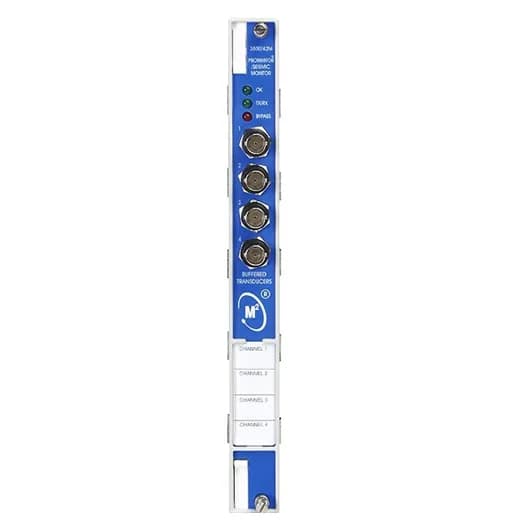
3500/42M Proximitor/Seismic Monitor
3500/42M Proximitor/Seismic Monitor: 4 channels for proximity and seismic sensors, vibration and position, 4–20 mA outputs
What the Bently Nevada 3500 does
According to the Bently Nevada datasheet, the 3500 System provides continuous online monitoring suitable for machinery protection and is designed to meet API 670 requirements. It is intended for auto-shutdown protection applications that require extremely high reliability and availability. Listed applications include industrial gas and steam turbines, aeroderivative gas turbines, hydro turbines, compressors, turbo expanders, electric motors and generators, gearboxes, pumps and fans.
Rack components
| Component | Required | Function |
|---|---|---|
| 3500/05 rack | Yes | 19" rack: 14 module slots plus power supply and TDI positions. The 12" mini rack has 7 slots |
| 3500/15 power supply | Yes, one or two | Each supply can power the whole rack. With two, the lower is primary and the upper is backup, taking over without interruption |
| 3500/22M TDI | Yes | Interface to configuration software and System 1. Not part of the critical protection path |
| 3500/XX monitors | Yes, one or more | Measurement, Alert and Danger setpoints, transducer checks |
| 3500/32M (4 relays) or 3500/33 (16 relays) | No, but strongly recommended | Trip relays with voting logic |
| 3500/25 Keyphasor | No, one or two | Phase reference signal for the monitors |
| 3500/92 communication gateway | No | Link to the DCS over industrial protocols |
| I/O modules, configuration software | Yes | Field wiring connection, setup |
Four-channel monitors allow a full 14-slot rack to hold up to 56 channels.
Which modules cover the API 670 items
| API 670 parameter | 3500 module | Per the datasheet |
|---|---|---|
| Radial vibration, casing vibration | 3500/42M | 4 channels; proximity and seismic inputs; radial vibration, thrust position, eccentricity, acceleration, velocity, Shaft Absolute and more |
| Axial position, differential expansion | 3500/45 | 4 channels; thrust position, several differential expansion schemes, case expansion, valve position |
| Phase reference | 3500/25 | 2 channels per module; up to 4 Keyphasor signals per rack (up to 8 paired); monitors use it for speed, 1X amplitude and phase |
| Speed | 3500/50M | 2 channels; speed, rotor acceleration, zero speed, reverse rotation |
| Bearing temperatures | 3500/60 | 6 channels; RTDs and thermocouples |
| Trip output | 3500/32M | 4 relays; AND/OR logic on Alert, Danger and Not OK statuses of any rack channels |
Overspeed protection is a separate task
The 3500/50M tachometer module measures speed, but Bently Nevada warns plainly that it must not be used on its own or as part of a speed control or overspeed protection system, because it lacks the required redundancy and response speed. Speed setpoints on the 3500/50M are for annunciation only. For overspeed protection the manufacturer points to the 3701/55 Emergency Shutdown system.
Setpoints and alarm delays
Using the 3500/42M datasheet as an example:
| Parameter | Value |
|---|---|
| Setpoints | Alert for each measured value, Danger for any two of them; 0 to 100% of full scale |
| Setpoint accuracy | within 0.13% of the desired value |
| Alert delay | 1 to 60 s in 1 s steps |
| Danger delay | 0.1 s or 1 to 60 s in 0.5 s steps |
The delay prevents a short signal spike from tripping the machine. Its value is chosen for the specific machine.
What not to do
- Wire the trip through 4–20 mA or Modbus. According to the 3500 System datasheet, these outputs are for annunciation and trending only: they lack the fault tolerance and integrity required. Automatic shutdown uses the 3500/32M or 3500/33 relay modules.
- Use the Rack OK relay for shutdown. Dozens of different rack events drive it to NOT OK, so Bently Nevada recommends the Rack OK relay for general annunciation only.
- Protect against overspeed with the 3500/50M. See above.
- Fit proximity probes on too small a shaft. For the 3300 XL 8 mm, the minimum shaft diameter is 50.8 mm and the recommended minimum is 76.2 mm; on shafts smaller than 76.2 mm the scale factor generally changes.
API 670 transducers
According to the Bently Nevada datasheet, the standard 5-metre 3300 XL 8 mm system fully complies with API 670 for mechanical configuration, linear range, accuracy and temperature stability. Its sensitivity is 7.87 V/mm (200 mV/mil) and the linear range is 2 mm. 3300 XL 8 mm components are interchangeable without matching or bench calibration. An application on large fans is described in 3300 XL proximity probes on large fans.
For auxiliary equipment (pumps, draft fans, mills), a separate rack with 3500/42M monitors is often enough. How it differs from main turbine-generator protection is covered in CHP auxiliary equipment vibration monitoring: the 3500/42M module.
What to choose for a turbine-generator
- Rack and power — 3500/05 and two 3500/15 supplies for redundancy.
- Radial vibration — 3500/42M monitors and 3300 XL probes.
- Axial position and differential expansion — 3500/45.
- Phase reference — 3500/25.
- Bearing temperatures — 3500/60.
- Trip relays — 3500/32M.
KEG TRK supplies Bently Nevada equipment in Kazakhstan. Price on request.
Sources
- American Petroleum Institute. API 670:2014 Machinery Protection Systems: abstract, edition, status (standards shop page).
- Bently Nevada. 3500 System Datasheet 162096.
- Bently Nevada. 3500/42M Proximitor Seismic Monitor Datasheet 143694.
- Bently Nevada. 3500/45 Position Monitor Datasheet 141537.
- Bently Nevada. 3500/25 Enhanced Keyphasor Module Datasheet 141532.
- Bently Nevada. 3500/32M 4-Channel Relay Module Datasheet 141533.
- Bently Nevada. 3500/50M Tachometer Module Datasheet 141538.
- Bently Nevada. 3500/60 and 3500/61 Temperature Modules Datasheet 141540.
- Bently Nevada. 3300 XL 8 mm Proximity Transducer System Datasheet 141194.
- Fabrico. API 670 machinery protection: typical X/Y probe arrangement.
Frequently asked questions
Equipment in this article
KEG TRK quotes prices and delivery times to Kazakhstan on request. We will prepare a commercial offer for your application.
3500/42M Proximitor/Seismic Monitor
3500/42M Proximitor/Seismic Monitor: 4 channels for proximity and seismic sensors, vibration and position, 4–20 mA outputs
3500/45 Position Monitor
3500/45 Position Monitor: 4 channels for thrust, differential and case expansion, valve position
Also in this article: 3500/25 Enhanced Keyphasor Module, 3500/60 Temperature Monitor, 3500/32M 4-Channel Relay Module, 3300 XL Series — Eddy-Current Proximity Transducer System, 3500/05 System Rack, 3500/15 AC and DC Power Supply
Read also
10/22/2026
Vibration Sensor: How to Choose (Accelerometer, Velocity Sensor, Proximity Probe)
A proximity probe measures shaft motion in fluid-film bearings, a velocity sensor gives overall casing vibration, an accelerometer covers high frequencies of rolling bearings and gearboxes.
10/22/2026
Steam Loss Through a Failed Steam Trap: How to Calculate It
Steam loss through a trap stuck open is estimated with Napier's formula: W (kg/h) = 0.24725 × P (bar abs) × D² (mm). At 10 bar and a 3 mm seat that is about 24.5 kg/h, or 215 t of steam a year.
6/24/2026
SonaVu or Crysound: Which Acoustic Camera to Choose in 2026
A comparison of the SDT SonaVu+ and Crysound CRY2600 acoustic cameras: detection range, number of sensors, PRPD partial-discharge analysis and use cases. Which camera fits leak detection and electrical inspection.